 Civilnet
By Lusine Vardanyan
In January 2022, I was renting a three-room apartment with a balcony in central Yerevan for 140,000 drams (≈ $370). By March, I was no longer living there: the rent had doubled. This is a familiar situation for Yerevan residents.
Alina, who relocated from Russia (name changed), says she was not aware of the prices before moving and therefore did not know what counted as expensive in Yerevan. After living there for some time, she realized that salaries in Yerevan did not match apartment prices. She says many of her friends did not stay in Yerevan for this very reason.
For instance, the landlord of Elen Muradyan’s family in Yerevan offered them either to pay nearly double or leave the apartment.
In February 2022, Russia invaded Ukraine. On September 21, partial mobilization began in Russia. In September 2023, Azerbaijan attacked Nagorno-Karabakh and forcibly displaced the population.
These events are the reasons behind the changes in rental prices. Russian relocants were ready to pay more, while Armenia’s residential rental sector was neither recovering nor regulated by law. Rental prices rose 2–3 times above market levels. Although this activity had a positive impact on the economy, it was accompanied by serious social problems. According to Armenia’s Migration Service, 1,130 mln Russian citizens arrived in Armenia in 2022, while 1,065 mln left. Later, more Russians departed Armenia, but the rental market did not return to pre-war levels.
2023. Displacement of Nagorno-Karabakh
At the time of the forced displacement of Nagorno-Karabakh Armenians, the rental market was already in a different dynamic. Nina Gulambaryan from the Kentron real estate company describes 2023 as a relatively stable year: Nagorno-Karabakh Armenians did not have the purchasing power present in the previous year’s market, which affected price formation, and the market responded more flexibly to the situation.
“We tried to work with a human-centered approach—low or zero brokerage fees. In addition, some owners demonstrated exceptional social responsibility by providing their apartments free of charge. I can cite one example: one owner provided his three apartments completely free for one year to three families,” Gulambaryan says.
In 2023, the main rental range was around 200,000–250,000 drams (≈ $525–$660), compared to 400,000–500,000 drams (≈ $1,050–$1,315) the previous year.
“Prices are generally lower than in previous years, the supply-demand balance is stable, and the market is now in a phase of natural, regular movement rather than sharp fluctuations,” notes the real estate specialist. In 2025, another important change compared to the previous year is that the number of rental transactions decreased by 28.6%.

Nina Gulambaryan, Kentron Real Estate
Georgia’s experience
A study of Georgia’s rental market shows similar trends there. From May 2022, students of Tbilisi State University returned to in-person learning. This was the first time since the start of the COVID-19 pandemic. However, the decision was not well received, as students living outside the capital could not afford apartments in Tbilisi at the revised prices.
Georgia’s Interior Ministry stated at the time that between February 24 and March 20, 2022, 35,028 Russian citizens entered Georgia—8,000 more than in the month preceding the war. Overall, rents in Tbilisi rose sharply after the outbreak of the war but began to decline from 2024 onward gradually. This trend continued in 2025.
In Batumi, rent growth slowed in 2024 but still did not return to pre-war levels.
Economist Giorgi Kishtovani predicts that rents in Tbilisi will decrease, reaching even pre-war levels. In Batumi’s case, he forecasts that the situation will remain stable, with no significant changes.
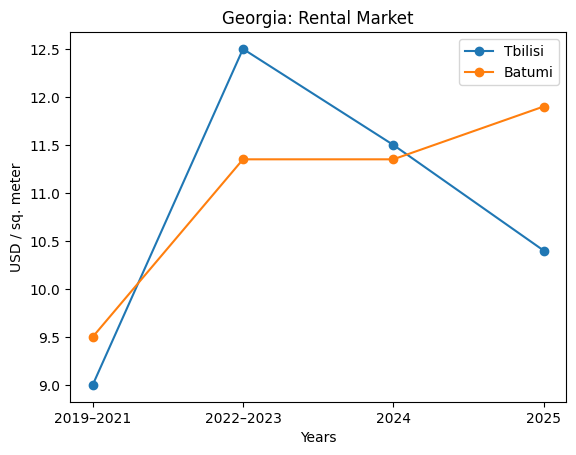
Source: TBC Capital Index, Galt & Taggart
How is the rental market regulated?
In Armenia, although the rental market is regulated by law, it largely operates in legal uncertainty.
Nina Gulambaryan believes that, unlike the property sales market, Armenia’s rental market has simpler and faster transaction mechanisms. Sales procedures are complex and costly, while rentals are usually completed quickly and for lower amounts.
Although the sector is regulated by the Civil Code, existing regulatory mechanisms are not fully implemented. One of the main regulatory tools is the written rental contract and its registration with the State Revenue Committee. In practice, however, contracts are often concluded without notarial certification or even verbally, which leaves them with insufficient legal force and frequently causes disputes.
In Georgia, individuals renting out residential property must register the lease with the tax service’s landlord registry. Income from rent is taxed at 5% (this applies only to residential real estate). In Armenia, this rate is 10%.
Kishtovani told CivilNet that he does not see a need for legislative or regulatory changes in Georgia. Nevertheless, he notes that the registry mainly includes commercial property owners and Airbnb operators. Ordinary citizens renting out apartments are largely unregistered and therefore do not pay taxes.
The mechanism is the same in Armenia. Most high-value apartments and commercial spaces are rented through formal contracts (notarized), which provide protection for the parties.
A view from a real estate agency
According to Kentron, a real estate company in Yerevan operating since 2005, several systemic steps are needed to make the market more transparent and protected:
tenants, owners, and agencies must be fully informed about their rights; apartment rentals should take place only through trusted companies and mandatory contracts; a unified electronic platform should be created where all rental contracts and transactions are collected and monitored under regulatory oversight.
The agency explains the importance of an electronic platform: “That is, there should not be a phenomenon where anyone sets whatever price they want for their apartment—there should be a market value. This will not only reduce the risks of illegal practices but also increase market transparency and make access to information fast and convenient for all parties.”
In Armenia and Georgia, rental housing prices have declined but have not returned to pre-war levels. It is unclear what will happen if similar inflows occur again. The lack of registration also means that comprehensive data on apartments is not collected. For landlords and tenants, this process is not only a financial burden but also an administrative one.
The rental boom in Armenia prompted the government to simplify the legal process for renting property. Whereas previously it required notarization, cadastral registration, and similar procedures, landlords can now simply declare their transaction and pay a 10% tax.
Estonia: a success story
Estonia has a successful experience in regulating the rental market.
Today, Estonia is one of Europe’s most digitized countries. Since 1991, it has transformed its “paper-based” public administration system.
At the core of this system is national digital identification (e-ID). Both locals and foreigners can sign legally binding contracts with e-ID, which are easily integrated into tax processes. As a result, banking transactions, tax payments, and even participation in elections are not perceived as an additional burden for Estonians.
However, Estonia’s success is not only technological. Oversight in Estonia does not occur solely by punishing unregistered owners. Instead, a system has been created where the tenant is interested in demanding an official contract, because without it they are deprived of several important opportunities, such as official residence registration, legal protection, and access to utilities and other services.
Estonia has managed to shift the burden of control inward, into the market itself:
the tenant demands registration to secure their rights, while the owner registers because without it their market access becomes limited.


 Stories