By Lia Avagyan
Plans to build a museum resembling Armenia’s ancient Garni Temple in the town of Talin have prompted a wave of online satire, with social media users recasting the mayor as an ancient Greek ruler and his town as a budding Hellenistic capital.
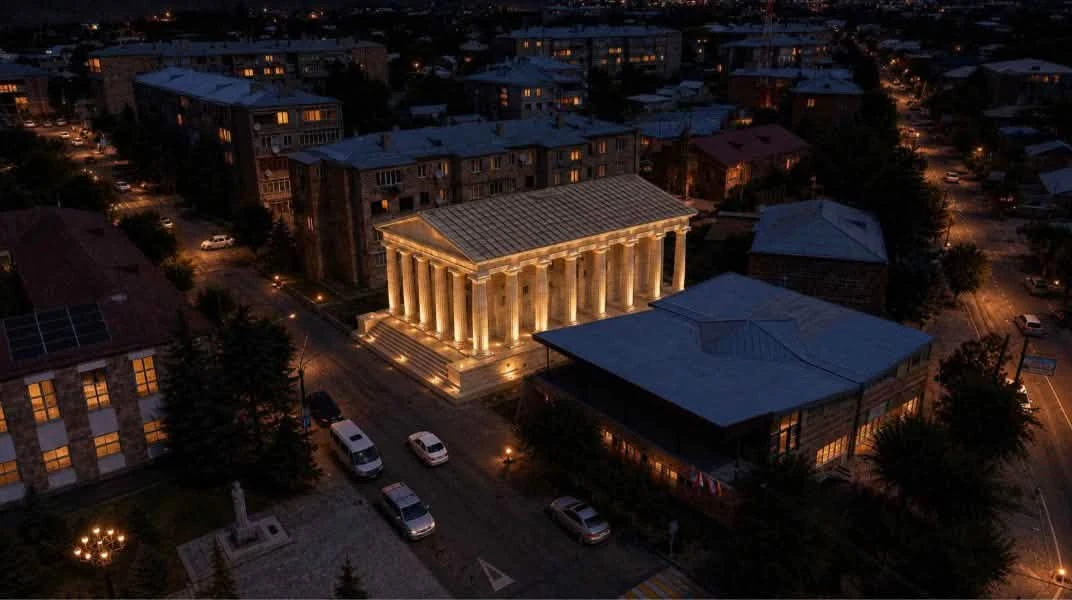
The municipality announced the project on September 29, publishing an architectural sketch for a two-story museum near the central square. The two-story museum is planned near the central square in Talin, a town of about 7,000 residents.
The project is an initiative of Mayor Tavros Sapeyan, a member of the ruling Civil Contract party, in cooperation with philanthropist and honorary Talin citizen Tigran Safaryan.
In its announcement, the municipality described the proposed building as having a “temple-style architectural design” and said the museum would preserve and promote the community’s history, culture and heritage.
Sapeyan and his first deputy, Sergey Mkrtchyan, visited the site to inspect demolition work already underway, according to the statement.
The design’s resemblance to Garni, Armenia’s best-known surviving example of Hellenistic architecture, quickly became the focus of jokes.
Greek cultural influence spread into Armenia following Alexander the Great’s conquests in the late fourth century B.C. and remained influential through the early centuries A.D., with Armenia’s late Hellenistic cultural phase commonly extending into the third century. Garni’s columned temple is generally dated to the first century A.D. and associated with the Armenian King Tiridates I.
The satirical Facebook page Ministry of Clarification of the Republic of Armenia depicted Sapeyan in ancient attire and renamed him “Tavros Stephanos, Archon of Talinos.” An archon was a ruler or senior official in ancient Greece.
The parody also gave his party a mock classical makeover as Civil Contractos.
“Guided by the shared municipal vision of Civil Contractos and the restoration of Ancient Greece, Tavros Stephanos has assumed a historic mission: to make Talinos once again a shining center of the Hellenistic world,” the page wrote.
A vast temple surrounded by columns would soon rise in the town’s “central agora,” the post continued, replacing the familiar municipal square with its ancient Greek equivalent.
The mayor’s transport arrangements also received a mythological upgrade.
“Emphasizing the importance of saving public funds and preserving Hellenic values, Tavros Stephanos has already given up his official vehicle,” the page wrote. “From now on, he will travel around the municipality exclusively on the mythical Pegasus.”
The satire extended to the municipal council, imagining a restored amphitheater where council members would present their decisions once a month “as a solemn tragedy, a comedy and, if necessary, a three-hour report.”
Commentator Gor Madoyan offered a different criticism, linking the proposal to a taste for imitating famous landmarks. He pointed to an Eiffel Tower replica in the southern Armenian town of Goris.
“The regions refuse to let Yerevan outdo them in kitsch. Talin wants a Garni of its own. Goris has had its Eiffel Tower for ages,” he wrote.
The municipality’s announcement did not specify the project’s cost, construction timetable or future collection. Nor did it explain when and through what procedure the plan was approved, or identify a municipal council decision connected to the project.



 Stories