By Siranush Adamyan
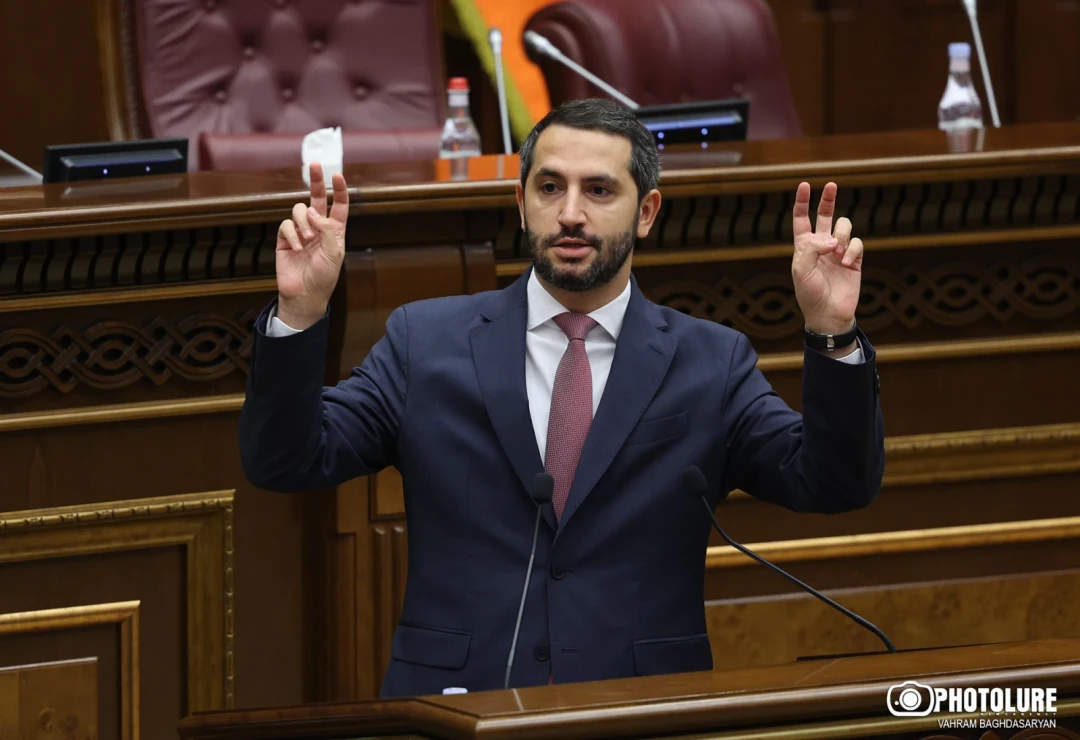
Armenian parliamentary speaker Ruben Rubinyan has called on opposition lawmakers to supply the six votes the ruling party needs to put a new constitution to a referendum, even if they then campaign against it.
“We ask them to give us the opportunity to put it before the people. Let them present their position to the people, and let the people decide,” Rubinyan, a senior member of Prime Minister Nikol Pashinyan’s Civil Contract party, told reporters in parliament on Friday.
Narek Karapetyan, the leader of the opposition Strong Armenia party, rejected the idea at a separate briefing the same day. He described the planned document as an ‘Aliyev constitution,’ dictated by Azerbaijan.
“An Aliyev constitution shall not pass in Armenia. The leader of a neighboring country may not decide on our constitution,” Karapetyan said.
Rubinyan dismissed that description.
“No one in Armenia is going to adopt an Aliyev constitution,” he said, adding that the new document would be an Armenian constitution, voted on by the people of Armenia.
Civil Contract won 64 of 105 seats in a parliamentary election earlier in June. Triggering a constitutional referendum requires 70 votes, leaving the ruling party six short. Strong Armenia holds 29 seats and the Hayastan (Armenia) bloc holds 12, leaving the government dependent on opposition votes.
Earlier this week, Foreign Minister Ararat Mirzoyan urged opposition lawmakers to back the referendum, raising the possibility that the government would resign if voters rejected the draft.
A constitution of weakness
Karapetyan said the U.S.-mediated peace treaty, initialed in Washington in August 2025, contains no condition on Armenia’s constitution. Baku raised the demand only afterward, he said.
“Azerbaijan has understood that the longer it drags out the peace treaty, the more concessions it will get from us,” Karapetyan said.
He seized on Pashinyan’s admission that he did not yet know whether a constitutional change would be Baku’s final demand. Karapetyan said the Civil Contract had campaigned on a promise of peace without knowing what Azerbaijan would ask for. He accused the government of misleading voters and hiding the state of negotiations.
He also noted that the draft constitution has still not been published. The fragments of information released so far are alarming, he said.
On Thursday, Pashinyan threatened to generate strong public pressure on the two opposition groups, and to keep them out of any snap election, if they keep rejecting the draft. Karapetyan dismissed the threat.
“We are here to advance our country’s interests,” he said. Most of society, he added, is applying a different kind of pressure: urging lawmakers not to take Azerbaijan’s bait.
“How can your adversary of decades write your constitution for you?” he said. “It is clear that it will be a constitution of weakness.”
Baku’s precondition
Baku says it will not sign the final treaty unless Armenia removes the reference to its Declaration of Independence from the constitution. Azerbaijan does not dispute Armenia’s independence itself, but objects to the Declaration’s reference to Nagorno-Karabakh, which it considers a territorial claim.
Armenian officials reject the demand, arguing that constitutional changes are an internal matter. At the same time, the government has pushed for a new constitution, saying the current document lacks public legitimacy. In August, a Civil Contract lawmaker said the new constitution will not reference the Declaration of Independence. Rubinyan made a similar point on Friday, saying the reference is not being removed because the new constitution is being written from scratch.
The draft was initially expected by the end of March, but the deadline was later pushed back to the end of 2026. On Thursday, Pashinyan said a parliamentary exchange with the opposition had convinced him the process would likely not come to snap elections, and that he could make the opposition an offer it could not refuse.


 Stories