 Civilnet
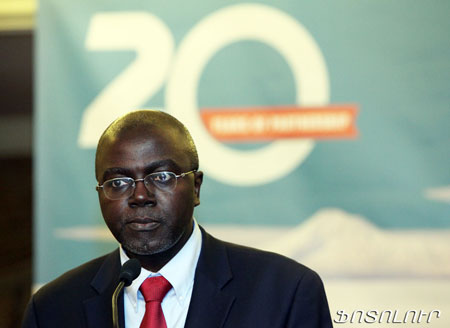
 The IMF has forecasted up to 5 per cent economic growth in Armenia in 2013, while the Government of Armenia has projected 6.2 growth. Jean-Michel Happi, World Bank Country Manager for Armenia, explains to CivilNet that “it is already clear that the upcoming electricity and natural gas tariff increase will push inflation up, slow down the initially projected growth, and adversely impact the poor.”
The Government of Armenia intends to subsidize 30 percent of the Russian gas price increase. What is the World Bank’s position on this issue?
As you know the price of the imported natural gas from Russia has increased by 50 percent from $180 to $270 per 1,000 cubic meter. This wholesale tariff increase necessitated adjustments of retail tariffs for gas and electricity consumers. Given the expected implications of the immediate and commensurate adjustment of the retail tariff on the Armenian economy and vulnerable segments of the population, it was decided to take a gradual approach of the retail tariff increase. As the first step, the Public Services Regulatory Commission made a decision to increase the retail tariff of natural gas for small consumers by 18.2 percent and for large consumers – by 14 percent. The retail tariff for electricity will also be adjusted - by 28.6 percent on average. The difference between the import and retail tariffs is estimated to total 72 billion AMD annually which will be covered by the State Budget.
During the year the World Bank will monitor the actual macroeconomic performance and will revisit forecasts for the country, nevertheless, it is already clear that the upcoming electricity and natural gas tariff increase will push inflation up, slower the initially projected growth and adversely impact the poor. The World Bank has earlier advised the country to further improve its fiscal position by building up a fiscal buffer, strengthening fiscal discipline and continuing fiscal consolidation efforts. The government has been also advised to foster structural reforms that could facilitate economic diversification, boost competitiveness to counteract on possible cycles of the economy and better deal with the future shocks. In the light of previous recommendations we will encourage and support the Government in these efforts, as we believe that this is the right way leading the country to a more sustainable development path. These reforms are needed also to help the country’s vulnerable and lift them out of poverty. In addition, it is clear that the prices for the imported gas in Armenia are far from the European and most of the other gas-importing CIS countries. This means that price adjustment could come back to the agenda in the future with all possible implications. Therefore, I would suggest to look at this challenge as an opportunity to revisit and further substantiate on the energy policy needs of the country, look for ways of reducing the energy dependency by diversifying and exploring alternative sources of energy, improving the country’s competitiveness by reducing business costs and productivity, and improving the energy efficiency in the country.
The Government is discussing the possibility of raising credit to subsidize the gas price. There has been initial talk of issuing Eurobonds to the value of $500 million, the proceeds from which would be used for this purpose. Please share with us the position of the World Bank on this.
The IMF representative has already commented on the issue of Eurobonds being linked to gas subsidies, which must have already answered the concern. Access to international capital markets is a welcome step especially at this stage of Armenia’s development. Issuing the Euro bonds will allow diversifying financing sources and attracting additional resources for financing infrastructure and social programs. Until now Armenia receives external support through bilateral and multilateral channels. As the country’s income level increases, these funds may not remain accessible to Armenia. Therefore, looking to capital markets and improving its access is an appropriate policy decision. Other countries in the region have accessed the international capital market even before the recent crisis (Georgia issued Eurobonds in 2008).
It is envisaged that the Eurobonds will be allocated for the period of 10 years with 6.1 percent annual interest. This means that this debt is more expensive than the one taken from IMF. In general, does the World Bank see any associated risks with regard to managing the state debt? If yes, what are those risks?
It is true that terms and conditions of funds attracted from the capital market are different from funding mobilized through official donors. However Armenia can’t reply and remain eligible for concessional financing forever. These loans with softer terms are designed to support development of low income countries. In the next few years, Armenia will graduate from institutions providing concessional financing. Therefore it should use the transition period to prepare the institutional, legal and skills base required to manage the process. There are peculiarities of the fund management received from the capital market, such as the repayment schedule, the minimum size and roll-over risks. The Eurobonds should be issued at least 500 million and need to be repaid in one shot. The major risk pertains to Armenia's ability to roll-over the debt in 10 years. To mitigate this risk, the overall economic performance of the country, including the tax and export performance, should be robust, to allow smooth repayment and service of the country’s external debt.
The IMF representatives recently published an open statement in which they urged the Government to speed up the reforms, otherwise the “positive results that the Armenians want to see will be gradual if at all possible.” Do you share the IMF view that the Government’s efforts to improve the business environment are slow and not radical enough?
We have a long standing constructive partnership with the Government and it is undeniable that a number of key areas has been reformed. This is a work in progress and the World Bank in its Global Economic Outlook has stressed the importance for the whole region to undergo structural changes in order to be better prepared to downturns. The country ought to think of ways for providing for enough fiscal space to counterbalance structural vulnerabilities and cushion possible crises with counter-cyclical policies. This would in part require implementing regulatory and infrastructure reforms to bolster the economy through its supply side. That then requires a long-term commitment on the Government’s side, aimed at employing measures to ensure improved productivity and sustainable growth. Through our constructive engagement and policy dialogue, so far we have been reassured of the commitment to diversify the economy through the creation of jobs, enhancement of competitiveness and provision of better quality equitable social services. The strategy presented by the new Government leaves much room for the optimism, especially prior to the negotiations of the new cycle of bank engagement in the country that is going to take within a couple of days.
The Government has predicted a 0.3-0.4 percentage point annual improvement in the tax/GDP ratio. Is this type of growth sufficient, if we take into account that the shadow economy accounts for 35 percent of Armenia’s economic activity?
Annual increase of the tax / GDP ratio in a range of 0.3-0.4 percentage points of GDP is associated with improving tax administration only. This means that if tax policy changes (such as new taxes, higher rates, wider base, etc) are introduced, they should be reflected in additional increase of the tax/GDP ratio.

 Stories