 Civilnet
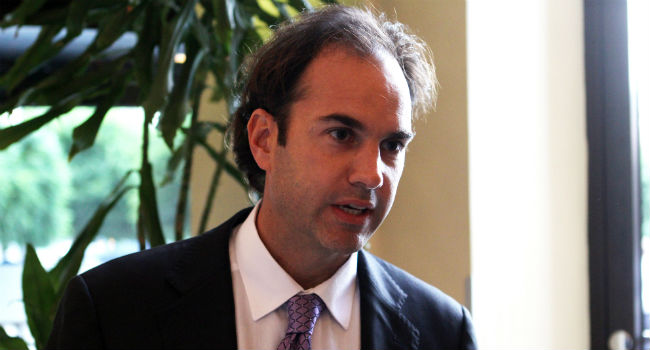
 Mr Tolosa reiterated the IMF’s position that the government should provide subsidies only for those who would be most affected, adding that it is not yet clear how that would be done, but that taking on new loans to cover the subsidies is not an option. (Photo: Daron Titizian)
On June 3, IMF Resident Representative in Armenia Guillermo Tolosa gave a farewell press briefing prior to leaving Yerevan to head the IMF offices for Bulgaria and Romania. He also introduced his successor, Teresa Daban, who worked for the Spanish Finance Ministry for eight years before joining the IMF in 2001. She has since headed the Fund’s Representation in nearly 30 countries in Latin America, Africa and Asia.
Tolosa gave a mixed overview of the problems and prospects facing the Armenian economy.
Regarding the government’s plans to subsidize Russian natural gas imports (270 AMD/1000 cubic meters) by 30 percent, Tolosa said that the final consumer prices should reflect the full cost of natural gas. He reiterated the IMF’s position that the government should provide subsidies only for those who would be most affected, adding that it is not yet clear how that would be done, but that taking on new loans to cover the subsidies is not an option. He said that the Armenian government and the IMF have an agreement that changes in fiscal policy will not be implemented mid-term.
European Debt: A new phase in the country’s development
According to preliminary estimates, an additional 140 million USD would be necessary to offset potential subsidies for natural gas prices. There is a possibility that the government’s 500 million USD Eurobonds would be used for that purpose, but Tolosa said that the IMF is confident that this will not happen. He said that the government’s intention to issue Eurobonds is simply a way to integrate Armenia’s markets. He went on to say that there is no connection between the subsidies and the issuance of the bonds. The bond issue is just a step to change the structure of the country’s debt and now is the optimum time to implement it. Acquiring European debt is a new phase in a country’s development.
The IMF Resident Representative noted that international financial organizations cannot continue to offer loan programs forever, and the time will come when Armenia must begin to generate loans itself. Tolosa said that this year’s loan tranche will be the last, and any new loans will be undertaken on a voluntary basis. He said the Executive Board will discuss the performance of the Extended Fund Facility (EFF) and Extended Credit Facility (ECF) programs and initiate talks on new credit programs.
Reports and Reality
In the World Bank’s Doing Business 2013 report, Armenia improved its position in the Ease of Doing Business index by 18 points and was ranked 32nd in the world. But in 2012 and the first quarter of 2013 foreign investment to Armenia still fell by an average of 10 percent, and foreign direct investment by 30 percent. Tolosa told reporters that these figures, especially following the financial crisis, are typical, and not specific to Armenia’s situation. He added that while steps have been taken to improve the business climate in Armenia, certain lingering obstacles must be removed in order for those improvements to materialize. He said that while the IMF is optimistic about Armenia, the current atmosphere is not very promising. Armenia, Tolosa said, finds itself in a pivotal transitional phase, and it is for that reason the IMF has urged speeding up the reform process.
In Tolosa’s opinion, several changes have taken place in Armenia. A two-year cycle of political processes has come to an end, Armenia’s GDP has surpassed 2008 figures, and GDP per capita figures have brought Armenia out of the low-income countries list. These developments, Tolosa said, demonstrate the need for swift, comprehensive, and decisive reforms.

 Stories