 Civilnet
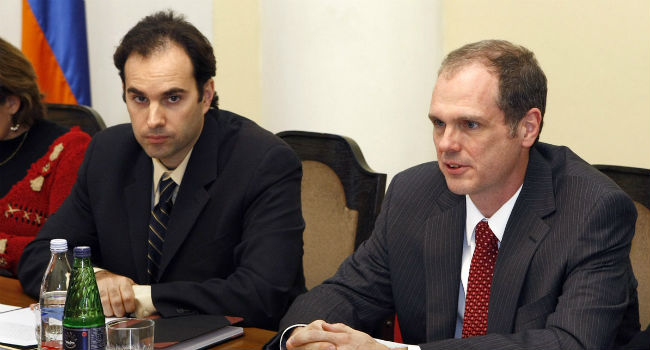
 The International Monetary Fund’s two current programs for Armenia – the Extended Fund Facility (EFF) and the Extended Credit Facility (ECF) - come to an end this year. An IMF Mission was in Armenia last week to assess implementation of the programs and discuss the possibility of a new loan to Armenia. Mark Horton, who heads the IMF mission to Armenia, describes the progress the Government has made, but at the same time stresses that “more work needs to be done.”
- This year the two IMF programs for Armenia - Extended Fund Facility (EFF) and Extended Credit Facility (ECF) - are due to end. Is it possible to give an initial evaluation of how effective they have been?
- The programs’ key objectives were to restore fiscal and external sustainability in the wake of the crisis, to preserve financial stability, and to support growth and poverty reduction. The programs helped foster crisis recovery by providing policy guidance and financial support, including to the budget. These objectives have largely been met, although additional progress is needed in some areas, particularly external adjustment, the business environment, and poverty reduction.
- How realistic is the possibility of a new IMF loan to Armenia? If so, what specifically would it focus on?
- This is a realistic possibility for later this year. We will focus on our traditional macro targets (reserves, budget deficit, etc.), but would also like to see more decisive progress to improve the investment climate in order to ensure that high growth is sustained and inclusive, generating employment, rather than being concentrated in the hands of a few.
- The IMF has stressed the need to improve customs and tax collection in Armenia. How effective have the Government’s efforts to act on that advice been, given that the tax/GDP ratio in Armenia is still very low, and according to official data, the shadow economy still comprises 35%?
- The government has made progress, but there is more work to be done. The government has made improvements in such areas as risk-based audits (targeting audit actions to areas where risk is high), in e-filing (electronic filing to improve efficiency and limit chances for corruption), taxpayer services (centers, hotlines, forms, websites, etc.), and in the tax appeals process (through the interministerial committee).
More needs to be done to strengthen compliance enforcement—to deal with the shadow economy—and to strengthen capacity in complex areas, such as policing transfer pricing abuses (when affiliated companies sell at non-market prices to avoid taxation). There is a need to build capacity in specialized sectors, such as mining or banking.
- The Government plans to improve the tax/GDP ratio by 0.4% annually over the next five years. Is the IMF happy with this schedule, or do you think there is room for a substantially higher improvement in the tax/GDP ratio?
- We would like to see a more significant increase up front. We see a need to bring the headline deficit down from 2.6 to 2.0 percent of GDP over 2013-15, so that public debt is stabilized in percent of GDP (our estimates suggest that this would be the case with a deficit of 2.0 percent of GDP). To reach this level, there is a need for more tax revenues, or else spending would need to be cut. We do not believe it is desirable to cut spending, as there are needs in infrastructure, for example, roads, in social spending (health, education), and in other areas. As we are aware, some government officials have been received pay increases in a decade. Also, revenue do remain somewhat low by regional and international standards, and there are some areas where it would appear that revenues could be raised, for example, excise taxes on fuel (with a new excise on compressed natural gas, which is not taxed as is petrol), tobacco, and alcohol, and continued improvements in tax administration. Taxation of big companies and wealthy individuals could be strengthened.
- Over the past three years, the Armenian Government has acted on IMF recommendations and pursued a restrictive fiscal and monetary policy to sustain macroeconomic stability. Do you think Armenia will shift to an expansionary policy, given the current risks of annual growth restrictions?
- No, we do not see that Armenia would shift to an expansionary policy unless there is a significant shock to the global or the Armenian economy. Even under these circumstances, the “policy space” that Armenia would have to shift to an expansionary policy may be limited by access to financing.
Armenak Chatinyan


 Stories