Loneliness in Yerevan: A User’s Guide (Part 2)
 Civilnet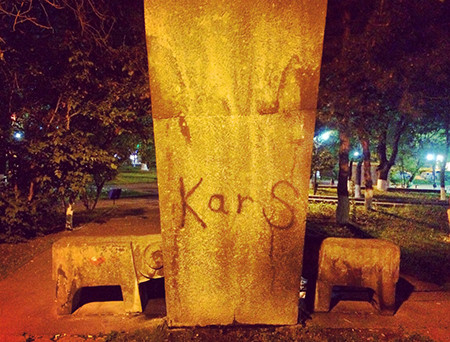
 It's around 1:00 am and you're jammed in the backseat of a grey, fancy, two-door Audi humming through the streets of Yerevan. You have little to no idea who the guys in the front seats are. You just met them an hour ago at a wine bar through other people you don't know well either. They're actors or designers or something. It matters and doesn't. You're all meeting up at another bar. The guy driving kicks it into fourth gear and speeds up Mashtots Street. The other guy fiddles with the radio. They joke with each other and laugh. It's hard to hear because of the revving engine and music. So you do what they do in those 80s teenage movies: lean your head against the glass and let the streetlights skim over you. Except instead of Simple Minds or OMD, the soundtrack is some random Russian pop song they're listening to, ironically, of course.
The club's small and dimly lit, with stone walls and wood floors. You sit at the bar and order a beer. Everyone seems to know each other. It's an artsy, mostly privileged circle—a mix of locals and diasporans. The DJ's playing some good electropop. You take a sip and feel yourself slightly receding from the rest of the scene, becoming somehow separate. It’s a stupid 1990 feeling you've been having a lot here because in Yerevan some group situations have weird hints of high school, complete with odd interpersonal dynamics and a schizophrenic mix of prudishness and hedonism. This packed club is a bit like a 10th grade dance, the one you didn’t go to because you preferred hanging out at your other “loner” friends’ basements, listening to Echo and the Bunnymen and Talking Heads. And you may ask yourself, Well, how did I get here? Letting the days go by.
You sit at the bar, adrift and anchored all at once. You are there with friends. No you're not. You're there with strangers. Well, that's not really true either. You're there with people you kind of know but whose demeanor, motives, and intentions you are utterly unable to read. It's by far the strangest thing about living here. Maybe it's how small the city is and that we’re all Armenian. Maybe it’s how sublimated and immature attitudes about sex are. Or maybe it's that many of these people are more insecure than they let on, over-compensating by acting, well, odd. Whatever the case, all you know is this: you have lived in Boston, Los Angeles, Glasgow, and Berlin, and somehow, in all those places you were able, for the most part, to gauge people, decipher interpersonal dynamics, and thus feel more connected and a bit more certain of what's what. In Yerevan, your hard-earned ability to read people is malfunctioning because...of what. Who knows.
Then, something begins to light up inside you.
 As 3:45am rolls around, a warm, liberating feeling sinks from your heart to your gut—the realization that it was a momentary lapse of reason, wanting to belong because you’re in a new place, thousands of miles from home. But now you get it. Even in Armenia, where your mom’s family is from and which has been mythologized and idealized to grotesque proportions in the diaspora, you don’t really belong. Same as it ever was, same as it ever was. It’s as though you’re still the kid who scrawled burn what you own with a black marker on your t-shirt when it definitely wasn’t cool. You’re still the kid who would show up in your Catholic school uniform with your tie loosened, your corduroys tight, and your hair dyed blue. You’re still the kid who left high school a year early because screw high school and popularity and groupthink and being cool and authority and cliques.
You settle your tab, say your goodbyes, and head out into the fresh night air. As you walk home in the stillness, there’s a small monument with graffiti sprayed on it: Kars. You stand there and look at it—a moment of quiet melancholy and joy. You sense your self there, alone, both vast and miniscule, content, crackling with energy and atoms, connected to the dirt under your feet, to this city, the earth, and all the other people, no matter how few, who know exactly what you’re talking about—the ones with spray cans who leave anonymous messages in cities and towns all over the world, and the ones who read them and know that we’re never alone.
You light a cigarette and start walking through the empty, illuminated streets, quietly singing to yourself: Time isn’t holding us, time isn’t after us. Same as it ever was, same as it ever was.
Topic



 Stories