 Civilnet
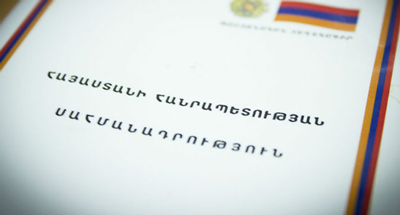
 The Office of the President’s Commission for Constitutional Reforms has unveiled a preliminary draft of a package of constitutional reforms. The draft can be found on the official website of Armenia’s Ministry of Justice. The commission, which was set up in accordance with a presidential decree signed on September 4, 2013, will present its main proposals to the president.
CivilNet lists below specific notable aspects of the proposed reforms:
- The constitution will ensure a clear model whereby, in the event that no party or coalition has a clear majority in the National Assembly, the president will ensure that the different branches of power work productively. Specifically, in such cases, the authority of the president may be restricted, as is the case in a parliamentary system of governance.
- The president of the republic will be elected by the National Assembly for a seven-year term without the right of re-election, and shall not be a member of any political party. Thus the president will be able to fully take on all the responsibilities of a non-partisan president. His/her main purpose will be to ensure the protection of the constitution and to counterbalance and restrain his/her authority as productively as possible. This is achievable only when the president is not involved in ongoing political issues, is non-partisan, is just, and when necessary serves as mediator and conciliator. His/her purpose is to ensure all of this, which in turn will provide the foundation for dynamic development. This is the best way to ensure systemic stability.
- The Prime Minister will be elected through parliamentary elections. He/she will form the Government and will answer to the National Assembly. The National Assembly, as a legislative body, will control the highest body of the executive branch – the Government. The President will ensure that the executive and legislative branches will protect the laws defined in the constitution. This type of system requires the existence of a stable parliamentary majority for the head of the executive branch. This type of system will have:
1) A joint executive body headed by the Prime Minister without the threat of a dualist executive branch, specifically for the spheres that are of vital importance for the country – foreign policy, national security and defense;
2) No confrontation between the parliament and the president will take place, because the president will be a fair, non-partisan arbitrator;
3) The threat of “random” people coming to power and of the super-personification of an authoritative power is minimized because the most powerful and acceptable head of a political party may become Prime Minister.
- The main aim of the election system is:
1) To ensure a political majority in the National Assembly;
2) To minimize as much as possible the influence the head of a political party can have on who will be the party’s representatives in the National Assembly. This is because that decision is one of the principles of a representative democracy and belongs solely to the voter;
3) To give the voter the possibility to vote for his/her preferred candidate depending on his/her political orientation; meanwhile ensuring a direct link between the voter and the candidate, which is considered an advantage of a majoritarian electoral system. It’s necessary to define separate barriers for political parties and political alliances in order for parties to expand, and to guarantee the stability of the political party system.


 Stories