 Civilnet
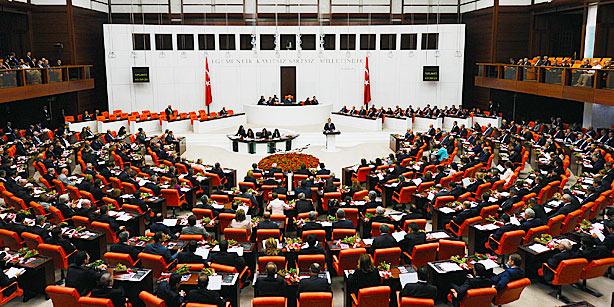

The Turkish Parliament’s Constitutional Conciliation Commission reached a three-party agreement on an article defining Turkey’s state language. The only party that objected to the wording was the pro-Kurdish Peace and Democracy Party (BDP).
The Constitutional Conciliation Commission has been working for nearly two years on drafting a new constitution. The ruling Justice and Development Party (AKP), the Republican People’s Party (CHP), and the Nationalist Movement Party (MHP) agreed to keep Article 3 of the current Constitution unchanged.
The current constitution of the Republic of Turkey was adopted in a referendum in November 1982 following the military coup in September 1980 that re-established military rule. Despite the overwhelming consensus on the need to overhaul the constitution and draft a new one, there have been numerous disagreements over its wording.
The AKP had proposed substituting the term “official language,” but finally opted to keep the current term “state language.” Support from the two parties for that formulation was reached on August 27, 2013, in the course of the debate.
The BDP had an alternative proposal which read: “The state’s official language is Turkish. All citizens have the responsibility and the right to learn the official language. Other mother tongues that the people of Turkey use can be used as a second official language with the decision of provincial councils.”
That alternative proposal would potentially bestow on Kurmanji, Zaza, Arabic, and other languages the status of second official languages in some provinces.
The BDP also took issue with the formulation “The state of Turkey with its territory and nation is an indivisible entity”. In 2009,the BDP’s predecessor, the Democratic Society Party (DTP), was banned because its activities were found to run counter to “the state’s indivisible integrity with its country and nation.”
A major AKP proposal on switching to a presidential system prevented the Commission from making progress for most of the past year due to fierce opposition from the three opposition parties. In recent months, however, the AKP considered withdrawing that proposal. The AKP had said it would affect only 20 other articles, but opposition parties claim it blocks further discussion of approximately 40 articles. According to Abdullah Bozkurt, Ankara bureau chief for the Zaman Daily Newspaper, "They [the AKP] are using it as a bargaining chip."
The switch to a presidential system is widely seen as intended to enable Prime Minister Recep Tayyip Erdoğan to remain in power. Implementing that proposal will depend to a large extent on how well the AKP performs in the local elections in March 2014.
The Constitutional Commission is headed by Parliament speaker Cemil Çiçek. The Commission comprises three members from each of the four political parties in Parliament. The parties’ conflicting ideas have delayed the process of reaching a finalized draft. Only 59 articles have been agreed on, while reservations have been expressed over a further 113.




 Stories