 Civilnet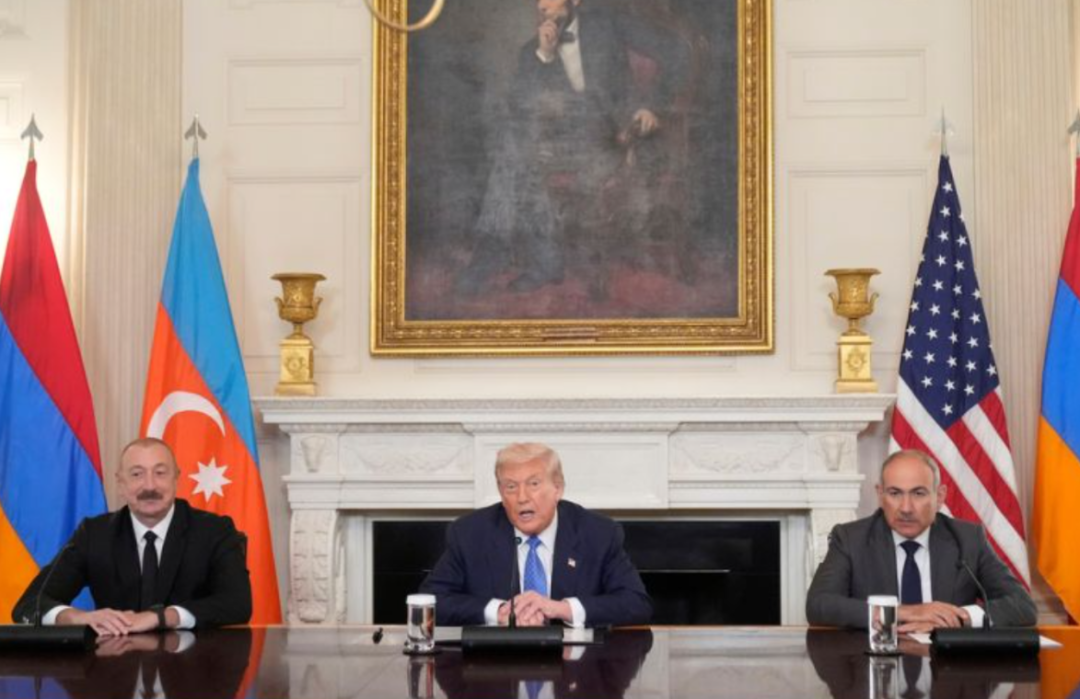
By Paul Vartan Sookiasian
Armenian Prime Minister Nikol Pashinyan and Azerbaijani President Ilham Aliyev were hosted at the White House today in Washington to sign a number of agreements aimed at bringing the long-running conflict to an end.
The sides initialed the 17-point normalization agreement that was reached in March after years of talks, though the full treaty still remains to be signed. Initaling means the sides have agreed on the wording of a final treaty and their commitment to the text, but does not have the legally-binding effect of an actual signature.
After privately meeting separately with each leader, Trump witnessed the signing of an agreement between Pashinyan and Aliyev, solidifying the outcomes of their negotiations and “affirming their path to peace, stability, and prosperity.”
“For more than 35 years, Armenia and Azerbaijan have fought a bitter conflict that resulted in tremendous suffering for both nations,” Trump said, while repeatedly emphasizing his belief that going forward Pashinyan and Aliyev would have “a great relationship.”
Trump noted the unsuccessful attempts by the European Union, Russia, and his predecessor U.S. President Joe Biden, but declared that peace had finally been achieved. He said that Armenia and Azerbaijan had agreed to “stop all fighting forever, open up commerce, travel, and diplomatic relations, and respect each other’s sovereignty and territorial integrity.”
Turning to what’s been dubbed as Trump Route for International Peace and Prosperity, a reference to a path through Armenia’s southern Syunik province, Trump said the route will allow Azerbaijan to “get full access to its territory of Nakhichevan while fully respecting Armenia’s sovereignty.” He further noted that Armenia is creating an exclusive partnership with the United States to develop this corridor for “up to 99 years,” and expressed his hope that it will be extended even longer.
Trump also announced the signing of bilateral agreements with each country to expand cooperation in energy, trade, and technology.
The Armenian and Azerbaijani leaders also signed a joint application to the OSCE Minsk Group to dissolve the body which was established in 1992 to facilitate a peaceful settlement of the Nagorno-Karabakh conflict. This fulfills one of Aliyev’s outstanding preconditions and demands on Armenia.
Following the meeting, Pashinyan’s press secretary Nazeli Baghdasaryan revealed that the three memoranda of understanding signed between Armenia and the United States concerned capacity development of the Crossroads of Peace project for opening regional connectivity, innovative partnership in the field of artificial intelligence and semiconductors, and in energy security.
Aliyev announced that Azerbaijan was embarking on the path to a strategic partnership with the United States, calling it a historic achievement for his country, something Armenia signed in January with the outgoing Biden administration. He also welcomed Trump’s waiving of Section 907, a law prohibiting assistance, including of a military nature, to Azerbaijan, something every president has done annually since 2002.
Both Pashinyan and Aliyev credited what was described as a breakthrough in negotiations to President Trump’s engagement and commitment to peace in the region.
“We are laying the foundation to write a better story than the one we had in the past… The initialing of the peace agreement will pave the way for ending the decades of conflict between our countries and open a new era based on the full respect for the sovereignty and territorial integrity of each other,” said Pashinyan.
Taking questions after the signing, the leaders were asked whether the Armenians of Nagorno-Karabakh would be allowed to return, but it was ignored in favor of talk of a much sought-after Nobel Peace Prize for Trump.
After the conclusion of the event, Pashinyan sounded an optimistic tone: “The future is today. Glory to the martyrs and long live the Republic of Armenia.”



 Stories