 Civilnet
By Yeghishe Kerobyan, Astghik Aboyan, Araqsya Nikoghosyan
The article was published on the Blog of KKpartners, a consulting firm
Executive summary
- On Aug 8, 2025, Armenia and Azerbaijan initialed a peace agreement and signed a joint declaration in Washington, D.C. That marked a step-change in perceived regional risk, though a final treaty is still pending.
- Eurobonds rallied for both sovereigns in the days after the announcement, reflecting lower-risk premia. Early coverage flagged broad gains across the Caucasus sovereign complex.
- Given Armenia’s higher starting risk premium and fresh USD 750mn 2035 Eurobond priced at a 7.10% yield / 286 bps over USTs in March, Armenia outperformed on spread compression; Azerbaijan, already investment grade at Moody’s Baa3 (positive) and Fitch BBB- (stable), saw a more modest (incremental) move. Net effect: Eurobond markets rally for both countries.
- Agencies have not announced ratings upgrades for Armenia post-event; Fitch said the framework “may support positive credit trends,” while reaffirming Armenia at BB- (stable).
- If implementation proceeds (border, transit corridor, legal changes), we see further room for Armenian spread tightening vs peers; for Azerbaijan, carry remains solid but upside is capped by a high starting rating and oil-linked macro.
What actually happened on Aug 8
Armenian PM Nikol Pashinyan and Azerbaijani President Ilham Aliyev initialed the text of a peace agreement and signed a joint declaration at the White House. Multiple official and press sources emphasize this was an initialing/Declaration, not final ratification - so implementation risk remains.
Several political analyses call it a “historic step,” while also noting it doesn’t by itself end the conflict without follow-through (constitutional questions, demarcation, and the proposed transit corridor).
How Eurobonds reacted
- Prices up / yields down across Armenia and Azerbaijan sovereign USD curves right after Aug 8; financial media explicitly described a regional bond rally.
- Armenia issued USD 750mn 10-yr (2035) on Mar 5, 2025, coupon 6.75%, yield at issue 7.10%, 286 bps over UST 10Y - leaving scope for post-event spread compression as geopolitical risk abated.
- Azerbaijan’s investmentgrade status and substantial sovereign buffers limited the magnitude of repricing - incremental tightening rather than a stepchange.
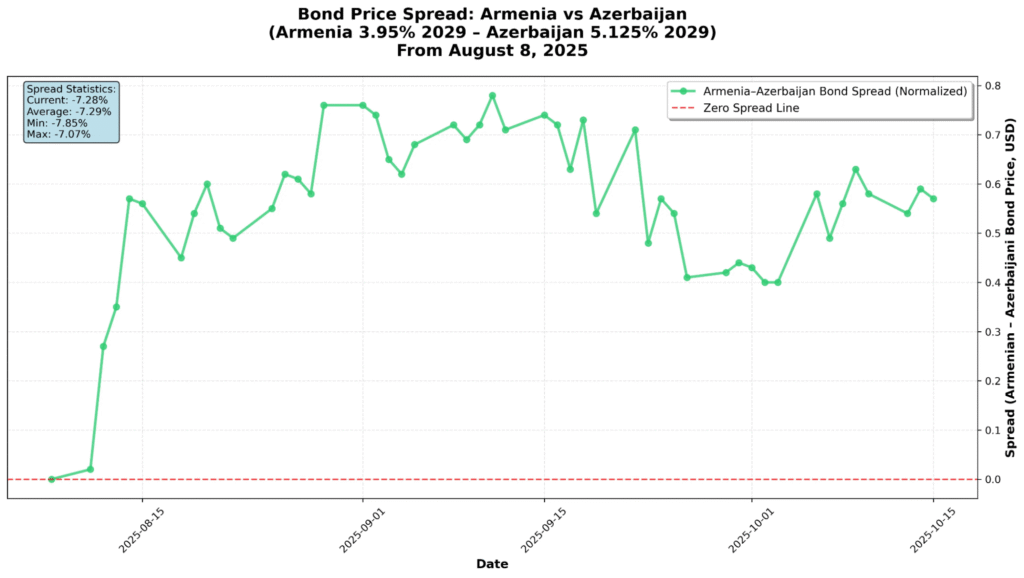
The Spread Between Armenian and Azerbaijani Eurobonds
The peace agreement triggered a notable market reaction: the spread between Armenian and Azerbaijani Eurobond prices spiked sharply. This surge was driven primarily by the faster and more pronounced rally in Armenian Eurobonds compared with Azerbaijani bonds.
The rapid widening of the spread highlights how the market immediately repriced Armenia’s sovereign risk. Investors interpreted the peace deal as a game-changer for Armenia, signaling a potential new era of financial stability and stronger creditworthiness.
Comparing the Impact
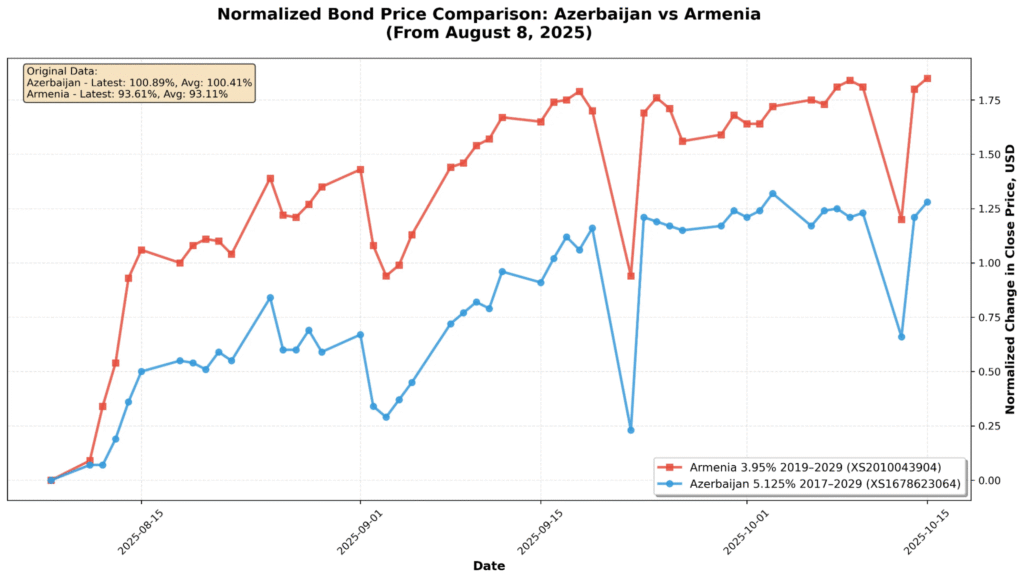
While both countries registered an increase in Eurobond values, the market reaction was more pronounced for Armenia due to several key factors:
- Risk Profile: Azerbaijan, as a major energy producer with a strong fiscal position, already had a lower-risk profile and a favorable credit rating prior to the agreement. The peace deal therefore produced more incremental gains for its bonds.
- Upside Potential: For Armenia, a smaller economy more directly exposed to the conflict, the peace agreement represented a fundamental turning point. It opened possibilities for new trade routes, foreign investment, and economic growth - all of which could significantly reduce the cost of future borrowings. The market likely priced-in this upside potential, leading to a sharper bond price rally and a more substantial narrowing of its credit spread.
The market reaction reflects optimism about Armenia’s ability to capitalize on the economic opportunities created by peace, including the opening of borders and new transport corridors. A recent credit rating agency upgrade assigning Armenia a "positive outlook" further supports this forward-looking perspective.
Disclaimer
This material is provided for research and informational purposes only and does not constitute investment advice, an offer, or a solicitation. Opinions are those of the authors and are subject to change without notice. Past performance is not indicative of future results.
Authors
Yeghishe Kerobyan is the Founder, KK Partners
Astghik Aboyan, is Quantitative Research Engineer, KK Partners Araqsya Nikoghosyan is a Data Scientist, KK Partners




 Stories