By Rupen Janbazian Editor in Chief at Torontohye
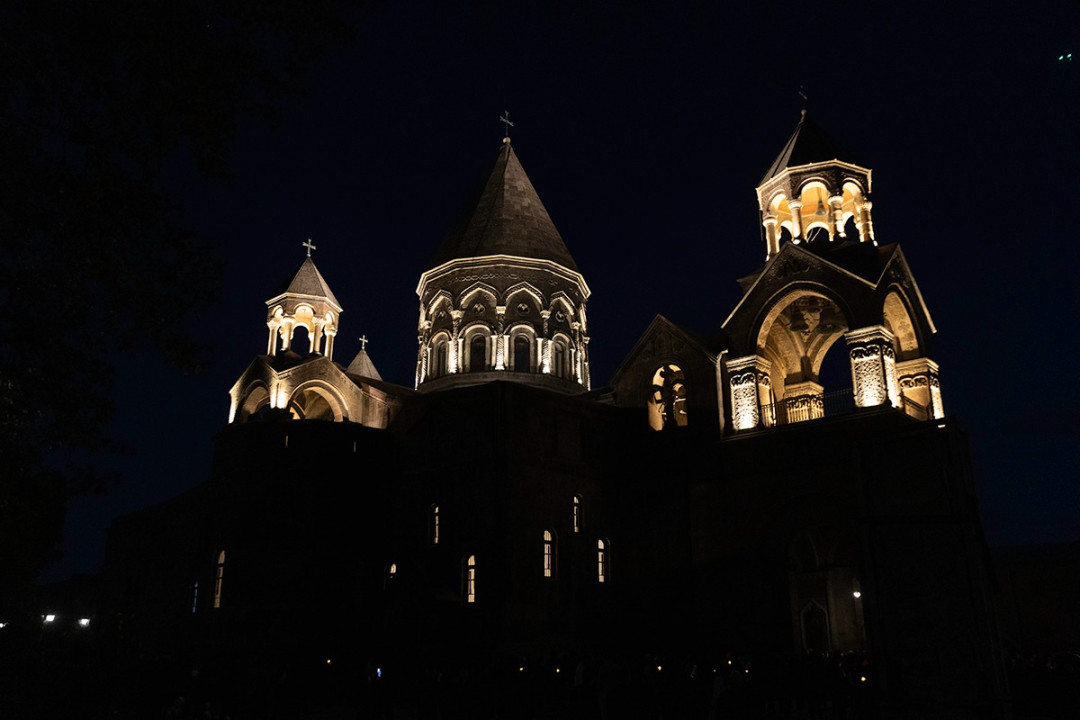
The official website of the Republic of Armenia Prayer Breakfast presents a serene picture. It speaks of renewing “spiritual foundations,” affirming “traditional Christian values,” and gathering leaders who share a “moral vision” for peace, prosperity, and principled governance. It stresses that this is a civil society initiative, with the support and participation of the Prime Minister, inspired by Armenia’s history as the first Christian nation and framed as part of a global tradition of prayer gatherings.
But as the event kicks off today in Yerevan, that language—harmless on the surface, even uplifting—lands very differently in the Armenia of 2025.
The event is being organized at a moment when senior clergy of the Armenian Apostolic Church and lay supporters of the Church are in prison or facing criminal charges that many human rights advocates, church bodies, and legal observers consider to be politically motivated. Archbishop Mikael Ajapahyan has already been sentenced to two years in prison for supposed “calls to overthrow constitutional order.” Archbishop Bagrat Galstanyan, who led mass protests against the government’s decision to hand over border villages, has been in pre-trial detention since June. Bishop Mkrtich Proshyan of Aragatsotn is also in pre-trial detention, accused of “coercing citizens” years after the fact. Russian-Armenian businessman and philanthropist Samvel Karapetyan, known for his public defense of the Church, has likewise been held for months on charges widely described as retaliatory.
More than 20 other supporters of the Church, as well as critical journalists and commentators, have been detained or arrested in recent months. Just as international guests were arriving in Yerevan for the Prayer Breakfast, two opposition podcasters were taken into custody. Christian Solidarity International’s representative has already warned of a climate of fear, shrinking space for dissent, and a government that seems confident it can continue down this path without serious pushback from its Western partners.
This comes on top of something deeper: a direct, ongoing confrontation between the government and the Armenian Apostolic Church itself. For more than a year, Prime Minister Nikol Pashinyan has openly questioned the legitimacy of Catholicos Karekin II, accused him of violating celibacy rules, attacked his family members, and declared that the Church has “no Catholicos.” The government has revived years-old recordings to open new criminal cases and has floated the possibility of reshaping the very process through which the Church elects its spiritual leader—a direct violation of the constitutional principle of church-state separation.
And when pressure and public attacks failed to force the Catholicos to resign, the government turned to a different tactic: elevating clergy who have been formally defrocked or are under disciplinary review, using them to create a competing religious narrative. In recent weeks, the Prime Minister and other senior officials have repeatedly attended services led by defrocked or suspended priests, with state television broadcasting the events and heavy police presence surrounding churches. What is framed as a simple act of “parishioner” worship begins to look very much like a coordinated attempt to undermine the authority of the Mother See and normalize a parallel religious structure more aligned with the government’s political needs.
A representative of Christian Solidarity International, who arrived in Yerevan for the event, has already warned of a deepening climate of fear, narrowing space for dissent, and a government that appears confident it can continue down this path without meaningful resistance from its Western partners.
Against this backdrop, the Prayer Breakfast’s promise to promote “religious freedom” and “moral leadership” does not simply ring hollow. It begins to look like something more troubling: a carefully staged exercise in reputation laundering.
This model is not unique; the American National Prayer Breakfast that inspired it is itself full of criticisms about blurred lines between piety, power, and political influence. Armenia is importing that format at the very moment its own government stands accused of intensifying pressure on the historic Church and curbing civil liberties.
What is perhaps most alarming is how muted the outcry has been. Apart from a handful of sharply worded op-eds and statements—including one from the European Armenian Federation for Justice and Democracy—most institutions have remained publicly quiet about the Prayer Breakfast. Even as bishops are arrested, properties searched, clergy publicly denounced, and internal church disputes turned into political theater, many organizations seem unwilling to confront a government that insists its actions are simply “reform.”
That cannot remain the case. The clearest and most principled voices should be coming from Armenia’s own religious landscape–not only from the Armenian Apostolic Church, but also from the Armenian Catholic Church, the Armenian Evangelical Church, and their affiliated institutions, charities, parish councils, educational networks, youth groups, and lay associations inside Armenia and throughout the diaspora. These communities have safeguarded Armenian faith and identity for generations. They cannot afford to remain silent while clergy of any denomination are arrested or used as instruments of political pressure.
Non-Armenian religious organizations that have long claimed solidarity with Armenia also have a role. Ecumenical bodies, Orthodox, Catholic, and Protestant institutions, and Christian human rights groups should not allow themselves to become decorative backdrops for any government that jails clergy while speaking of “moral renewal.”
Some invitees have chosen not to attend the Prayer Breakfast. Others will come, hoping to build relationships or speak from within. Whatever path they take, silence is not an option. Sharing a stage with Armenia’s leaders at a “prayer breakfast” requires, at a minimum, acknowledging the prisoners whose absence defines the moment. It requires asking publicly about arrested bishops and archbishops, and about the journalists and commentators detained in full view of international guests.
Prayer is not a photo-op. If this gathering is to have any moral credibility, it must confront the reality outside the conference hall, not help obscure it. Otherwise, it will not renew Armenia’s spiritual foundations; it will only help erode them.Rupen Janbazian is Editor in Chief at Torontohye, a Canadian-Armenian newspaper.

 Stories