 Tigran Grigoryan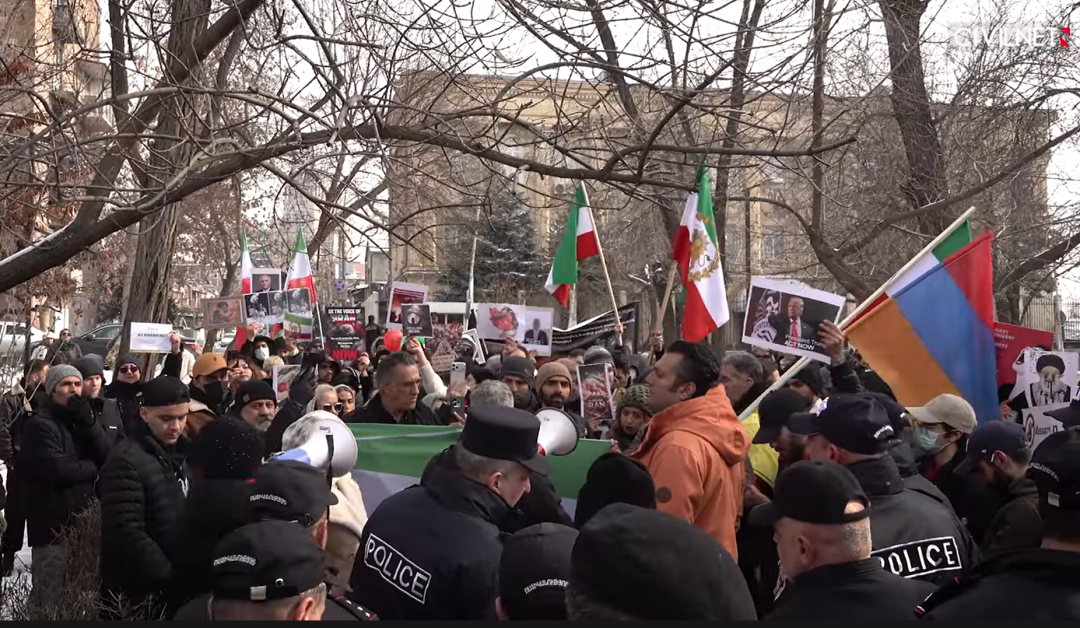
By Tigran Grigoryan
Against the backdrop of escalating domestic tensions and widespread protests in Iran, Yerevan has also emerged as a venue for political mobilization by Iranians living in Armenia. In recent days, dozens of Iranian residents have rallied to condemn the Iranian authorities’ crackdown on nationwide protests triggered by soaring inflation and the sharp devaluation of the national currency. Some demonstrators have gone further, openly calling for the overthrow of the Iranian government and the restoration of a monarchy.
After several days of protests in front of the Iranian embassy, Iran’s newly appointed ambassador to Armenia, Khalil Shirgholami, held a press conference in which he accused the Armenian government of failing to prevent the rallies. He stated: “An opinion is forming in Tehran that Armenia is becoming a serious center for the actions of forces hostile to Iran.”
Armenia’s interior ministry responded to these allegations by stating: “As a democratic state, Armenia has an obligation not to impede the exercise of citizens’ rights to freedom of movement and freedom of peaceful assembly within the framework of the Constitution of Armenia, the Law on Freedom of Assembly, and international commitments.”
Prime Minister Nikol Pashinyan also publicly responded to the Iranian ambassador, stating that since 2018, no rally has ever been banned anywhere in Armenia, and it is impossible to act differently in any individual case.
Nevertheless, on January 17, a march by Iranian protesters from the Iranian embassy to the Blue Mosque was banned. Seven Iranian nationals were detained near the embassy and later released. According to RFE/RL’s Armenian service, several participants in the protest said that days after the ambassador’s remarks, they were summoned by the police and the National Security Service.
This situation is problematic on many levels, including legally. However, the most serious issue is the fact that a diplomat representing a foreign country appears to have influenced Armenia’s domestic procedures and democratic practices through the use of threatening language. Given that Armenia interacts with neighbors and regional actors with less open and more centralized political systems, this incident sets a dangerous precedent that could be exploited by other external actors as well.
Differences in political systems often generate expectations among Armenia’s more authoritarian interlocutors—such as Azerbaijan and Russia, and more recently Georgia—that the Armenian government should control or prevent certain processes deemed by these actors to be directed against them or their interests. This authoritarian logic frequently interprets actions or statements by independent actors within Armenia as being directed or orchestrated by the Armenian government, projecting their own political realities onto others. Thus, the Russian government often treats anti-Kremlin rallies and other political initiatives as Yerevan’s hostile acts toward Moscow’s interests, even when they are organized by opposition actors.
Azerbaijan, in turn, has sought to influence domestic discourse in Armenia by equating statements and actions by non-governmental actors with official government policy. Even the Georgian government has reportedly attempted to pressure its Armenian counterparts to prevent Georgian NGOs affected by its “foreign agents” law from registering in Armenia—an action that would have violated Armenian legislation.
Yerevan’s primary line of defense against such expectations has consistently been the argument that Armenia is a democratic country governed by the rule of law and separation of powers, where the executive cannot arbitrarily impose decisions or restrict freedom of speech and assembly.
In this context, the decision to violate these principles following pressure from the Iranian ambassador risks undermining that defense and may embolden other external actors seeking to influence Armenia’s domestic processes.
Another factor weakening this position is Armenia’s ruling party’s own violations of democratic principles, which demonstrate that commitments to democratic norms and the rule of law can be set aside for political expediency. In this sense, the erosion of democratic norms directly undermines Armenia’s resilience and its ability to safeguard its sovereignty.
It is understandable that Iran is a strategically important partner for Armenia, as one of only two neighboring countries with open borders. However, a clear distinction must be maintained between rational geopolitical considerations and the protection of democratic institutions at home. One cannot come at the expense of the other.
Rather than complying with unacceptable demands, Armenian authorities should have clearly explained to their Iranian counterparts that there are lines that cannot be crossed, even in pursuit of geopolitical interests.
Democracy Watch is a joint initiative of CivilNet and the Regional Center for Democracy and Security.



 Stories