 Civilnet
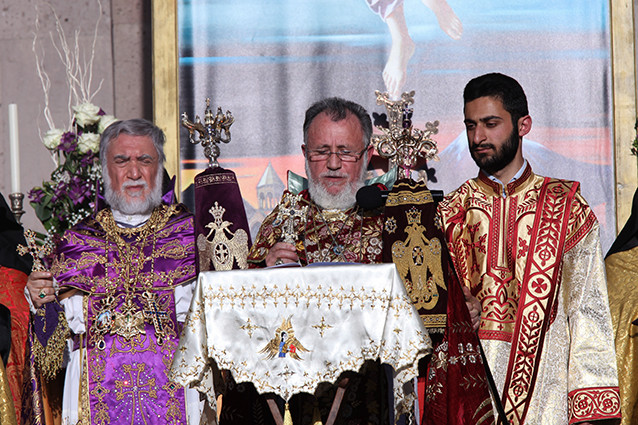
 Catholicos Karekin II and Catholicos Aram I.
The Armenian Church canonized the Martyrs of the Armenian Genocide yesterday during a two-hour outdoor ceremony at the St. Trdat Open Air Altar at the Mother See of Holy Etchmiadzin.
The ceremony, believed to be the biggest canonization service in history, occurred one day before the 100th anniversary of the Armenian Genocide. On April 24, 1915, the Ottoman Empire began its systemic plan to annihilate the Armenian population. Over 1.5 million Armenians perished during the calamity.
Hundreds of people from around the world gathered to watch the first saints canonized in the Armenian Church in 400 years. Numerous giants television screens were set up across Etchmiadzin’s complex to handle the overflow of people arriving for the ceremony.
“The canonization of the martyrs of the Genocide brings life-giving new breath, grace and blessing to our national and ecclesiastical life,” said His Holiness Karekin II, Supreme Patriarch of All Armenians. “We believe that we are weaving the crown of a new spiritual rebirth for our people, by canonizing the martyrs of the Armenian Genocide. The memory of our holy martyrs will therefore not be a requiem prayer of victimhood and dormition, rather a victorious song of praise by incorporeal soldiers, triumphant and sanctified by the blood of martyrdom.”
The ceremony concluded at 7:15 p.m. Yerevan time (19:15) with the coordinated worldwide ringing of church bells 100 times to symbolize the year in which the Genocide began, and the century which has passed.
 Cities where church bells rang include Yerevan, Beirut, New York, Madrid, Paris, Venice, and Berlin.
During the ornate service, 14 holy relics of the Armenian Church were used. These included:
The Holy Lance or “Geghard,” the right hand of St. Gregory the Illuminator, Relic of the True Cross, Reliquary of Skevra, the Right Hand of St. Stephen the Protodeacon and First Martyr of the Church, the Right Hand of the Apostle Ananias, The Right Hand of St. Sahak I Parthev, The Right Hand of St. Sarkis the Warrior, The Right Hand of St. Gevork the Warrior, the Cross-reliquary of St. Thaddeus and St. Virgin Sandukht, Cross-reliquary of St. John the Baptist, Reliquary of St. Gregory of Narek and Other Saints, and the Gospel of Zeytun.
The issue of canonization in the Armenian Church in modern times began in 1923 when a “Central Committee of Reforms” was established by Catholicos Gevorg V. The canonization issue continued to be discussed under the next Catholicos, Khoren I.
During the 1960s, Catholicos Vasgen I focused the canonization discussion in two phases as part of the Armenian Church’s administrative and spiritual life restoration process. Those discussions included restoring the tradition of the Canonization Rite of the Armenian Church and examining the possibility of canonizing the victims of the Armenian Genocide.
The process to officially canonize the victims of the Armenian Genocide began in 1990 when Vasgen I and His Holiness Karekin II, Catholicos of the Great House of Cilicia (later Karekin I, Supreme Patriarch and Catholicos of All Armenians) issued a joint statement announcing that preparatory work on the canonization had begun.
 In 2005, His Holiness Karekin II, Supreme Patriarch and Catholicos of All Armenians; and His Holiness Aram I, Catholicos of the Great House of Cilicia, issued pontifical orders for a special Canonization Committee to be formed, thus starting the “technical phase” of the canonization process.
A Bishop’s Synod at Holy Etchmiadzin in 2013 reached a principle consensus to adopt the canonization process of the Armenian Genocide victims. A year later, another Bishop’s Synod agreed to add April 24 to the Armenian Church Liturgical Calendar as the “Remembrance Day of the Holy Martyrs who were Martyred for their Faith and Homeland during the Armenian Genocide” after the canonization ceremony.
“Today our people in Armenia and in Diaspora are in joy because their forefathers and foremothers, who were the victims of the genocide planned and executed by the Ottoman government in 1915, join the multitude of saints and martyrs who sacrificed their lives for Christ,” said Aram I, Catholicos of the Great House of Cilicia. “Our martyrs, who, empowered by the Holy Spirit overcame the "war against evil", empower us with renewed faith to face boldly the new evils of new times.”



 Պատմություններ