 Civilnet
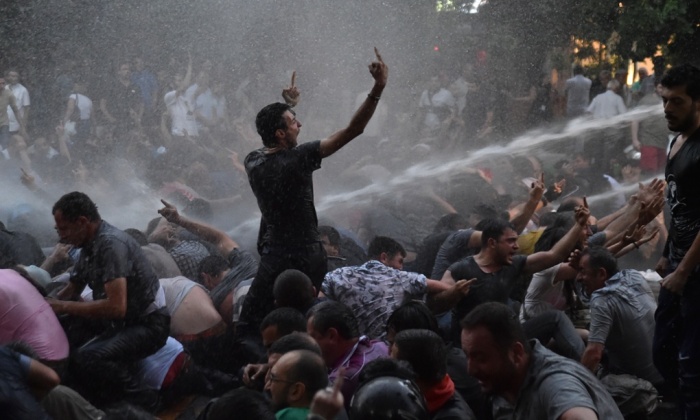
 Iconic photo of protester during #ElectricYerevan sit-in.
June 25A peaceful movement
Today, in the early morning hours, the few hundred protesters who had remained for the night were woken by a small chanting crowd singing Armenian songs. As the sun rose, many people stretched and joined in while others organized the clean-up of Baghramian Avenue. The evening before, like all others, had been peaceful, with protesters sitting in small groups, singing, playing the drums, playing chess and slowly falling asleep when the music receded.
Baghramian Avenue, one of the main roads leading in and out of the city of Yerevan, and home to the Presidential Palace, has been occupied and barricaded by protesters since Monday evening. The protests initially started on June 17, when Armenia’s Public Services Regulatory Commission (PSRC) unanimously approved increasing electricity rates by 7AMD/kWh or by 10 percent.
Waiting outside to hear the decision of the PSRC were a few hundred protesters. Once the decision was made public, demonstrators began throwing eggs and tomatoes in the direction of the building. There were clashes with police and several youth activists were arrested and later released.
On June 19, thousands of people rallied in Yerevan’s Liberty Square to protest the rate hikes. They decided to stage a three-day sit-in in the square and issued an ultimatum to authorities - if their demands were not met in three days, they would take their protest to the Presidential Palace located on Baghramyan 26.
At 7:00 the protesters began marching toward the Presidential Palace. They were met with a heavy police presence, riot police had blocked their march to Baghramyan 26.
After several tense hours of negotiations between police and the demonstrators, in the early morning hours of June 23, security forces, backed by water canons began dispersing the crowd. The heavy-handed police action where scores were injured and over 230 people arrested, warranted criticism from several international bodies.
 Several organizations, including the OSCE, the EU Delegation to Armenia, the US Embassy, Reporters Without Borders and Amnesty International, condemned the excessive use of force against protesters.
Meanwhile, the photo of the young protester giving the middle finger at the water canons has made headlines around the world and has become a symbol of the movement… as can be seen in the logo (on the right) that appeared on signs and was heavily shared on Facebook in the last two days.
“The more you water us, the faster we grow”
Protesters decided to deal with the severity of the police action with humor and several of them showed up the next morning wearing flotation devices and carrying water guns. Mocking the water canon.
The catchphrase “Inchkan djerek, kadjenq” (The more you water us, the faster we will grow) seems to have proven true, as the number of protesters has multiplied in the last three days. Despite the initial police repression, the movement is becoming increasingly popular, with people of all ages joining in.
Yesterday’s crowd was probably the largest so far; unofficial estimates range between 10.000 and 20.000 protesters at the peak of the demonstration, around 8:00PM last night.
At the beginning of the week, as many as 237 activists were arrested and detained, and a few were charged with hooliganism - despite the protest being remarkably peaceful and civic by all accounts. To date, all of those who were arrested have been released.
The next steps
Whether or not the movement will be successful remains to be seen. There have been recent examples where civic initiatives at forcing authorities to claw back utility rate hikes were successful - in 2013, following massive protests, a 50% rate hike of the bus ride fare was cancelled.
Although the authorities now state that the electricity price rise is necessary, it is not clear if they will buckle to public pressure. Behind this #ElectricYerevan protest, however, also lies at least two bigger issues.
One is the price inflation of basic goods - the suggested augmentation of electricity prices being the final straw that drove people to the streets. The second is Armenia’s power system, its lack of diversification, and its heavy dependence on foreign sources of energy.
The next few weeks will be critical in showing whether or not the determined activists, concerned citizens and sleepless protesters can come up with propositions and solutions.
Charlotte Poulain

 Պատմություններ