 Civilnet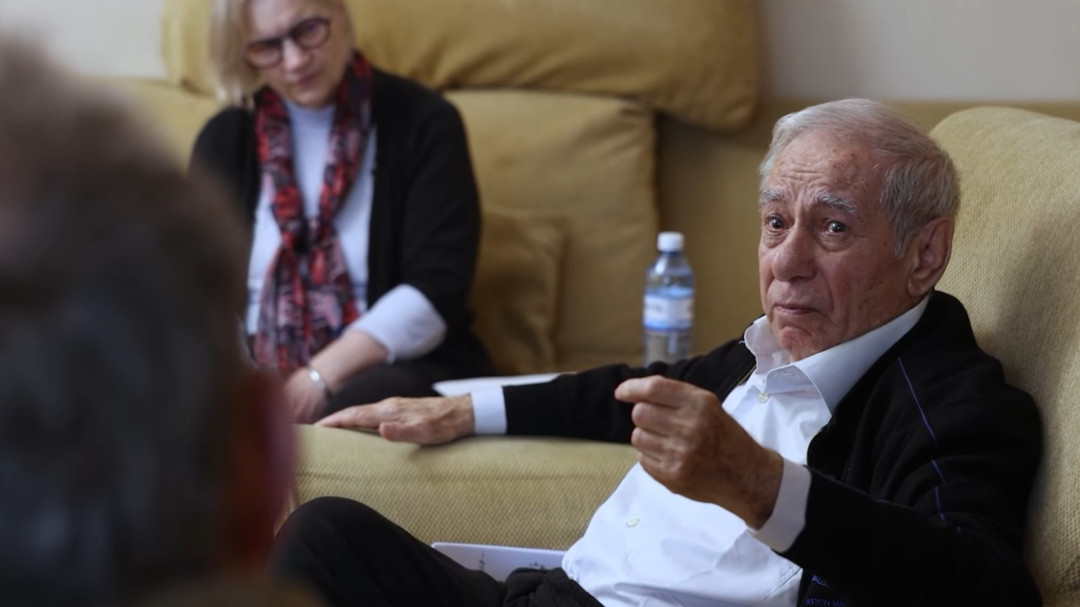
By Zhanna Avagyan
In February 2025 in Baku, Azerbaijani writer Akram Aylisli gave an almost two-hour interview to well-known South Caucasus expert Thomas de Waal and literary translator Katherine E. Young. The recording is being published only a year later. From the full conversation, CivilNet selected key excerpts — about childhood, memory, Stone Dreams, and the price the writer paid for his novel. A special place in the discussion is given to his native village of Aylis in Nakhichevan — the historic Agulis, once a large Armenian settlement with a rich cultural heritage.
Childhood memories of Armenians: “I saw good people”
Aylisli does not always speak Russian smoothly; at times, he searches for words. But his thought is clear: “I need the person. The way I saw him.” He rejects approaches that force the past into ideological frameworks.
“I did not see villains… My fate was such that I met good people,” he says. And adds: “I believe what my soul knows… that’s how my heart perceived it.”
For him, this is not a political stance but a childhood memory — from before “hatred, like a flood,” swept everything away.
Grandmother, Eskhi, and thyme tea
When Aylisli speaks about his childhood, his speech slows. He returns to a morning when he was eleven or twelve. His grandmother woke him early and said, “Let’s go to Lower Agulis.” Her friend lived there — an Armenian woman named Eskhi.
He describes the path from their home in Upper Aylis to Lower as a true journey. Along the way, his grandmother was not simply leading him — she was handing him an entire world. “She showed springs, trees, told stories,” he recalls. It was the Aylis of her childhood, before divisions and before hatred. “I have been to America and England… but I have never seen such a journey as with my grandmother,” Aylisli says.
Eskhi’s house was poor. The times were hard. “She could hardly offer us anything,” he remembers. But that did not matter. What mattered was what happened in the first minutes of the meeting: the two elderly women embraced “like sisters,” could not let go of each other, remembered childhood, neighborhood, life as it once was. “When I remember, I want to cry,” the writer admits.
According to him, Eskhi lived almost alone in Lower Aylis. He stresses that the place had once been predominantly Armenian, and then everything changed. There is no political rhetoric in his recollection — only the feeling of lost coexistence.
The thyme tea served by the hostess becomes almost symbolic. A simple treat — a sign of dignity and hospitality preserved despite poverty. Aylisli returns to this detail not for ethnography, but for feeling: memory of people is more important than historical schemes.
Loss of memory and “patriotism of territory”
Aylisli speaks bitterly about how, in the late 1980s, “people of art” joined the wave of hatred. Those from whom he expected restraint began to “stoke” it themselves. He sharply criticizes the transformation of Karabakh into the sole measure of patriotism.
“What writer can live by territory and not by the soul?” he asks.
In his view, a writer must “remove negativity,” not amplify it.
“Platina” (1986): the first text about Aylis Armenians
Aylisli emphasizes that Stone Dreams did not arise suddenly. Back in 1986, he wrote the novella Platina, where he first addressed the theme of Aylis Armenians.
“They raised such a howl,” he recalls. Although it was still the Soviet period, the reaction was painful. He saw that the atmosphere was heating up and felt the approach of disaster.
Silva Kaputikyan: a conversation that remained inside
Aylisli recalls the story involving Armenian poet and writer Silva Kaputikyan not as a literary dispute, but as an internal turning point.
At one of the last major events of the USSR Writers’ Union in Moscow in the late 1980s, various commissions and lists were being formed. The atmosphere was already tense; the national question was becoming increasingly sensitive.
Aylisli admits he spoke against including Kaputikyan in one of the lists. At the time, he perceived her as a “nationalist” author. “That was my perception,” he says, not attempting to soften his position retroactively.
After the meeting, however, a woman — an editor from a Moscow publishing house who had worked on his book — approached him and said a phrase that changed everything: “Her father was buried alive.”
He does not elaborate, but the meaning was clear: behind public positions stood personal trauma, family tragedy.
“I couldn’t answer her anything,” he says. “Later, I answered myself for a long time.”
National memory, he concludes, is a heavy burden. But if every conversation begins only with accusations, there will be no future. “I don’t ask you to forget. Don’t forget. But when we want to build a new life, we should not begin with the bad. Negativity must be removed.”
Hrant Matevosyan: “To a Real Writer”
Aylisli speaks warmly about Armenian writer Hrant Matevosyan. They met in Yerevan during the staging of one of Aylisli’s plays.
Later, at a table among Azerbaijani and Armenian writers, Matevosyan raised a toast: “Let’s finally drink to a real writer.” For Aylisli, this was recognition of an equal — someone who writes not for political expediency.
He calls Matevosyan “a very great writer,” “deep,” “wise,” emphasizing that he “was not a cheap nationalist.” He recalls Matevosyan’s admiration for Hovhannes Tumanyan and compares his prose to stone carving: “Like a master carving a khachkar — his word was like on stone.”
He also remembers another meeting at the Armenian–Azerbaijani border. “We had a wonderful day. We drank, ate, and sang. How good it was,” he says — and the repetition sounds not like nostalgia, but loss.
“Stone Dreams”: Fate, Triggers and a Letter to Aliyev
Aylisli speaks of the novel as an inner necessity: “If I hadn’t written it, I would have stopped respecting myself.”
He worked on the book in 2006–2007. Among the triggers, he names the case of Ramil Safarov, the destruction of the Armenian cemetery in Nakhichevan, and his irritation at the silence of international structures: “UNESCO did not utter a word.”
Safarov, an Azerbaijani officer who killed a sleeping Armenian officer in Budapest in 2004, was sentenced by a Hungarian court to life imprisonment, but in 2012 was extradited to Azerbaijan, pardoned, and later celebrated as a hero.
Research has documented the systematic destruction of Armenian cultural heritage in Nakhichevan — hundreds of monuments and thousands of khachkars. For Aylisli, this became a personal wound.
He says he wrote a letter to Heydar Aliyev about the destruction of monuments. The response, according to him, was brief: “You are right, but don’t rush.”
Harassment and house arrest
“I understood that something would happen, but not on such a scale,” he says about the reaction to the novel.
In 2013, his books were burned in the streets; there were calls for violence. He was stripped of his title of People’s Writer and his state pension. Later, he was detained at the airport and banned from leaving the country.
He recalls that on the day when threats were shouted in his courtyard, he went out for a walk in the city. “To prove to myself that I am not a coward.” He was certain that without an “order from above,” he would not be killed.
At the end of the interview, the 88-year-old writer says simply: “I consider myself an elementary decent person.”
He does not call himself a prophet and does not claim the role of judge. But his position remains unchanged: a writer must oppose hatred, even if he has to pay with his own safety and peace.
Read the article in Russian



 Stories