By Hrair Balian
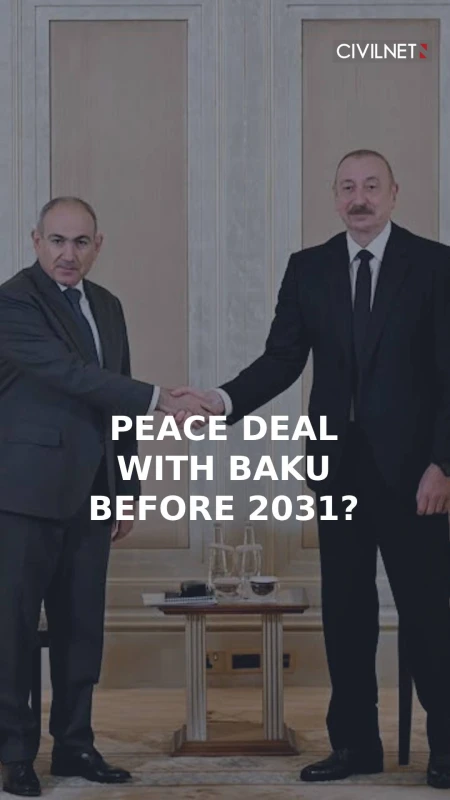
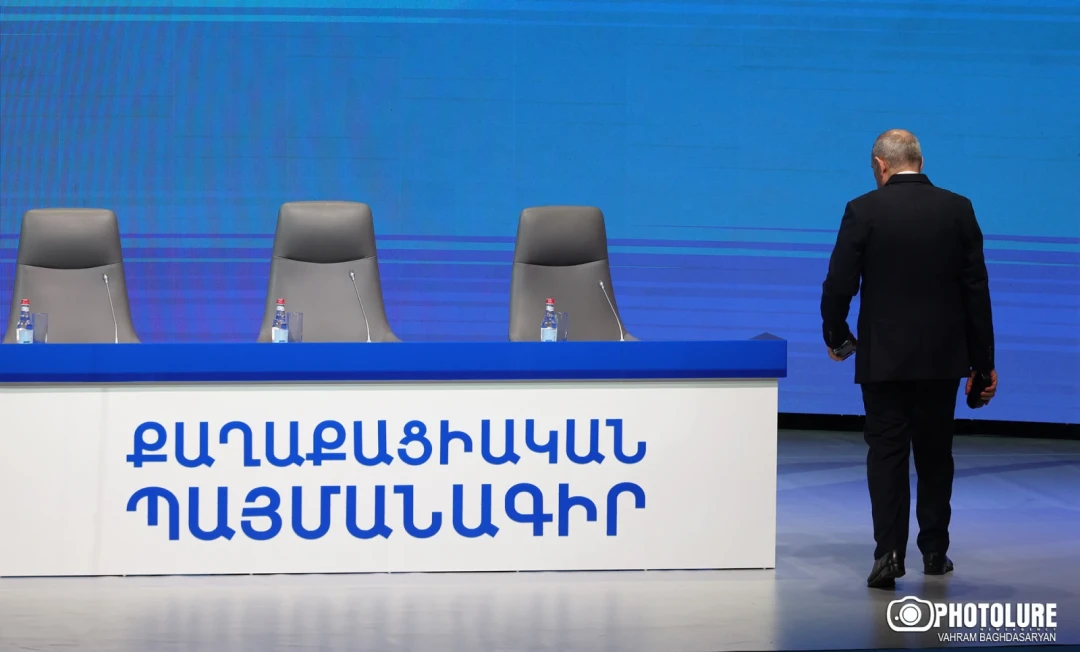
Armenia’s Prime Minister Nikol Pashinyan stated in a press conference on March 19 that, if he loses and the opposition comes to power at the June 7 parliamentary election, the country would face imminent war “with the loss of not only territory but also sovereignty”. He added, “All these forces are advocating a revision of peace, which means inevitable war very soon after the elections, in autumn the latest…. They are preparing a new … war with grave consequences”.
Prime Minister Pashinyan’s argument implies that war or peace is a function of who governs Armenia, not of Azerbaijan’s decisions, strategic calculations, or external dynamics. This is a fundamental misattribution of causal agency. If we were to reframe the argument more rationally, it is Azerbaijan — not the Armenian electorate — that decides whether to go to war. The risk of war is determined primarily by Baku’s strategic calculus, not by the political outcome of Yerevan’s domestic elections.
Presenting the election as a referendum on war vs. peace inverts the actual decision-making architecture.
The Prime Minister’s claim functions as coercive framing, as an instrument of electoral intimidation: vote for me or face catastrophe. This is a well-documented populist tactic — the leader presents himself as the sole guarantor of national survival, making the election a false binary between him and disaster. A rational response should name this for what it is: the securitization of democratic choice, which undermines the very legitimacy of the electoral process.
This rhetorical move has ample precedent in comparative politics. Benjamin Netanyahu, “Mr. Security”, has repeatedly framed Israeli elections as binary choices between his leadership and existential peril, casting every challenger as dangerously naïve on security. In the post-Soviet space, Alexander Lukashenko invoked external threat and the specter of instability to delegitimize electoral competition and justify his continued grip on power. The common denominator is the claim to unique, non-transferable competence in matters of national survival — a claim that is by design unfalsifiable: any catastrophe that follows an electoral change is blamed on those who “undermined” the leader, while any period of stability confirms his indispensability. This securitization of elections is a characteristic feature of competitive authoritarian regimes precisely because it erodes the normative foundation of electoral choice: the principle that governments can change without catastrophe.
Furthermore, Prime Minister Pashinyan ignores the structural factors that determine war risks. A more analytically grounded assessment of war risk would examine:
The state of the peace treaty process between Armenia and Azerbaijan — whether a durable agreement has been signed and what its implementation status is.
Azerbaijan’s internal political economy — whether President Ilham Aliyev faces domestic pressures that make military adventurism attractive regardless of who leads Armenia.
The international deterrence environment — the posture of Russia, the EU and its monitoring mission, U.S. engagement, and the instability caused because of the U.S./Israeli war against Iran.
And Armenia’s own military readiness and deterrence posture — which is an institutional matter, not a personal one tied to any single leader.
None of these variables depend on whether Pashinyan’s party Civil Contract wins a majority in June.
Among these structural factors, Russia’s dramatically altered role deserves particular emphasis, as it represents the single most consequential shift in Armenia’s security environment in a generation. For decades, Armenia’s strategic calculus rested on CSTO membership and the expectation of Russian military backing as a deterrent against Azerbaijani aggression. Russia’s failure to act during the 2020 war, its passivity during the 2023 fall of Nagorno-Karabakh and 2022 Azerbaijani takeover of slices of sovereign Armenian territory totaling 240 Sq2, and Armenia’s subsequent suspension of active CSTO participation have fundamentally dismantled that architecture. Armenia now faces the challenge of rebuilding deterrence — diversifying security partnerships toward the EU, France, India, and others — without a settled alternative framework in place. This transformation is entirely independent of which political party holds a parliamentary majority in Yerevan. It is a structural reality that will confront any Armenian government. The Pashinyan government both oversaw the collapse of the Russian security relationship and initiated the search for new partners; this is his record to defend on its merits. Reducing it to a question of who wins the June election obscures rather than illuminates the strategic challenge Armenia faces.
The Prime Minister’s threat undermines any credible deterrence that Armenia may have developed in recent years. Paradoxically, a leader who publicly ties his own reelection to national security may weaken Armenia’s deterrence posture. It signals to Baku that Armenia’s defense is personalized and fragile — dependent on one man’s political fortunes — rather than institutionally robust. A rational state communicates continuity of strategic commitment to deterrence regardless of electoral outcomes.
If accepted at face value, Pashinyan’s claim renders him unaccountable for his own record. Any critique of his peace diplomacy — concessions made, documents signed, Karabakh’s loss — becomes impossible to voice without being accused of “inviting war.” This is rhetorically convenient but epistemically dishonest. A rational electorate should be able to evaluate a leader’s performance without being told that doing so will cause imminent war.
Pashinyan himself was in power in 2020 when war broke out and in 2023 when Karabakh fell. If the presence of any particular leader were the primary determinant of war and peace, his own incumbency during these catastrophic events should give voters serious pause about the framing he is now offering. With such rational, the historical record cuts against him.
A rigorous critique of Pashinyan’s framing must nonetheless engage honestly with the opposition’s actual policy positions rather than treat them as a monolithic abstraction. Armenia’s fragmented opposition includes factions with meaningfully different orientations: some have called for outright rejection or revisiting aspects of the peace process, others for a renewed accommodation with Russia and the CSTO, and others still for a harder line on outstanding territorial and border issues. These are legitimate subjects for democratic debate and voter scrutiny, and there is nothing inherently illegitimate about voters considering a candidate’s foreign policy orientation when casting their ballot. The problem is not that security considerations belong in an election campaign — they plainly do — but that Pashinyan’s formulation collapses all policy disagreement into a single catastrophic outcome. Transparent policy comparison, with each party accountable for the coherence and credibility of its security strategy, is exactly what democratic competition should produce. What it should not produce is the foreclosure of that comparison by declaring any alternative to the incumbent synonymous with war.
A more honest and rational public discourse would ask: What institutional, diplomatic, and military conditions are in place or need to be in place to make war less likely — regardless of who governs? Such a framing shifts the focus from a leader’s person to the structural requirements of durable security: a signed peace treaty with international guarantees and significant outstanding issues such as the release of Armenian hostages in Baku; normalized borders and Azerbaijani forces’ withdrawal from more than a dozen pockets of Armenian sovereign territories they are currently occupying; a reformed and capable military; diversified foreign policy anchors; and credible deterrence. These issues would represent a constructive alternative framing of war and peace issues confronting Armenia. This is the kind of discourse Armenia’s democratic development needs — and it is precisely what Pashinyan’s framing will suppress.
Hrair Balian, JD, DoL, has served in leadership positions at the UN, OSCE, the International Crisis Group, and The Carter Center, working on conflict transformation in the Balkans, Eastern Europe, North & South Caucasus, Central Asia, Middle East & Africa. He has served as Adjunct Professor at Emory University, School of Law.

 Stories