 Lusine Vardanyan
 Alexander Pracht
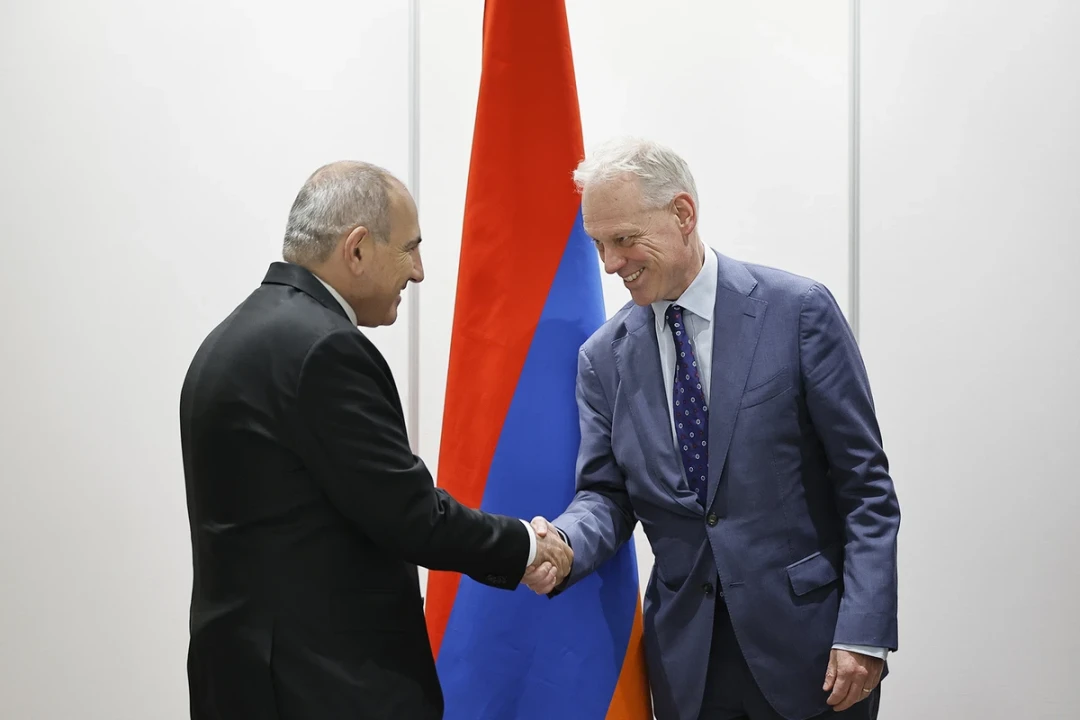
Armenia is committed to pursuing a European future, Gert Jan Koopman, the European Commission's Director-General for Enlargement and the Eastern Neighbourhood, told CivilNet on Friday.
“Armenia has clearly embarked on a European path. It's still early days, but [Yerevan] is clearly determined and we're working very closely with the government to facilitate that. We have a task force with [Armenia's] deputy prime minister, and things have moved pretty [...] quickly after some difficulties,” Koopman said in a comment to CivilNet.
The official met with Prime Minister Nikol Pashinyan in Yerevan last week and again in Brussels on Tuesday to discuss EU–Armenia relations and Armenia's exports to the bloc, according to readouts from the prime minister's office.
“I had the pleasure of meeting [with] the prime minister earlier this week. [...] The country really is reorienting quickly. It is ultimately, of course, for the country itself to [decide whether to] submit a membership application,” Koopman told CivilNet.
He also rejected the suggestion that Armenia's progress towards European integration was linked to Georgia's own EU accession prospects.
“The answer is no,” he said.
His remarks contrast with comments Pashinyan made earlier this week. In an interview with the Euronews publication on Tuesday, the prime minister was asked to identify one key commitment related to EU accession. He replied: “To support Georgia. For Armenia, Georgia’s success is extremely important.”
Speaking before the European Parliament in March, Pashinyan said the breakdown of political dialogue between Georgia and the European Union posed a serious challenge to Armenia's European integration.
Georgia was granted EU candidate status in 2023, but Tbilisi’s relations with the bloc have deteriorated sharply since then. Brussels has repeatedly criticized Georgia’s government, which was reelected in 2024, over democratic backsliding. The government has faced widespread criticism for its crackdown on protesters and its increasingly pro-Russian political course.
Armenia adopted a non-binding law last year, known as the EU Integration Act, which declared Yerevan’s aspiration to become a member within an unspecified timeframe.
The EU Enlargement Commissioner Marta Kos said last year that “for any country to apply for membership in the European Union, there are two conditions: it must be a sovereign state and be in Europe.” In a separate interview, she added: “Armenia is European.”
The European Union, created in its current form in 1993, last admitted a new member in 2013, when Croatia joined.
Speaking with CivilNet last September, Kos explained that for about a decade after Croatia’s accession, the EU had been reluctant to admit new members, but that the situation has now changed.
“Twenty-three of the 27 EU members are supportive of enlargement. [...] The [potential] expansion is not about gaining more square kilometers or more people, but about ensuring peace, freedom, and prosperity,” she said.
Also read: EU commissioner: ‘Helping Armenia on its European path is our responsibility’
The path to full EU membership from a formal application takes nine years on average, but can take as long as 14 years, as was the case with Malta and Cyprus.
Current candidates for membership include Armenia’s northern neighbor Georgia, Moldova and Ukraine, as well as Albania and the former Yugoslav countries that have yet to join the bloc. Montenegro is considered the closest to becoming a full member.
To join the European Union, a country needs to satisfy extensive requirements known as the Copenhagen criteria. These include, among other things, stable democratic institutions, the rule of law, human rights, respect for and protection of minorities, and a functioning market economy. These adjustments are made by candidate countries through negotiations with Brussels.

 Stories