 Civilnet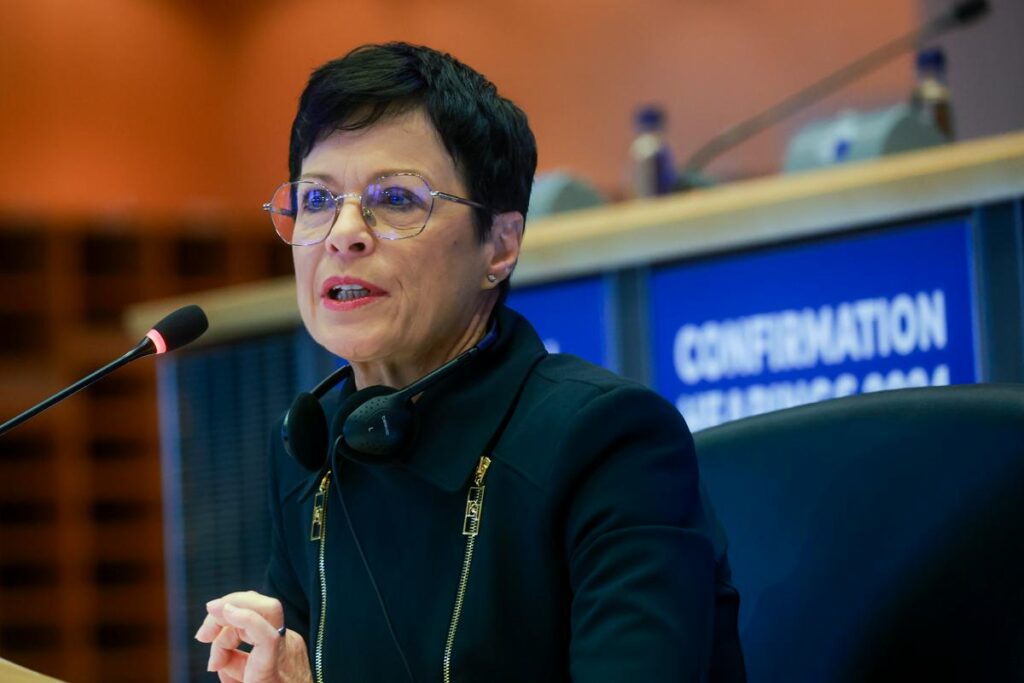
By Alexander Pracht
Marta Kos, the European Union’s Enlargement Commissioner, arrived in Armenia on Friday. In Yerevan, she met with Prime Minister Nikol Pashinyan and members of the government, including Interior Minister Arpine Sargsyan, who leads talks on visa liberalization with the EU.
On Saturday, at a joint interview attended by CivilNet, Kos spoke about Armenia’s path toward EU membership, the commitments between Yerevan and Brussels, the EU monitoring mission on the border with Azerbaijan, and assistance for refugees from Karabakh.
Kos highlighted the agreement reached last month at the White House, where Armenian Prime Minister Nikol Pashinyan and Azerbaijani President Ilham Aliyev signed a peace declaration and pledged to unblock regional communications.
“What we are now seeing is a historic moment. Wise people in your government made it possible, as well as the people of Armenia who recognized that it is very important to go on [with peace],” she said.
Kos compared the potential rapprochement between Armenia and Azerbaijan to how European countries, once wartime adversaries, chose to cooperate after World War II, eventually building the foundations of the European Union.
She stressed that peace in the South Caucasus is vital for linking Europe with Central Asia, a priority for Brussels.
“No nation can choose where to be located, but it is possible to choose how you use your geographical position,” she added, noting that in talks with Baku, Yerevan, and Ankara, the EU has proposed setting up a joint working group to explore connectivity improvements.
Kos underlined that the EU is open to welcoming new members, including Armenia.
“Twenty-three of the 27 EU members are supportive of enlargement,” she said, citing a recent opinion poll showing that 56% of people across EU countries would not object to new members, an increase of 20% compared to 2015. She recalled that in the previous decade, Brussels had deliberately “put enlargement on the ice,” but said the climate has now changed.
“External destructive forces are trying to stop [these developments] but we will not let it happen,” Kos said, stressing that EU expansion is not about gaining “more square kilometers or more people,” but about “ensuring peace, freedom, and prosperity.” She added that the EU and Armenia are now closer to each other than ever before.
“It is now our responsibility to help you, get you prepared for this rigorous and long process [implementing] everything that is needed to be done on your European way,” Kos said.
Kos also addressed concerns that Georgia’s sidelining from EU accession due to its government’s democratic backsliding might affect Armenia’s chances.
“Every country has its own development on the European path, and it is merit-based,” she said, noting that developments in Georgia cannot directly impact Armenia’s prospects as long as Yerevan maintains momentum in reforms and continues to pursue its European aspirations.
While acknowledging that full membership remains a distant goal, she stressed that the process of introducing reforms to align with EU standards is beneficial in itself, helping countries advance and see results long before membership is achieved.
Answering CivilNet’s question on whether it is easier for smaller countries like Armenia to implement the necessary reforms compared to larger, less flexible nations, Kos said that being part of the European family gives smaller countries significant advantages, making it easier for them to assert their rights in negotiations with major players such as the United States.
“Sometimes it’s easier for smaller countries,” she added, noting that reforms require strong leadership and broad societal inclusion, which always plays a bigger role.
Kos also spoke about the EU monitoring mission, which was deployed to Armenia’s border with Azerbaijan in February 2023 at Yerevan’s request to observe ceasefire violations. She stressed that the mission is strictly civilian and unarmed, emphasizing that its presence is based on bilateral agreements between Yerevan and Brussels, addressing Baku’s discontent with the mission and its calls for its removal.
She also reflected on her trip to Azerbaijan earlier this week, including her visit to Aghdam in Karabakh. Kos acknowledged that she did not raise the issue of the return of Armenian refugees with Azerbaijani officials. However, she noted that she discussed the situation of Karabakh Armenians with the Armenian government, highlighting that the European Bank for Reconstruction and Development (EBRD) and the European Union are expanding support for refugee-founded businesses in Armenia while also strengthening the country’s overall economic resilience.
Earlier on Friday, Kos announced an additional EU tranche of more than $230 million aimed at supporting business sustainability, transport, and digitization in Armenia. She also noted that since 2021, the EU has already mobilized almost $3 billion in investments for Armenia.
Addressing threats from Russia over Armenia’s EU aspirations and the country’s energy and trade dependence on Moscow, Kos said, “Every country can choose its own destiny and its own way. Armenia has done a lot [for its prosperity], especially the recent peace agreement with Azerbaijan.”
She highlighted a stark contrast between what she described as the Russian approach and the European approach: “We want to see your economy strong, we want to see your society strong, we want Armenia to have strong and resilient institutions, capable of protecting democracy, as well as free media. In contrast, Russia does not want [its partner] countries to be economically strong or democratic, or independent, because it makes it impossible to control them.”
Asked to deliver a short message to the Armenian people to conclude the press conference, Kos said: “Trust yourself, work on peace, work on regional connectivity, and take care of your people.”



 Stories