By Olivia Mouradian
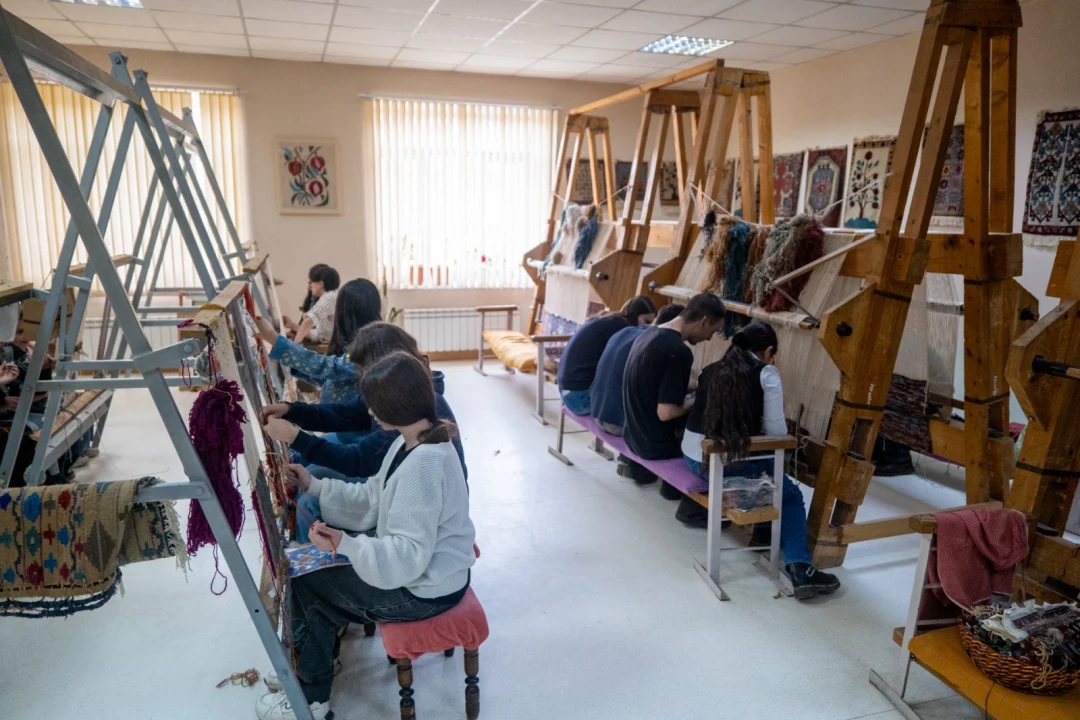
Upon entering Narine Martirosyan’s classroom at Gyumri’s Endanik Center, one can see two rows of looms: some with several nearly completed small rugs, and others with larger rugs that show only the first traces of their designs. The benches in front of the looms are low to the ground, filled with students weaving strands of yarn through delicate networks of string. The walls are lined with completed rugs, each with a different design.
A nurse by trade, Martirosyan initially saw rug weaving as a hobby. Gradually, realizing how much she enjoyed weaving, she turned this practice into her profession. The skill came naturally to her, and she eventually expanded her practice to include carpet and leather techniques She has been working with rugs for 20 years and leads weaving classes for children at Gyumri’s Endanik Center.
While weaving is often passed down generationally, Martirosyan came to master it on her own. She has passed it down to her two sons, and their children also know how to weave. Beyond her own family, she welcomes any student who is interested in weaving to her classes.
“The techniques I teach are Armenian. The ties I teach are Armenian. The looms I use are Armenian,” says Martirosyan. Although she exclusively works within the Armenian rug tradition, she fuses new and old aspects of the practice with her students. For example, students may weave a vishapagorg, a rug with a dragon design on it that dates back to medieval times, on a modern loom. She also gives her students the liberty to choose their own designs.
In her classes, Martirosyan teaches patterns from different regions—each with its own traditional designs. But she says she has observed a recent shift where patterns from different Armenian regions (Syunik, Lori) are being brought under the umbrella of the general Armenian rug. Beyond the natural evolution of traditions over time, in some cases, this has been a forced change. For example, now that Nagorno-Karabakh is under Azerbaijani control, the patterns unique to Artsakh are often being woven in Yerevan. These changes have contributed to what Martirosyan sees as an increasingly common practice of weaving rugs from different regions in the same place.
In the Soviet era, as individual enterprise was discouraged, large carpet factories were established to meet industrial demand. Many of these factories have since closed. During this period, the Soviet Armenian government prioritized commercialized rug and carpet production over the practice of traditional weaving, which was sustained in some households but lost in many. In the decades since the fall of the Soviet Union, there have been efforts to revitalize and preserve traditional methods of weaving.
Martirosyan hopes that weaving will gain more popularity and take up a wider space in the Armenian marketplace so that more people see there is a future in this profession. Even when children are interested in learning, she has observed that many parents do not allow their children to take classes because they cannot see how this skill could contribute to a professional career. She hopes to see factories reopen and more educational opportunities provided. Currently, only a few cultural schools offer weaving classes.
In reflecting on the role of rug weaving within Armenian communities over time, Martirosyan emphasizes the longevity and artistic breadth of this practice. With a generous array of symbols, Armenian rugs hold diverse themes. Even with the same symbol, it can represent different meanings in different contexts. Martirosyan details how a pomegranate can signal fertility, life and eternity, prosperity, and/or protection. Conversely, the same meaning can come in different symbols. Martirosyan highlights that, in addition to the pomegranate, ram’s horns and the tree of life also represent fertility. She mentioned that, in ancient times, rugs featuring rams’ horns were made for new couples to sleep on.
For Martirosyan, Armenian identity, language, and letters are immortalized in the rugs and carpets Armenians weave. “When someone passes away and is no longer with us, their work remains,” Martirosyan says. For this reason, she stated she is not afraid of dying, but of dying without creating enough. Her work at the Endanik Center is one part of the legacy she hopes to leave behind.


 Stories