 Alexander Pracht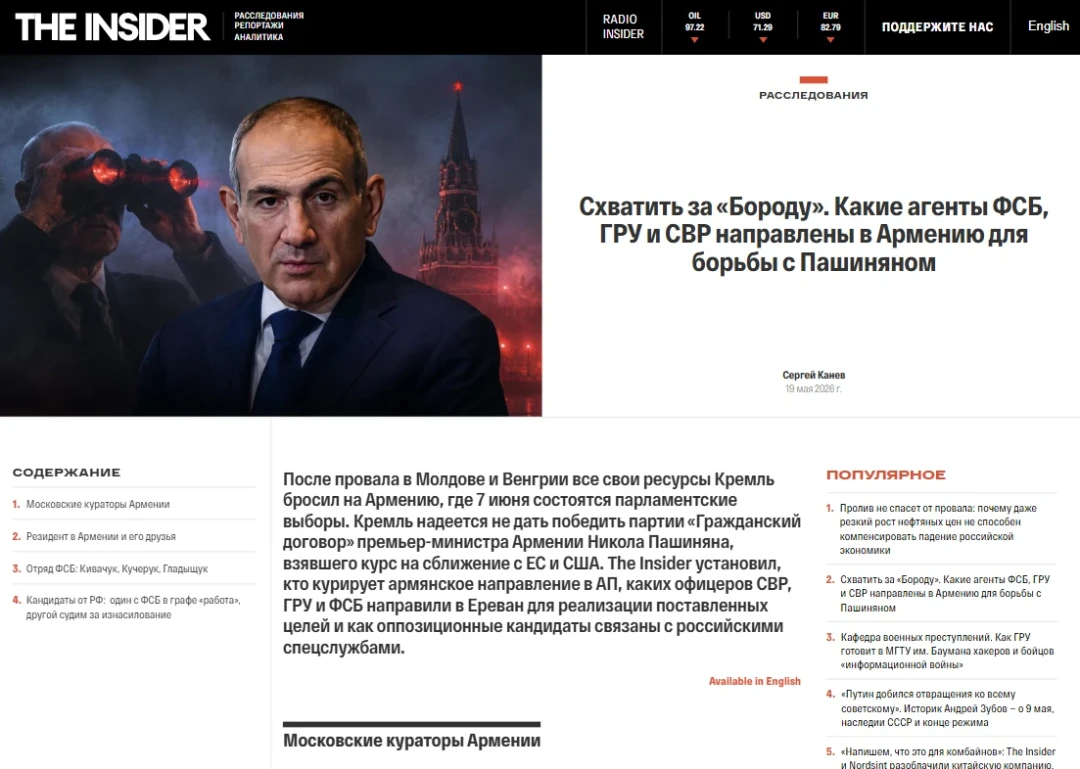
An extensive report by the exiled Russian investigative outlet The Insider, published on Tuesday, revealed what the journalists believe to be Russia's intelligence network in Armenia.
The report suggested that the group conducts surveillance on Prime Minister Nikol Pashinyan and is tasked with influencing the outcome of the country's parliamentary election, scheduled for June 7.
The network is described as a joint effort of the Russian foreign intelligence service, known by its Russian acronym SVR, and the Russian presidential administration, overseen by veteran policymaker and former prime minister Sergey Kiriyenko. Senior officers assigned by Moscow to the “Armenian effort” include figures with backgrounds in the Federal Security Service (FSB) and the military, whose names and career paths were revealed in the report.
It also identified a branch of Moscow’s Armenian influence network through the Russian foreign ministry, naming senior diplomat Mikhail Kalugin as a key figure. Kalugin previously worked at Russia's embassy in Lithuania and was expelled by that country on suspicion of espionage, and was later linked to the 2016 scandal related to Russia's interference in the U.S. presidential election while serving in Washington.
Also read: Moscow slams EU engagement with Armenia, says it has ‘a lot to offer’ instead
The leading figure on the ground in Armenia was named as Alexey Myshliavkin, formally listed by the Russian embassy as a trade representative but described as a senior intelligence operative.
“Through his extensive agent network, Myshliavkin knows about every step of Armenian Prime Minister Nikol Pashinyan,” the report said. It also suggested the network attempted to recruit Kristine Grigoryan, the head of Armenia’s foreign intelligence service established in 2023.
“We invited her for an internship in Moscow at the SVR, but she decided to engage with the CIA instead, and after that the Americans helped her create Armenia's own foreign intelligence bureau,” a source in the Russian secret services told The Insider, adding that attempts to find compromising material on Grigoryan were unsuccessful.
Another major revelation concerns Samvel Karapetyan, a Russian-Armenian billionaire behind the Strong Armenia party, which leads public opinion polls as the most popular opposition force ahead of the June 7 election, trailing behind the ruling Civil Contract party.
Karapetyan owns the Tashir business empire, which has close ties with the Russian energy giant Gazprom, and, as earlier investigative reports suggested, may have a direct personal connection to Russian President Vladimir Putin. He was arrested in Armenia last June on charges of making public calls for a violent regime change and money laundering, after siding with the Armenian Church in its conflict with Pashinyan.
Born in Soviet Armenia, Karapetyan has been a Russian citizen for decades.
“Samvel was never interested in politics; his thing has always been building connections with the authorities and law enforcement agencies to support his businesses. Apparently, he was pressured by the Kremlin into setting up an opposition movement to challenge Pashinyan,” a source in Karapetyan's entourage told the publication.
Using leaked databases, The Insider said it found Karapetyan's file at Russia’s migration authorities, created in 1999 when he applied for a Russian passport. The file included an employment reference to the “FSB information center,” a tag indicating that authorities should verify information on the applicant with the security services. An immigration officer told the publication that this tag is typically used for individuals working for the FSB or acting as its informants.
After the report was published, Karapetyan rejected the accusations of working for the Russian secret services.
“Nikol Pashinyan is behind the report,” he told reporters on Tuesday, while also accusing Pashinyan of being an FSB operative.
Pashinyan also commented on the report the same day.
“We highly respect our international partners, but sending agents here to engage in political activities and build agent networks is not the spirit of partnership,” Pashinyan said.

 Stories