By Gevorg Tosunyan
Following Prime Minister Nikol Pashinyan’s call to block the participation of certain opposition forces in Armenia’s June 7 parliamentary election in a televised debate on June 4, the Republic Party has formally asked the Central Electoral Commission (CEC) today to revoke the registration of the Strong Armenia alliance. However, Armenia’s Electoral Code sets strict legal grounds and procedures for removing a party or alliance from the ballot, making such an outcome difficult without clear evidence or a court ruling.
According to the Electoral Code, only a political party or alliance participating in the election has the right to request the cancellation of a rival’s registration. The Republic Party, therefore, has the legal standing to submit such an application.
The request must be filed with the election commission that registered the party list — in parliamentary elections, the CEC — no later than two days before voting, by 6 p.m. The commission must then consider the application within five days, but no later than noon on the day before the election.
Also read: Aram Sargsyan to seek ban on Karapetyan alliance ahead of vote
When the CEC can act on its own
The Electoral Code distinguishes between cases in which the CEC can independently invalidate a party’s registration and those that require a court decision.
The CEC may revoke a party or alliance’s registration if evidence emerges after registration that documents submitted by the political force were falsified.
The commission may also cancel registration on objective legal grounds, including if a party withdraws from the election, is dissolved, has its activities suspended or banned, or if an electoral alliance ceases to meet the minimum legal requirements, such as having fewer than two member parties.
When a court ruling is required
If a party argues that a rival should be removed from the ballot because of campaign or campaign-finance violations, the CEC cannot make that decision on its own.
In such cases, the commission must apply to a court, and registration can be revoked only through a judicial ruling.
The court would need to determine that the political force in question — in this case, Strong Armenia — committed a serious violation of campaign rules.
Under Armenian law, a violation is considered serious if it is ongoing, if its consequences cannot be remedied, and if it could have a substantial impact on the election result. A court must also conclude that the violation was committed or directed by the candidate or political force itself.
Another possible ground for deregistration is excessive campaign spending. A court may revoke a party’s registration if the difference between permitted campaign expenditures and the amount of fines imposed exceeds 20 percent of the maximum size of the party’s election fund.
As a result, political statements or accusations by rival parties alone are not sufficient to remove a candidate's name from the ballot. Armenian law requires either clearly established legal facts or violations confirmed through judicial proceedings.
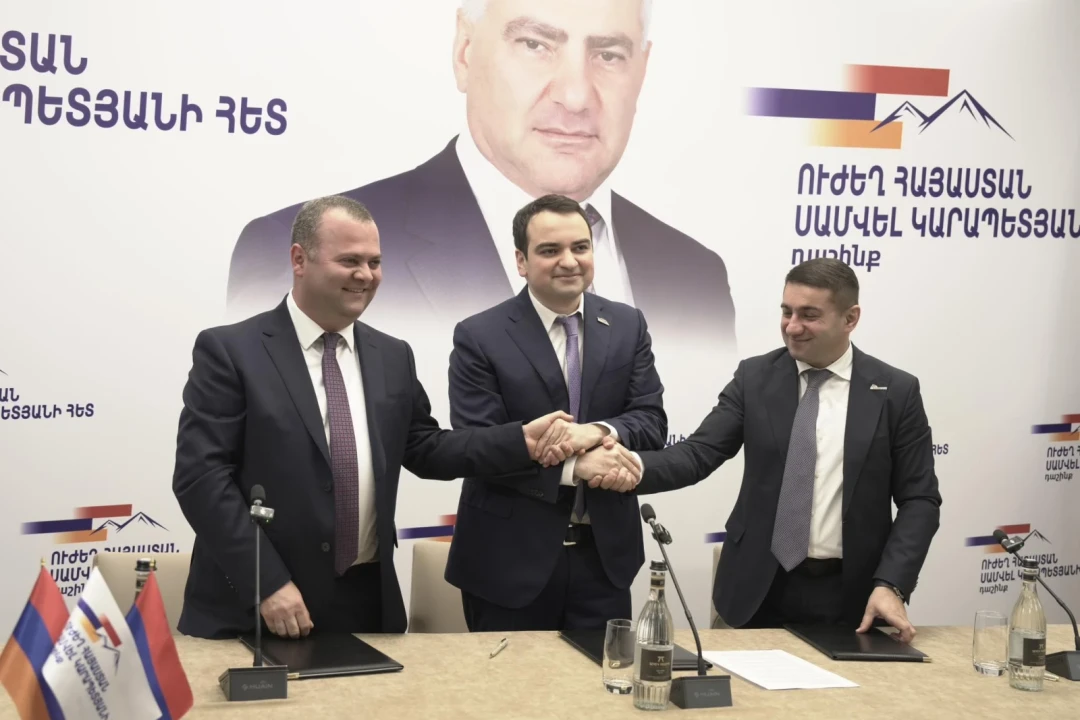
The issue gained prominence after Republic Party leader Aram Sargsyan announced that he would ask the CEC to bar the participation of the Strong Armenia alliance and the Armenia alliance led by former President Robert Kocharyan. Sargsyan said the move followed Pashinyan’s repeated campaign claims that the election features what he has described as a “three-headed monster” consisting of Kocharyan’s alliance, the Strong Armenia bloc backed by businessman Samvel Karapetyan, and former President Serzh Sargsyan’s Republican Party.




 Stories