By Nicholas Castillo
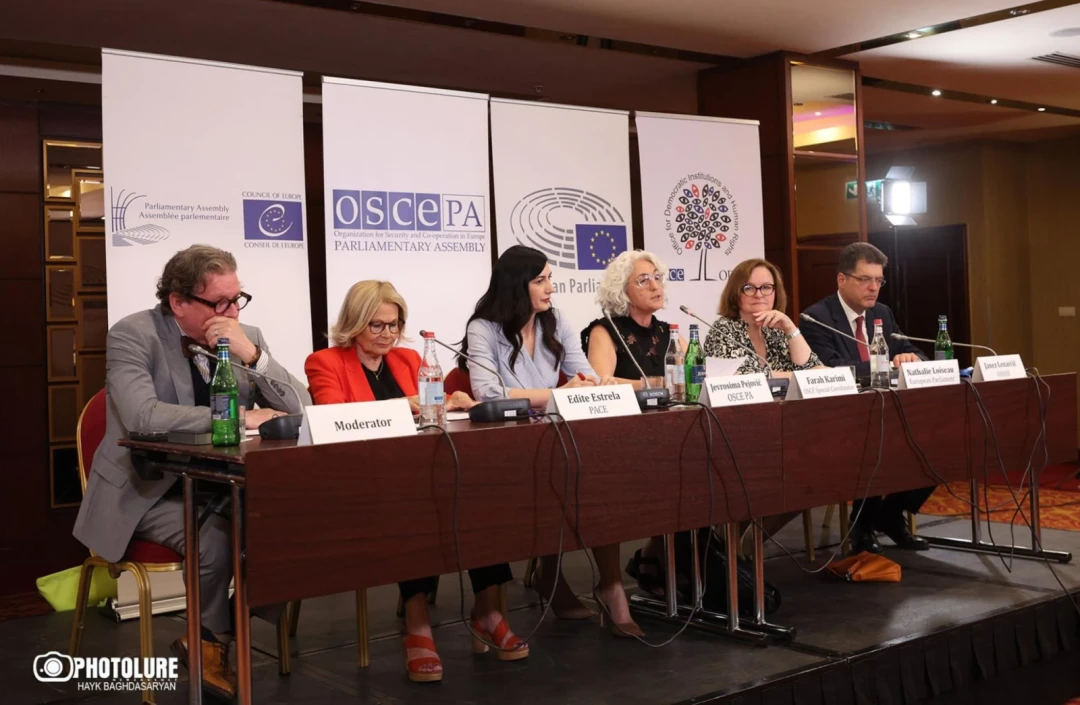
The day following Armenia’s national parliamentary elections, the OSCE Office for Democratic Institutions and Human Rights released its preliminary report on the conduct of the vote. In the 23-page document, the OSCE monitors report a mixed view of the electoral period, although they underscore that election day itself was conducted in an orderly manner and offered voters a variety of choices.
The OSCE report opens by stating that the “parliamentary elections offered voters a genuine choice among political alternatives in a well-run process.” The report goes on to compliment electoral authorities on their conduct of the elections themselves, writing that “election day proceedings were assessed overwhelmingly positively in the vast majority of polling stations observed.”
The authors describe procedures on June 7 as largely “orderly and calm.”
The report also writes positively of Armenia's electoral administration, describing it as “professional and efficient” and noting it enjoys the confidence of most stakeholders across the political spectrum. The document does raise concerns, however, surrounding appointments to the Central Electoral Commission and risks to political independence.
The OSCE is more critical of the broader campaign period and actions by both domestic and foreign actors.
“The campaign was highly confrontational with divisive rhetoric and marked by allegations of vote-buying and other electoral violations that led to numerous criminal proceedings of opposition candidates and activists, resulting in many opposition supporters refraining from actively engaging in the campaign,” the report outlines in its first paragraph.
Cases against opposition members alleging vote-buying or other electoral violations “led to the perception of selective law enforcement and concerns about the impact on campaign opportunities.”
A likely reference to Prime Minister Nikol Pashinyan’s repeated public heated arguments and controversial interactions with constituents, the document alleges a “repeated use of inflammatory rhetoric, including by the ruling party lead candidate.” The document also notes the numerous instances of Pashinyan’s pledge to use legal power against opposition forces.
Additionally, the OSCE raises concerns around Armenia’s broader democratic environment, including the use of pre-trial detention by the government. The report also notes “tensions” between Yerevan and the Armenian Apostolic Church and the head of the Strong Armenia party, Russian-Armenian billionaire Samvel Karapetyan.
As for the opposition parties, the OSCE criticises their use of unsubstantiated claims against the government, including that the governing party plans to resettle hundreds of thousands of Azerbaijanis in Armenia. The document also includes references to the accusations of vote-buying and “economic pressure” by opposition actors.
The OSCE also critiques a lack of regulations surrounding party spending before the official launch of the campaign period. Moreover, the report argues, “gaps in the regulatory framework and its implementation remain, compromising transparency, accountability and integrity of party and campaign finance.”
Turning to the international attention the election received, the report states that “direct pressure from the Russian Federation in the form of escalating trade restrictions and threats to the future economic stability of the nation linked to the outcome of the elections featured throughout the campaign.”
“At the same time,” the document continues, “some prominent EU and US leaders publicly endorsed the Prime Minister, which was viewed by most opposition parties met by [the OSCE mission] as external involvement favouring the ruling party.”
A separate preliminary report, the International Republic Institute (IRI) broadly gave the elections a positive assessment.
“The mission observed voting and counting processes that were generally calm and orderly, conducted in accordance with established procedures, and supported by a significant presence of party and citizen observers, contributing to civic oversight of the voting process,” the IRI statement reported.
“No systemic irregularities were observed; the overall conduct of voting and counting of ballots was assessed as credible based on direct observation.”
Like the OSCE however, the IRI does raise issues such as polarization, a need for campaign finance clarity, and international influence operations.
Armenia’s parliamentary elections concluded on Sunday with a victory for the governing team, albeit one that will reduce their share of seats in the National Assembly. Aside from Pashinyan’s Civil Contract, two opposition parties, Strong Armenia and Armenia Alliance, passed the electoral threshold and will receive parliamentary seats. While Armenia Alliance has made its pro-Russian stances explicit, Strong Armenia has been accused of direct coordination with Moscow. Its party head, Samvel Karapetyan, continues to be under house arrest following anti-government comments.
Pashinyan has pledged to continue to target opposition forces, labeling them as “representatives of the criminal-oligarchic system.”

 Stories