By Zhanna Avagyan
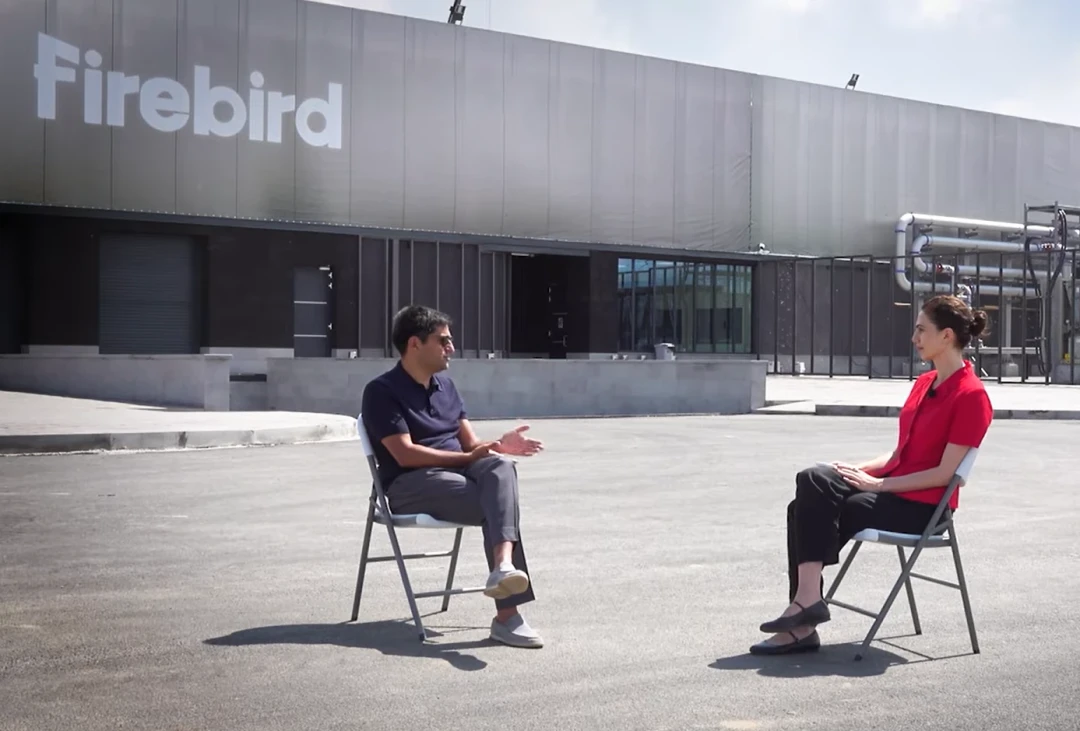
Firebird’s new artificial intelligence factory in Hrazdan is primarily an export-oriented operation, with 95-97 percent of its customers based outside Armenia, company co-founder Alexander Yesayan told CivilNet during an interview at the facility.
The Armenian-American company launched the data center earlier this month, completing the first phase of a project that has attracted about $500 mn in investment.
The facility uses computing technology from U.S. companies Nvidia and Dell and is intended primarily to serve international customers. Firebird has billed the project as the largest AI facility in the former Soviet region and one of the largest foreign investments in Armenia’s modern history.
Yesayan said the roughly $500 mn invested in the first phase combines equity and debt financing. He said the equity came mainly from U.S.-based investors, including Armenian-Americans, while debt financing was raised locally, including from Armenian banks. He said the project’s equity was entirely foreign, while financing from Armenian banks and pension funds was provided as debt.
“If we are talking about equity, it is entirely foreign investment,” Yesayan said.
The Armenian government has also supported the project, including through customs-duty exemptions for eligible imported equipment, measures to expedite permitting and a $25 mn agreement to purchase high-performance computing resources from Firebird over five years.
Yesayan said obtaining Nvidia’s advanced processors required U.S. export licenses and extensive work with American authorities. Nvidia provided significant support during the process, he said.
He linked the approval partly to Armenia’s efforts in recent years to build ties with Nvidia and its founder and CEO Jensen Huang. According to Yesayan, Firebird initially had to explain to U.S. officials why the company wanted to locate advanced AI computing infrastructure in Armenia.
The first phase is designed to operate 6,144 Nvidia B200 GPUs and currently requires around 18 megawatts of electricity, according to Yesayan.
Demand for the computing capacity has been strong. Yesayan said almost all of the first phase has already been sold, with foreign companies accounting for around 95-97 percent of customers. Most are from the United States and Europe. “We are exporting services,” he said.
Firebird plans to reserve part of its computing capacity for Firebird Labs, an initiative intended to give Armenian startups and universities access to high-performance computing resources.
The company is already preparing the second phase of the Hrazdan project. Yesayan said construction work had begun and Firebird aimed to have the next stage operational around the same period next year.
Firebird had previously announced plans to invest around $4 bn in Armenia, but Yesayan said the eventual figure could be higher.
“I think we will invest more than $4 billion,” he said.
The company plans to expand the Hrazdan facility in stages, ultimately reaching around 400 megawatts of capacity, Yesayan said.
Firebird is also expanding beyond Armenia. Yesayan said the company is starting construction of a similar AI factory in Kazakhstan as part of its expansion in the region.
Yesayan said Armenia was Firebird’s first major AI infrastructure hub, with the company seeking to develop similar projects in other markets.
“We are building the same thing in Kazakhstan,” Yesayan said, adding that Firebird was looking at other countries as potential locations for future facilities.
Yesayan dismisses environmental concerns
The rapid development of the Hrazdan project has also raised questions about its environmental footprint and the level of regulatory scrutiny applied to the facility.
In a December 2025 article, Armenian news outlet Epress.am reported that Firebird had not submitted an environmental impact assessment for the project. Armenia’s Environment Ministry told the outlet at the time that the company had not filed environmental impact assessment documents.
The outlet also reported that the Water Committee did not know where the facility would obtain water, whether water would circulate through a closed system or whether there would be discharges. Epress.am raised additional questions about future electricity consumption, noise, electronic waste and the absence of public hearings in Hrazdan.
The report said Armenia’s environmental impact assessment legislation, adopted in 2014, does not specifically list AI data centers among the types of facilities subject to assessment. It argued that this regulatory gap allowed the project to proceed without the environmental and social assessment procedures applied to a range of other large projects.
Yesayan rejected concerns about water consumption, saying the Hrazdan facility does not use water for cooling.
“We don’t use water at all,” he said, adding that the cooling system instead relies on electricity. Hrazdan’s relatively cool climate was among the reasons the company selected the location, he said.
Yesayan also said the first phase’s electricity requirement of around 18 megawatts would not significantly burden Armenia’s power system. Electricity demand, however, would increase substantially if Firebird proceeds with its planned expansion to hundreds of megawatts of capacity.





 Stories