By Paul Van der Stegen (text and photos)
On the eastern bank of the Beirut River, two kilometers from the port, a neighborhood founded by survivors of the Armenian genocide became one of the Middle East’s great centers of goldsmithing. Six years after the August 4 explosion, and just months after another war, its goldsmiths are holding on, closing up shop or leaving.
A little after six in the evening on August 4, 2020, Levon calls his father in a panic. “Dad, there’s been an explosion. They bombed near the house.” Kevork, in his workshop, tells him Bourj Hammoud has been hit too. Memories of the war come rushing back; stomachs tighten. Beirut’s first thought that day was that Israel had attacked. But the blast had not come from the sky. It had come from the port. In Bourj Hammoud, people did not merely hear it: the shockwave crossed the river as if it were crossing a street.
What people here talk about first are the windows. Glass falling all at once, everywhere at the same time: in apartments packed behind narrow façades, in workshops on the upper floors, across the benches where gold is worked down to a tenth of a gram. In a neighborhood that lives behind shop windows, the explosion was, first and foremost, an immense sound of breaking glass.
The windows were replaced fairly quickly. What took hold in the months that followed was never repaired. Kevork, who spent his life in the neighborhood and now lives in Armenia, puts it plainly: “The port explosion, on August 4, 2020, was the first time I seriously considered leaving Lebanon for good.” He did not leave straight away. But eventually he did, taking his goldsmith’s craft with him.
In the shops, that date still serves as a kind of year zero. Lisa, who runs a small store selling accessories and handmade jewelry, does not say “since the crisis.” She says “since the port explosion.” As if the currency, the banks, the tourists and the rents had all tipped over on the same evening, in the same deafening crash.
The 2026 war
In March 2026, war returned. From Bourj Hammoud, on the other side of the city, the strikes could be heard. Not constantly — “sometimes,” Arpi Mangassarian clarifies. For years, she was in charge of urban planning at the municipality; today she runs Badguèr, the Armenian house she founded in the neighborhood. Lisa could hear the explosions from her shop too. By mid-April, a ceasefire had come into effect; more than two thousand people had been killed in Lebanon and over a million displaced. It was extended, renewed, violated and renegotiated.

What remains is the sound in the sky. The drone is there almost all the time, above the rooftops, a flat, endless hum that people eventually stop commenting on. “I feel like we are being targeted all the time. The people, the population. We are under threat. And no one is protecting us,” Arpi says. An Israeli machine reminding you, day and night, that neither your rest nor your work really matters. The strikes on Beirut have, for now, stopped. The psychological war has not.
Something in her anger predates the current year. When the war forced residents of the South onto the roads, other images resurfaced. “We were refugees too. And that history is not so far away.” She thinks of the olive trees that could not be harvested that season, left standing alone in the strike zone, and of the oil that was never made. Here, the memory of exile is still a family memory, only one or two generations removed.
Bourj Hammoud was born out of exactly that.

The city of marshes and goldsmiths
A century ago, the eastern bank of the Beirut River was little more than a stretch of wild mulberry trees, vegetable gardens and marshland. It was already known as Bourj Hammoud. According to the account adopted by the municipality, the name comes from Emir Hammoud Arslan, a landowner who had built a two-story house with an attic on elevated ground. Amid the low-rise buildings around it, the house looked like a tower: Hammoud’s bourj.
In the 1920s, survivors of the Armenian genocide settled in tents in Karantina and Mar Mikhaël, just a few hundred meters away. By the end of the decade, forced to move on, they crossed the river. They built a city of streets, schools, churches and associations. They gave its neighborhoods the names of the cities they had lost — Marash, Sis, Adana — preceded by the word nor, meaning “new”. In 1952, Bourj Hammoud became a municipality in its own right: two and a half square kilometers, around 150,000 residents today, and a population that has since become far more mixed.

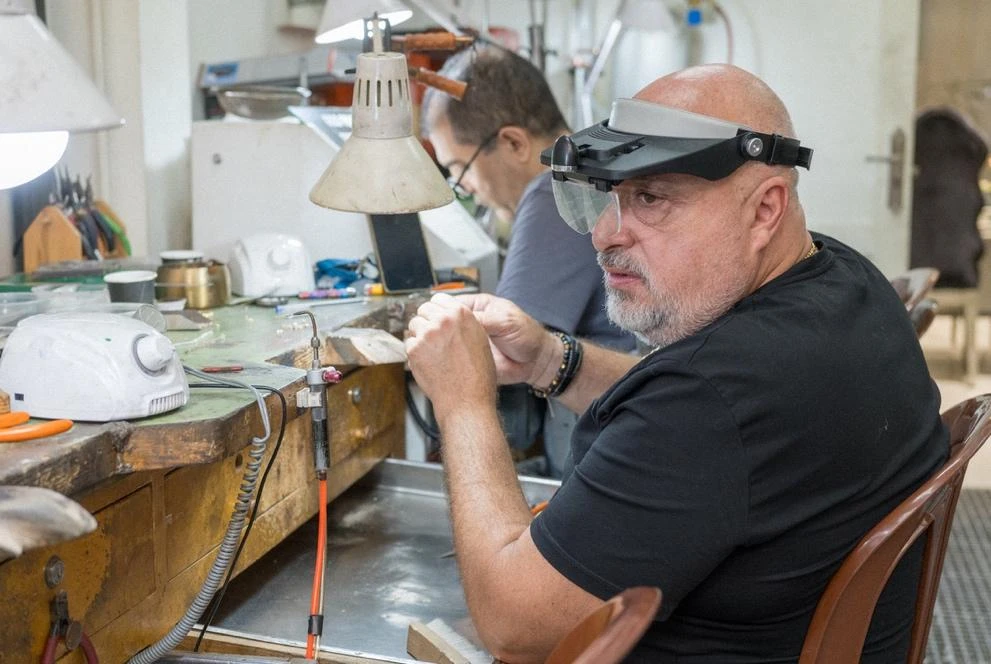
This was a city built by hand. Many of the survivors had lost everything; what they still had were their trades. Shoemakers, tailors, leatherworkers, mechanics and goldsmiths. Within two generations, Bourj Hammoud became the place where Lebanon came to buy its gold, and from where jewelry was shipped on to markets across the Gulf.
Kevork remembers how people entered the trade. The son of a tailor, he was expected to take over his father’s workshop, but the flood of imported clothing steadily eroded the family’s clientele. He went into business with a close friend, who taught him the craft, and his talent for drawing did the rest. “Bourj Hammoud is a place where everyone seems to have a talent for jewelry.” In his day, he says, 99 percent of the residents were Armenian. He drew on Armenian symbols, Lebanese motifs and Western trends, supplying shops in the South without ever concealing his identity: there, he says, it was celebrated.
Between workshops, competition was not quite the right word. “We were like one big family, with no jealousy. Everyone had their loyal customers. We helped each other when we needed to, and we shared ideas.”
“Did you open the till today?”
In the autumn of 2019, the Lebanese pound collapsed, banks froze deposits, and then the pandemic arrived. “People prioritized food and rent,” Kevork sums up. “A lot of people lost their jobs. Jewellery sales fell.” He used to visit the shops he supplied in the South several times a week; when the war began, those roads became dangerous, and demand disappeared with them.
In the shopping streets, the crisis eventually acquired its own form of small talk. Shopkeepers and jewelers no longer ask each other how business is going. They ask whether you opened the till today. Many no longer do. They cannot sell enough to make a living.
Lisa lived in France for twenty years. She came back fifteen years ago to care for her sick parents and stayed. Her shop is small and unpretentious; one of her three cats lets her know when someone walks in. She makes some of what she sells herself and is proud of it: she taught herself everything by watching videos online. There used to be customers from Iraq, Iran, Saudi Arabia and other Arab countries. Today, hardly any tourists are left. In two weeks, her landlord is raising the rent. She does not know whether she will be able to pay it. She does not think she will.

Rent has become one of the main forces driving workshops out of business. Deregulation has pushed some rents up to $1,000. “For the son, it is hard to support a family and pay that kind of rent,” Arpi says. “It has played a big role.”
Serge, meanwhile, has worked since the 1990s in a shopping center overlooking Armenia Street, where almost all the shops are Armenian-owned. He spends nine hours a day in the workshop. There used to be five or six; now there are three. Successive crises have thinned their ranks, and he says it without drama: they know crises come, and they do the best they can. He makes pieces that he sells to shops, which then sell them on to visitors. Everything depends largely on tourism, especially from the Gulf. If tourists come in numbers, business is good. If there is war, no one comes. A little further down the street, another Armenian family, established there since the 1990s, sells and repairs workshop machinery. Same story, same trajectory.

Then there is another constraint no one here can control: the price of gold, at a historic high of more than four thousand dollars an ounce. The cost of the raw material soared just as purchasing power collapsed. After Covid, walking past one shuttered storefront after another, Arpi thought it was over. “I thought that this time it was finished, that they would not manage to survive.”
And yet it is not that simple. Perhaps that is what is most striking in these streets: two stories coexist, told by people working fifty meters apart. In one shop, someone says they are closing because of the rent; in the workshop next door, someone else says business is fine.
Two truths on the same street. It is impossible to untangle what comes from the state of the market and what comes from the part each person plays in convincing themselves that things are going all right — because here, too, saying you are all right is one way of staying on your feet.
Fewer and fewer to take over
The question hanging over the workshops is who will carry the craft on. Kevork is not optimistic. “Our generation grew up during the war. We often missed out on university; we needed a trade, something we could do with our hands. The new generation goes to university, and there are more and more office jobs. The number of Armenian goldsmiths in the neighborhood will probably decline.” His son Levon, 23, studied at university in Armenia and now works in Yerevan for a large American company.
Some choose to carry on. Rafi, for instance, is a leatherworker. About fifteen years ago, as work dried up, his father began selling off his machines one by one. His son, a university graduate, had spent every summer of his teenage years in the workshop: leather had got into his blood. He came to his father and told him to stop selling. He was taking over the family business. His father stayed on to work beside him, but the son had become the master. “He’s an exception,” Arpi warns. “But stories like that do exist.”
Those who left, meanwhile, have not severed the thread. Kevork had to start all over again at an age when people aren't supposed to start over: finding workshops, earning the trust of clients who didn't know him, creating designs that would set him apart. There was the language too: the Western Armenian of Bourj Hammoud, laced with Arabic words, versus Eastern Armenian, full of Russian loanwords. And yet living in the homeland had always been his dream, as it was for many others. What he misses, he lists without ranking one above another: “My home, my community, my workshop, and everyday life, the routine I had.”
Arpi has never considered leaving. Her grandparents planted in her heart a love for a land they had lost, and because that love could no longer be lived out there, it took root in Bourj Hammoud instead. “In our souls, there is Armenia and there is Lebanon. They overlap. One completes the other. I can’t separate them.”
A thousand kilometers away, Kevork shows his favorite piece: a khachkar. Those Armenian stone crosses, covered in intricate carvings, stand on the high plateaus as a way of saying someone passed this way. He has turned one into a piece of jewelry. Something you can carry with you anywhere.

. . .
Paul Van der Stegen is a French documentary filmmaker based in Armenia. He reports on social issues and the South Caucasus. While studying at Sciences Po Bordeaux, he directed Han's Call, a documentary filmed in Seoul that explores mental health.


 Stories