 Tigran Grigoryan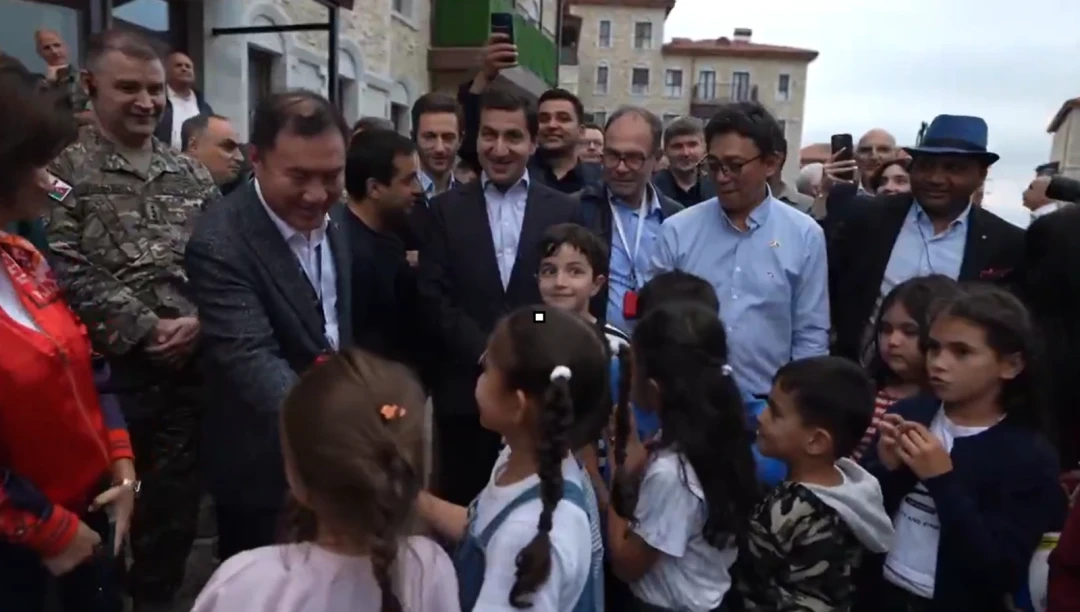
By Tigran Grigoryan
Stepanakert’s Renaissance Square, known simply as “the square” among locals, was the city’s most important public space. Here, the first mass demonstrations of the Karabakh Movement began. Originally named after Lenin, the square was renamed after the Nagorno-Karabakh Republic declared independence in 1991. During its years of independence, it became the republic's political heart, surrounded by the National Assembly, the presidential administration, and government buildings.
The square was not just the epicenter of political life in Nagorno-Karabakh, but also of its social life. With the first days of spring, the area surrounding the square would become a large pedestrian zone, with people from across the city coming out in the evenings to engage in their favorite pastime: walking. The route stretched from the round park informally known as Pyatachok, named after the Russian word for a five-kopeck coin, with its singing fountains, to a hopelessly Soviet-looking gray building that had housed the local political education center, known as Politprosvet, during the Soviet period. It was renamed the Youth Palace in the post-Soviet period, but remained known among locals simply as Polit.
Also read: Azerbaijan presents Armenian monasteries as Caucasian Albanian during diplomats’ Karabakh tour
Walking from Pyatachok to Polit and back was one of the city's most familiar rituals. It was how people socialized, exchanged gossip, discussed politics, and caught up on the latest developments while enjoying Stepanakert’s summer evenings. The ritual was so deeply embedded in the city’s life that it became part of its identity. The square and the surrounding streets also became an improvised playground for children. Their toy cars were virtually the only vehicles allowed there, as patrol police would stop traffic around the square during the evening walking hours.
In recent days, Armenian and Azerbaijani media have been dominated by another walk through Stepanakert’s square. Dozens of foreign diplomats, guided by Azerbaijani President Ilham Aliyev’s foreign policy aide, Hikmet Hajiyev, walked through the same square, which has undergone major changes since the ethnic cleansing of Nagorno-Karabakh in September 2023. Many of the buildings that defined the square for decades have been demolished by Azerbaijan as part of its post-conflict spatial control and reshaping of the city. Most importantly, the people who once lived there are no longer present, having been forced to leave their homes and lives behind.
The diplomats, some of whom I have met in person, were supposedly there to witness firsthand the reconstruction work carried out by Azerbaijan after its full takeover of the territory. However, what they were really brought there to do was add another layer of legitimization to the ethnic cleansing. And they did so with what appeared to be full enthusiasm, even enjoyment.
It was a genuinely grotesque spectacle. For decades, these countries and institutions had been heavily involved in mediating the Karabakh conflict. They had repeatedly insisted that there could be no military solution to the conflict and, before 2023, had loudly emphasized the importance of protecting the rights and security of Karabakh Armenians. Yet now, representatives of many of these same countries and institutions were visiting the so-called Victory Park in Stepanakert, a marble expression of Aliyev’s megalomania and a primary monument to the ethnic cleansing, built on the site of a freshly destroyed Armenian neighborhood in the historic part of the city.
It was equally troubling to see this group allow itself to be used as extras in Hajiyev’s primitive exercise in historical revisionism, with the pseudo-scientific Albanization theory being used at the Gandzasar and Dadivank monasteries to portray Armenian Christian heritage as Caucasian Albanian. By participating in this carefully staged exercise, the diplomats were not merely observing Azerbaijan’s falsification of history and its continued policy of erasing the traces of Armenian presence in Nagorno-Karabakh. They were lending their presence and credibility to it.
One might argue that it is difficult to have any expectations of foreign diplomats when the Armenian government itself has not only abstained from speaking out against the ethnic cleansing in Nagorno-Karabakh and the continued destruction of its cultural and religious monuments, but has also urged other actors to avoid these topics, claiming that focusing on them could endanger peace.
This line of thinking is partly valid. The Armenian government’s reluctance to speak about these issues has made it less controversial for international actors to visit Nagorno-Karabakh and participate in Baku’s propaganda tours.
However, this does not make such visits any less problematic. A number of reputable international institutions, including the European Parliament and Freedom House, have described what happened in Nagorno-Karabakh in 2023 as ethnic cleansing. And even in this post-liberal, transactional era, participating in propaganda tours that help legitimize the mass displacement of people from their homes should still be considered deplorable.
Visiting monuments that glorify war crimes and forced displacement, willingly or unwillingly, makes these diplomats part of an effort to sanitize the consequences of ethnic cleansing. This is especially problematic when they represent countries and institutions that claim to prioritize human rights, democracy, and the rules-based international order.
Having read this, participants in this propaganda tour, as well as many others, would probably argue that diplomacy is about hard choices, unpopular decisions, and the need to engage with malign actors in pursuit of larger goals. They might even go a step further and dismiss this piece as moralizing, non-pragmatic, and out of touch with the prevailing trends of this new “era of peace” in the region.
My response would be that, apart from being morally reprehensible, their involvement in all of this, and particularly the manner in which they participated, was simply bad diplomacy. Dancing and enjoying themselves in places that are likely just meters away from a destroyed Armenian cemetery, church, or neighborhood is not only a grave insult to the people who were displaced from Nagorno-Karabakh just three years ago, but also profoundly counterproductive to the stated goal of achieving lasting peace.
Exacerbating the trauma of tens of thousands of displaced people, reopening wounds across Armenian society, and contributing to the deepening of societal grievances is the last thing diplomats genuinely interested in achieving peace should be doing.
It is also a terrible look for the countries and institutions they represent. I cannot remember seeing such a strong backlash against the international actors involved in this exercise on Armenian social media for a long time. Whatever diplomatic benefits they may have hoped to gain, this episode has been an unmitigated failure even from the narrowest pragmatic perspective.
More importantly, it was an unconscionable mockery and form of emotional torture for tens of thousands of displaced people whose only way of remembering their towns and villages has become hours of scrolling through Google Earth, often only to discover that their homes have been demolished and the cemeteries where their parents and grandparents are buried have been turned into roads and sewage lines.


 Stories