 Karen Harutyunyan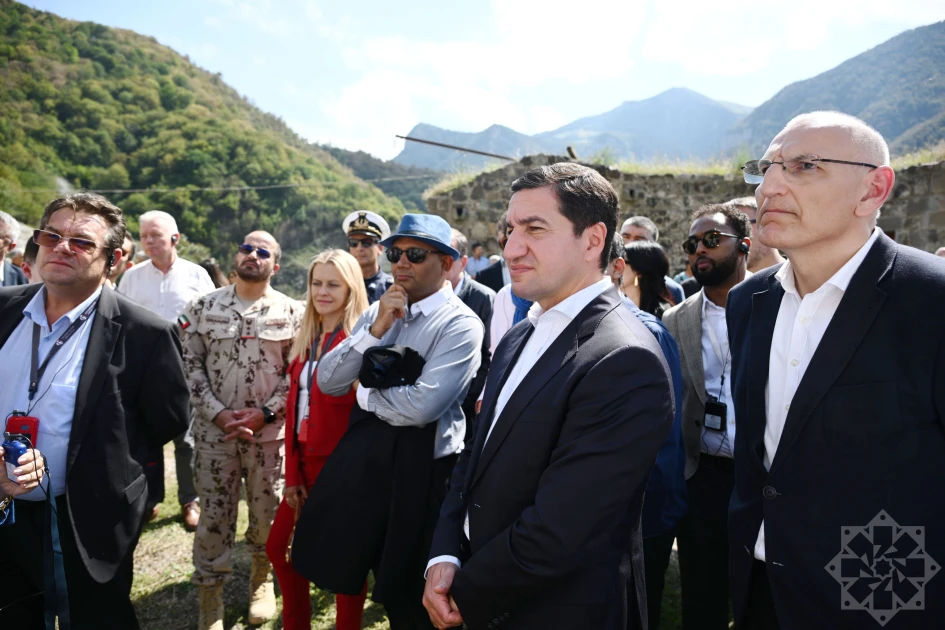
By Karen Harutyunyan
Azerbaijani officials presented two medieval Armenian monasteries in Nagorno-Karabakh as part of Caucasian Albanian heritage during a government-organized visit by foreign diplomats to the region, three years after its entire Armenian population was displaced.
The September 11-12 tour brought together 150 representatives from 58 countries and nine international organizations, according to Azerbaijan’s state news agency AZERTAC. The group visited Stepanakert, Shushi, Gandzasar Monastery and Dadivank (which Azerbaijan calls Khankendi, Shusha, Ganjasar and Khudavang, respectively).
The delegation included European Union Special Representative for the South Caucasus Magdalena Grono, who was visiting Azerbaijani-controlled Nagorno-Karabakh for the first time. France’s ambassador to Azerbaijan, Sophie Lagoutte, was also among the diplomats, according to photographs and Armenian media reports. Azerbaijani coverage separately identified diplomatic representatives from China, Moldova, Belarus and Iran. Azerbaijan did not publish a full list of participants.
The diplomats were accompanied by Hikmet Hajiyev, Azerbaijani President Ilham Aliyev’s foreign policy adviser.
“Together with the diplomatic corps, we visited the Ganjasar and Khudavang churches — an integral part of the ancient Albanian Christian heritage,” Hajiyev wrote on X.
He described Gandzasar’s founder, Hasan-Jalal Dawla, as a Caucasian Albanian ruler and said the monastery testified to the “centuries-old Christian heritage of Caucasian Albania.”
Hajiyev also accused Armenians of compromising the monuments’ “architectural authenticity and original character” through interventions carried out under the guise of restoration. He said Azerbaijan was committed to protecting and restoring all historical and religious monuments under its control.
Azerbaijan’s Culture Ministry gave the visiting diplomats a similar account. AZERTAC said officials described Gandzasar as a major religious center of the Albanian Catholicosate and accused Armenians of carrying out unauthorized alterations at the site between 1993 and 2023.
Armenian inscriptions omitted from Baku’s narrative
Gandzasar is a 13th-century Armenian Apostolic monastery in the historic Armenian principality of Khachen. Its Cathedral of St. John the Baptist was built between 1216 and 1238 by Prince Hasan-Jalal Dawla.
The complex contains extensive medieval Armenian inscriptions documenting its construction, patrons and religious affiliation. An inscription by Hasan-Jalal identifies him as the builder and records that the church was consecrated in 1240.
The Albanian Catholicosate cited by Azerbaijani officials was, by the medieval period, an ecclesiastical jurisdiction of the Armenian Apostolic Church, with Gandzasar later serving as its seat. The continued use of the Albanian title reflected the institution’s historical lineage. Gandzasar’s architecture, Armenian-language inscriptions and documentary record place the monastery within the medieval Armenian Christian tradition.
British journalist and Caucasus specialist Thomas de Waal addressed the contradiction in his book Black Garden: Armenia and Azerbaijan Through Peace and War. Recounting an Azerbaijani historian’s description of the monuments as Albanian, he asked:
“But how come all those hundreds of ‘Albanian’ inscriptions … in places like Gandzasar and Hurekavank were all written in medieval Armenian?”
De Waal also described a 1997 Azerbaijani pamphlet titled The Albanian Monuments of Karabakh. Its cover depicted Gandzasar’s facade, he wrote, but “the draftsman has carefully left out all the Armenian writing.”
Dadivank, the other monastery shown to the diplomats, also contains Armenian inscriptions and khachkars, or carved Armenian cross-stones. The complex’s surviving principal buildings date mainly from the 12th and 13th centuries and belonged to the Armenian Apostolic Church.
Baku’s attempt to relabel Armenian churches as Caucasian Albanian predates its takeover of Nagorno-Karabakh. Azerbaijani officials have repeatedly claimed that the region’s medieval Christian monuments have no Armenian connection, despite Armenian inscriptions visible on their walls.
Research by prominent scholars, including Robert H. Hewsen, Cyril Toumanoff, Vladimir Minorsky, Victor Shnirelman, Jost Gippert and Jasmine Dum-Tragut, distinguishes ancient Caucasian Albania from the later Armenian political and ecclesiastical institutions that retained the Albanian name, contradicting Azerbaijan’s attribution of Gandzasar to Caucasian Albanian culture.
Also read: Cultural Heritage at Risk in Nagorno-Karabakh
Armenian criticism, but no official response
Former Nagorno-Karabakh State Minister Artak Beglaryan accused Hajiyev of continuing what he called Azerbaijan’s “genocidal policy and ideology” against Armenians.
“Hajiyev continues his boss’s genocidal policy and ideology against the Armenian people, now falsifying even Armenian manuscripts and inscriptions in Artsakh,” Beglaryan wrote on X.
Historian Karpis Pashoyan also criticized the visit and the presentation of Armenian monuments through Azerbaijan’s state-sponsored Caucasian Albanian narrative. He said the diplomats who participated in the visit, including EU representative Magdalena Grono, “effectively legitimize the destruction of Armenian cultural heritage and the ethnic cleansing of Armenians through their silence.”
As of publication, Armenia’s Foreign Ministry, Culture Ministry and leading state academic institutions had not issued public statements addressing the diplomats’ visit or Hajiyev’s claims about the monasteries.
The absence of an institutional response drew particular attention because the delegation included Grono, the EU’s senior representative working on the Armenia-Azerbaijan peace process.
The visit took place almost three years after Azerbaijan’s September 2023 military offensive against Nagorno-Karabakh. More than 100,000 Armenians, virtually the region’s entire population, fled to Armenia within days. Nagorno-Karabakh has since remained closed to its displaced Armenian residents and independent international heritage specialists.
Destruction documented by satellite imagery
The visit came amid mounting evidence of the destruction and alteration of Armenian cultural sites under Azerbaijani control.
Caucasus Heritage Watch, a research initiative affiliated with Cornell and Purdue universities, monitors nearly 500 Armenian heritage sites in Nagorno-Karabakh using satellite imagery because independent researchers have no access to the region.
A June 2024 report found that the number of destroyed Armenian heritage sites had risen by 75 percent between fall 2023 and spring 2024, while the number classified as threatened increased by 29 percent. The losses accelerated after the displacement of the Armenian population.
Documented destruction includes Shushi’s Kanach Zham church and Ghazanchetsots cemetery, the cemetery at Mets Tagher and several smaller churches and sacred sites. The Armenian village of Karintak has been almost entirely razed.
In Stepanakert, Azerbaijan has demolished two Armenian churches. Satellite imagery showed that the Holy Mother of God Cathedral, the principal Armenian cathedral in Nagorno-Karabakh, was razed between March 3 and April 2, 2026. The cathedral, consecrated in 2019, had also served as a bomb shelter during the 2020 and 2023 hostilities. Azerbaijan had earlier demolished the nearby St. Jacob Church.
In May 2026, an Armenian-Russian cemetery in Shushi containing five medieval khachkars and dozens of 19th-century gravestones was destroyed to make way for a wastewater treatment facility, according to satellite evidence reviewed by Caucasus Heritage Watch.
Caucasus Heritage Watch’s latest broader assessment also lists Kanach Zham, the Ghazanchetsots cemetery and the Mets Tagher cemetery among sites completely destroyed since Azerbaijan regained control of the territories in 2020.
The evidence raises questions about Hajiyev’s invitation to foreign media to “see the reality on the ground.” Access to Nagorno-Karabakh remains controlled by the Azerbaijani government, and the visiting diplomats were taken through the region on an official itinerary accompanied by senior Azerbaijani officials.
Nakhichevan offers a warning
The fate of Armenian heritage in Azerbaijan’s Nakhichevan exclave offers a precedent for what could happen in Nagorno-Karabakh, according to researcher Simon Maghakyan. His research describes how the destruction followed the disappearance of Nakhichevan’s Armenian population and took place over several years, largely beyond the view of international observers. Caucasus Heritage Watch later determined through satellite imagery that Azerbaijan had destroyed 108 Armenian monasteries, churches and cemeteries between 1997 and 2011 — 98 percent of the Armenian cultural sites the project documented in the exclave.
Among the most prominent losses was the medieval Armenian cemetery at Julfa, once home to thousands of intricately carved khachkars. Azerbaijani forces methodically destroyed the cemetery in the 2000s, including by breaking up the cross-stones and dumping the remains into the Arax River. The destruction was recorded from across the river in Iran, but Azerbaijan denied that an Armenian cemetery had existed there and prevented independent investigators from accessing the site.
In his paper Monumental Lessons from Nakhichevan for the Future of Nagorno-Karabakh’s Past, Maghakyan warns that the erasure of a population may be followed by the erasure of the physical evidence of its history. Nakhichevan, he argues, shows how denial, restricted access and the relabeling of Armenian monuments can prepare the ground for their eventual disappearance. The same pattern makes international access and detailed documentation in Nagorno-Karabakh urgent: once churches, inscriptions and cemeteries are destroyed, diplomatic visits organized by the state controlling the territory cannot recover what has been lost.



 Stories