By Antonio Reis
The Central Bank of Armenia (CBA) is moving to establish an Evidence to Policy Lab, Martin Galstyan, chair of the bank, said Tuesday. The announcement came together with the opening of an Autumn School on Experimental Methods.
"It is my distinct pleasure to announce that the central bank, in tandem with our partners in the government of Armenia, including the Ministry of Finance and other partners, are moving toward the establishment of the Evidence to Policy Lab," Galstyan said. The lab, he said, would help policymakers work through a key set of questions: "What problems are we solving? What is the mechanism by which the policy is expected to work? What data do we need? Can we test it before scaling it? How should the result change the policy?" The aim, he added, is "to provide a working interface where policy, research, and data can intersect."
The Autumn School runs September 22–25 in partnership with J-PAL Europe, the regional arm of MIT's Abdul Latif Jameel Poverty Action Lab. The program offers early-career researchers advanced lectures on randomized controlled trials (RCTs), hands-on workshops and the chance to develop their own research proposals. A separate track this week gives 34 regional participants advanced researcher training, including presentations of case studies and their own proposals for feedback from CBA and J-PAL faculty.
Galstyan illustrated the case for the Evidence to Policy Lab with a story from the CBA's own 2014 national financial literacy strategy. The bank tested a rural financial-education program with a randomized trial, comparing villages that received training to those that didn't. Early gains in financial knowledge and attitudes had largely faded by the time researchers followed up. Absent that evaluation, Galstyan said, "we might have simply called the programme a resounding success." The episode, he said, taught the bank that "important knowledge is not the same as changing behaviour over the long run," and that embedding evidence durably "must be systematic and institutional rather than ad hoc."
Galstyan framed the shift as requiring both capacity — policymakers able to ask the right questions and understand data and context, and "culture" – institutions willing to question their own assumptions and draw lessons from both success and failure. J-PAL Europe's executive director, Cillian Nolan, told the audience that the culture Galstyan described was something the partnership had been building for several years.
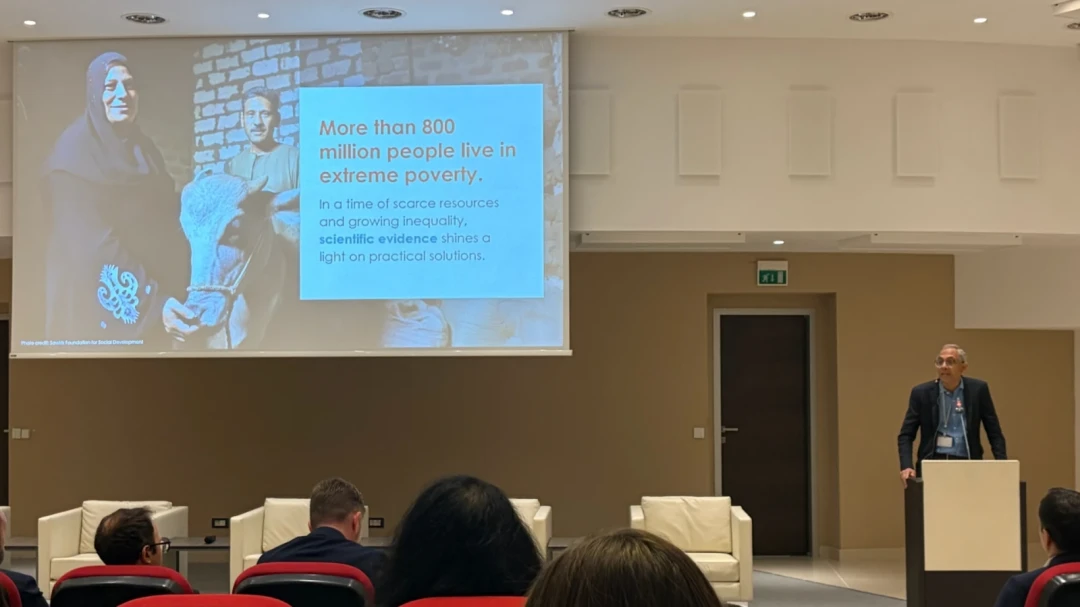
In his keynote, titled "From Evidence to Better Policy: What Does It Take?", Nobel Laureate Economist and J-PAL co-founder Abhijit Banerjee made the case for RCTs with several examples. Comparing three education interventions in India and the Philippines, he noted that while computer-assisted learning produced the largest raw gains in student test scores, remedial education was the most cost-effective, delivering roughly twice the learning gain per $100 spent as the computer program and about two and a half times that of a read-a-thon program.
"There are a lot of bad ideas," Banerjee said. "Stopping bad ideas is as useful as promoting good ideas... lots of things are unknowable." He described J-PAL as "doubling down on government partnerships" since governments remain the largest funders of social programs in low- and middle-income countries, citing work in more than 120 countries over the past decade and 30 active Policy Innovation Labs worldwide, including in Uzbekistan, Brazil, India and Luxembourg, with Armenia on track to join them.
On a panel with Galstyan, Banerjee addressed how J-PAL protects its independence when working with governments. "We don't pay our researchers... the only currency we accept is that the research is going to be published irrespective of the result... Sometimes it's very uncomfortable, but at least we have already insisted that if you don't accept that particular term of engagement, then we're not going to go there," he said.
Galstyan said the point wasn't to have a Nobel laureate "stamp" CBA policies as good, but to design genuinely better ones. "Publishing of the paper would be kind of a straitjacket on you not to continue with something which is inherently wrong, and I think that's a good thing," he said. He pointed to an existing CBA program, "execution excellence," run with McKinsey and the IMF, built around measurable goals: "output should move to the outcome." After the panel, attendees followed Banerjee outside, where he planted a tree to mark the event.
Speaking to CivilNet afterward, Galstyan said the CBA plans to run a handful of proof-of-concept projects before formally establishing the lab. He expects to bring in CBA and government staff alongside economists from the J-PAL network. Despite anchoring his opening remarks, financial literacy won't be among the lab's first priorities, Galstyan said: "We will start with priorities for the government, not for the central bank — social policy, health, something like that."
The day also included panels on why rigorous evidence matters for governments and on how governments can embed evaluation into policymaking. Speakers included Viktorya Aydinyan, head of the Deputy Prime Minister's Office; Marc Gurgand, scientific director of J-PAL Europe and an economist at the Paris School of Economics; Xurshid Zafari, director of Uzbekistan's Social Policy Lab; Teresa Molina-Millán, a researcher at the University of Alicante; and Garik Petrosyan, head of program evaluation at Armenia's Ministry of Finance.
J-PAL's ADEPT director, Sarah Kopper, outlined the organization's capacity-building approach: short training courses, embedded policy labs, and university partnerships built on MITx's online DEDP MicroMasters program. Partnerships are already in place with ENSEA in Côte d'Ivoire, INSPER in Brazil, and New Uzbekistan University, with an integration with the American University of Armenia now under exploration for 2027. J-PAL says it has run more than 2,500 randomized evaluations in over 95 countries, affecting some 850 million people. MIT Sloan professor Christopher Palmer, presenting on "An Evidence-Based Policy Future for Armenia," said the goal was for evidence-based policymaking "to be woven into the DNA and to the culture of our environment."
Closing the day, Adrien Pawlik, J-PAL Europe's associate director of research and operations, put the announcement on the record as a testable claim rather than a ceremonial one. "The job now is to make sure this is not a one-time discussion," he said. "You can consider this a public commitment... The next time we meet, you can judge whether we have delivered on that commitment or not."





 Stories