By Siranush Adamyan
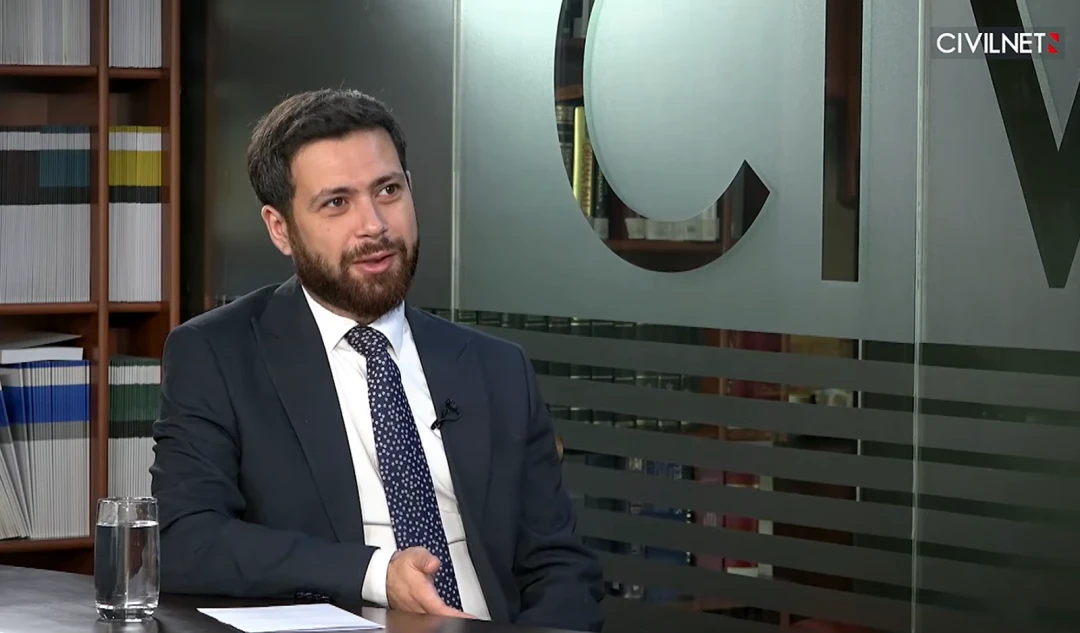
The U.S.-backed TRIPP transport project will not involve an American military presence in Armenia, Deputy Minister of Foreign Affairs and International Trade Vahan Kostanyan told CivilNet in an interview on Friday, addressing Iranian concerns about the planned route near its border.
“Such a presence has not been planned, is not being planned and will not be planned,” Kostanyan said. “The Iranian side therefore has no reason to be concerned.”
The Trump Route for International Peace and Prosperity, or TRIPP, is intended to connect mainland Azerbaijan with its Nakhichevan exclave through Armenia’s southern Syunik province. The project also envisages broader regional transport and energy links. Under the implementation framework outlined earlier this year, the United States would initially hold a 74 percent stake in a joint development company, with Armenia owning 26 percent. TRIPP emerged from the August 8, 2025, White House summit between Armenian Prime Minister Nikol Pashinyan, Azerbaijani President Ilham Aliyev and U.S. President Donald Trump.
Iran has opposed arrangements that could alter regional borders or disrupt its direct access to Armenia. A potential American military presence near its frontier has also been a concern, although Iranian officials previously welcomed Armenian assurances that U.S. involvement would remain civilian.
Kostanyan said discussions during Foreign Minister Ararat Mirzoyan’s visit to Tehran earlier this week included updates on TRIPP. But he cautioned against treating Iran’s position as uniform.
Some Iranian officials’ concerns had been dispelled, he said, while others still required continued dialogue and information sharing.
Development rights and construction plans
Kostanyan rejected claims that granting the joint company rights over the project area would place that territory beyond Armenian control.
“There is no question of ceding Armenia’s sovereignty or jurisdiction over this territory to a third party,” he said. “This is simply about granting the TRIPP Development Company the right to develop that area.”
He said feasibility studies would identify the land needed for the infrastructure. Asked whether Armenians would be able to cross the railway route, he said they would, rejecting the suggestion that the project would create an area separated from the rest of the country.
The published implementation framework reserves national security, law enforcement, border control and customs authority for Armenia, alongside the right to enforce Armenian laws throughout the project area.
Kostanyan said the Armenian–U.S. international agreement on TRIPP would probably be submitted to parliament for ratification in late October. Negotiations on the development company’s charter and shareholders’ agreement were nearing completion, with only one or two outstanding issues.
The company could be established shortly after ratification, he said. It would then create subsidiaries responsible for individual infrastructure projects, including railways, electricity transmission lines and pipelines. Preliminary discussions with the American side were also underway on attracting investment and involving operators.
“The shared understanding and desire of both our side and the American side is to begin preliminary work on the ground by the end of 2026 or at the beginning of 2027,” Kostanyan said.
An American organization is conducting feasibility and engineering studies, with final assessments expected around the end of this year or early next year, he added.
Kostanyan also said Armenia had resisted earlier approaches involving an extraterritorial corridor. He described the current initiative as a transport connectivity project operating within Armenia’s jurisdiction.
Strategic ties and gas talks with Iran
Separately, Kostanyan said Armenia and Iran were negotiating a comprehensive strategic partnership document, an initiative originally proposed by Yerevan.
Armenia had submitted the first draft and received Iranian comments, he said. Armenian government agencies were reviewing provisions covering their respective sectors before the Foreign Ministry consolidated a response.
“We are ready to sign this document. Let us see how negotiations with the Iranian side proceed,” he said.
No date had been set for Prime Minister Nikol Pashinyan’s next visit to Iran, Kostanyan added.
Asked whether Armenia’s deepening relations with the United States constrained cooperation with Tehran, he said Yerevan was developing both relationships and explaining its priorities to each side.
“The United States is an important strategic partner for us, and the Islamic Republic of Iran is a very important neighboring country,” he said.
Armenia has also discussed importing Iranian gas for domestic consumption outside the existing gas-for-electricity barter arrangement. Kostanyan said the issue had been raised during the Armenian minister of territorial administration and infrastructure’s recent visit to Iran.
“There are no concrete agreements at this point, but we do not rule out such opportunities in the future,” he said.



 Stories