By Stella Mehrabekyan
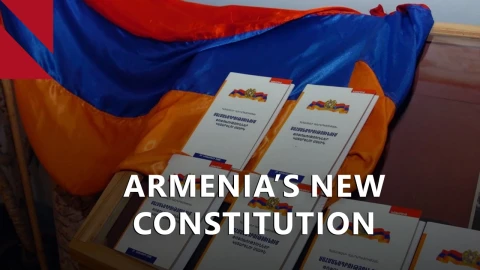
Armenia’s proposed new constitution would introduce a constitutional requirement for media outlets to operate transparently in their finances, raising questions among media experts about future government oversight, the protection of private donors and the independence of news organizations.
The draft, published on November 23, also removes the explicit constitutional status of Armenia’s broadcasting regulator, leaving its replacement and independence safeguards to legislation.
Justice Minister Srbuhi Galyan told CivilNet that the government was not currently considering restrictions on foreign funding for media organizations. However, she did not rule out future discussions on the issue.

Media experts say the principle of financial transparency is not problematic in itself. Their concerns center on why the requirement needs constitutional protection, how it might be enforced and whether future legislation could be applied selectively against independent or critical media.
What would change under the constitution?
Article 28 of the draft constitution states that mass media outlets operate according to the principle of financial transparency.
The current constitution contains no equivalent provision. However, Armenian media outlets have been subject to financial reporting requirements for more than two decades.
Under Armenia’s 2003 Law on Mass Media, media outlets must publish annual financial reports detailing their sources of income by March 31 of the following year. The proposed constitutional provision does not specify what additional information outlets would have to disclose, whether individual donors would be identified or which authorities would supervise compliance.
Speaking to CivilNet, Galyan said the government wanted to protect financial transparency requirements from being easily reversed by future parliamentary majorities.
"Our view is that the obligation of media outlets to operate with financial transparency is a principle that should be enshrined in the fundamental law," Galyan said, explaining that voters, not parliament, should decide any future change.
The minister acknowledged that more detailed transparency rules could also be introduced under the existing constitution. She suggested that media outlets might eventually publish financial information through the State Revenue Committee’s website, similar to reporting arrangements for nongovernmental organizations.
Media experts question constitutional requirement
Nouneh Sarkissian, executive director of the Media Initiatives Center, a media support NGO, said comparable constitutional provisions exist in Italy and Romania, but their wording differs from Armenia’s proposal.
The Italian and Romanian constitutions allow legislators to require disclosure of media financing. Armenia’s draft, by contrast, establishes financial transparency as a direct constitutional principle.

Sarkissian said the distinction could affect how the provision is interpreted and applied.
She argued that any constitutional reference to transparency should be framed as a guarantee of citizens’ right to information, with the details and limitations clearly determined by legislation.
"Requirements and regulations for the media sector should be established through sector-specific legislation rather than becoming part of the constitution," she told CivilNet.
Davit Alaverdyan, a member of Armenia’s Media Ethics Observatory and editor-in-chief of Mediamax news agency, said the provision would not necessarily introduce substantially new obligations because outlets already submit financial reports under existing laws.

The uncertainty, he said, concerns what additional measures could follow. Alaverdyan also linked the constitutional proposal to other legislative discussions affecting the media, including possible changes to compensation rules for defamation and insult.
He said the cumulative effect could expand state control over the media sector.
Concerns over selective enforcement and donor confidentiality
The new provision also raises questions about safeguards against discriminatory or selective enforcement.
Could future authorities impose additional disclosure requirements on government-critical outlets while applying the same rules less rigorously to politically connected media organizations?
The draft does not establish specific enforcement procedures or penalties. Those details would depend on subsequent legislation.
Another concern involves donors who support journalism but do not wish to be publicly identified.
Some individuals and organizations may fund investigative reporting on corruption, political influence or other sensitive subjects while seeking confidentiality. Mandatory public identification could discourage such support, particularly where donors fear political or commercial repercussions.
Would a constitutional transparency requirement eventually oblige newsrooms to disclose the identities of all private donors, including those supporting investigative journalism? Would exceptions be available to protect personal information and legitimate confidentiality interests?
These are potential consequences of future regulations, not requirements explicitly set out in the draft.
Galyan acknowledged that the government had yet to determine how detailed financial disclosures would be.
She said the rules would need to balance transparency with banking secrecy and personal data protection, and that media representatives should be consulted.
Government says foreign funding restrictions are not under consideration
Unlike the draft’s provisions on political parties, Article 28 does not prohibit or directly restrict foreign financing of media outlets. Asked whether the government intended to introduce such restrictions, Galyan said no proposal was currently under consideration.
"As of now, we have no such proposal. We have not discussed it," she told CivilNet.
The minister said restrictions on foreign funding for political parties were being proposed in response to identified concerns. In the media sector, she said, the government had not conducted sufficient research, partly because it had difficulty obtaining financial information.
However, Galyan added that foreign funding was an issue that could be discussed in the future.
The distinction matters for Armenian independent media, most of which rely on international grants and donations to finance reporting and investigative projects.
Broadcasting regulator would lose constitutional status
A separate change has raised concerns about the independence of Armenia’s media regulator.
Under the current constitution, the Television and Radio Commission is an independent state body responsible for ensuring the freedom, independence and diversity of broadcasting media. The new draft removes the commission’s separate constitutional status.
Under the draft constitution, its functions would be transferred to an autonomous body established by law. The existing commission would continue operating until the new body is established, but for no longer than one year after the next parliament convenes.
The future regulator’s powers, composition and independence safeguards remain to be determined.
Sarkissian questioned the rationale for replacing a constitutionally protected independent body with an autonomous institution whose safeguards would be defined by ordinary legislation.
Alaverdyan raised a similar concern, asking whether the proposed change was intended to address shortcomings in the existing regulator or enable greater control over broadcasters.
He also noted earlier discussions about extending regulatory oversight to television-style programming distributed through YouTube and other digital platforms.
The constitutional draft does not itself introduce such oversight, but the future regulator’s jurisdiction has not been established.
The broader question is whether Armenia’s new constitutional framework would strengthen public accountability without exposing independent journalism to additional political pressure.
The draft remains open to public discussion and possible revision. For media organizations, the central issue is not whether financial transparency is desirable, but how it can be enforced without undermining editorial independence, legitimate donor confidentiality and equal treatment under the law.




 Stories