 Civilnet
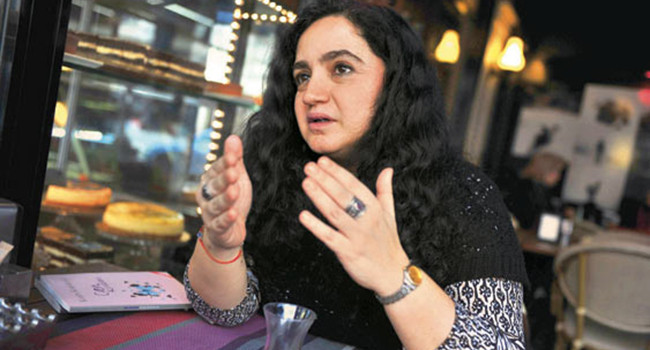
 Karin Karakasli is a columnist for the Istanbul-based weekly newspaper “Agos.” In her most recent article, she assessed Turkish writer Ayse Kulin’s recent scandalous comments about the Armenian Genocide. CivilNet translated the full article from Turkish to English.
Yes, of course! You can chose to be a “project writer”, you can specify your agenda topics in your annual calendar and you can ovulate your relevant works to coincide with with great sensations. As it stands, you create two-dimensional characters in a narrow space and you teach them some ready lines. Everyone and everything becomes objectified.
Whereas literature is first and foremost the story of a human being, and in a place where the official [version of] history is mixed with lies and hypocrisy, it also undertakes the function of recording unofficial history by going beyond being solely the product of the imagination of the writer. It is the sound of the secret whispers in the wind or streams of water. It comes from deep down like a wave, but trembles in front of a candle flame.
That is why, when a writer describes one of the greatest tragedies in his/her land by lowering his/her eyes in the style of a radical right-wing politician, you want to distance yourself without prejudice from the pain these words cause you and pity the poverty of his/her soul.
Ayse Kulin’s thoughts were exactly like this, when she was participating in Enver Aysever’s TV program “Contradicting Questions” to show-case her new book. I need to share the line emphasizing the signs of materialism, because they hit me in the eye. “I like ARMENIANS very much, BUT those were deportations during the war. It is DIFFICULT TO CALL IT GENOCIDE what happened during THE WAR. It wasn’t LIKE THE Jews. We did not BUTCHER the Armenians WITHOUT A REASON.”
In the Turkish language there is a phrase called “hidden subject”. In this sentence, we can play “find the hidden subject-publicly known genocide”. For example, we can start with the charms of using plurals that can be gushed with a full mouth. Being an Armenian myself, I don’t like “Armenians” very much. I cannot like any nation in the plural, because I must also be able to hate to be able to form that sentence.
Let’s pass over the charms and talk about this “but” that makes everything said before it meaningless… Thus, we are learning that it is difficult to call what happened during the war genocide. Well, it is a very important priority what definition describes the process of severing a people’s roots. By comparing genocides, we learn that the Armenians weren’t butchered like the Jews without a reason. If they were butchered, there must have been a reason or a justification. Probably, it is the official story of “cooperating with the Russians in the eastern regions and stabbing us in the back”, that the writer is comfortably using “we”. In this mess, the “we” is being defined this way: “We too are Ottomans. We are the heirs of the Ottomans. No, I am a daughter of the new Turkish Republic, but my generation is different. I grew up in my Ottoman grandfather’s arms. You cannot cut off your history with scissors in one moment.”
The story of how the dialogue brought us here starts today. She says “As a Turk, I feel responsibility and pain that the perpetrators of Hrant Dink’s murder have not been found,” then she adds “I didn’t exist during the massacres of the Armenians, my mother was not even born. I do not feel responsibility for that, but I feel responsible for the shameful things we have in today’s Turkey where I am living.”
Shall we remember together some of those shameful things? Hrant Dink was targeted because he wrote a news report about the possibility that Turkey’s first women military jet pilot, Ataturk’s adopted daughter Sabiha Gokcen, might have been one of the Armenian orphans adopted after 1915. He was stigmatized as an “enemy of the Turks” Armenian journalist by a systematic media and trials campaign against him. Just before he was murdered, he was also put on trial for his statement to Reuters that what happened in 1915 was a genocide. Having all that information, not seeing the link between Hrant Dink’s murder and the denial of the Armenian Genocide, can be explained only by a deliberate effort.
Ayse Kulin showed that deliberate effort in what she wrote about her Armenian brother-in-law in 2006: “If we had killed Armenians instead of deporting them for inciting the Russian soldiers who were occupying our eastern regions and preventing them from fighting against us wearing Russian uniforms, today, I wouldn’t have known my dear aunt’s husband. If the stigma of “genocide”, with which they want to label us, was correct, then my aunt’s husband should have been killed long ago, consequently my grandmother’s father Resat dede wouldn’t have attempted suicide because her daughter fell in love with an Armenian. Our family wouldn’t have got caught up in a scandal and my aunt wouldn’t have been exiled to Cyprus.”
You cannot tell how much it comforted me to read this logic in reverse. Think about it; If genocide was true then I wouldn’t have written this article, because I wouldn’t have been born descended from my grandparents. I wouldn’t have been able to tell you that genocide is the public ‘hidden subject’ in this mentality which is integrated with the republican ideology. If I was born, I would have hoped to tell what I wanted. Otherwise, I see no point in being alive, indeed.


 Stories