 Civilnet
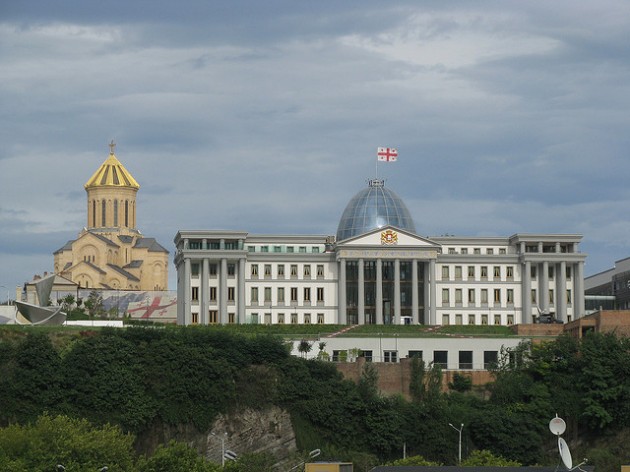
 2013 is the year of presidential elections in the three internationally recognized states of the South Caucasus. In February, Serzh Sargsyan was re-elected for a second presidential term, defeating Raffi Hovanissian in a controversial ballot. According to official results, Sargsyan received 58% of the votes, and Hovanissian - 37%. A few weeks ago, as widely expected, Ilham Aliyev was re-elected for a third consecutive term as president of Azerbaijan. International organizations and the United States clearly stated that the election did not meet European standards. Ilham Aliyev received 85% of the vote, and the main opposition candidate, Camil Hasanli, 5%.
There are 23 candidates for the Georgian presidential elections on October 27, of whom three are women. The main battle will be between the Georgian Dream coalition’s candidate, Giorgi Margvelashvili (44), and United National Movement party David Bakradze (41). Some of the other candidates are relatively well known politicians, including former Parliament speaker Nino Burjanadze (49), Christian-Democratic movement leader and well-known journalist Giorgi Targamadze (39) and Labour Party chairman Shalva Natelashvili (55).
Margvelashvili as a political figure is not well known either within or outside Georgia. He has a doctorate in philosophy and has worked extensively in the university system. Last year, when Ivanishvili became prime minister, Margvelashvili was appointed education minister, and later deputy prime minister. David Bakradze was the speaker of parliament until last year, and foreign minister for a short period prior to that.
These elections in Georgia are remarkable for various reasons. The current president Mikheil Saakashivili is stepping down, and Georgia will have a new president. Since independence, Georgia has had three presidents: Zviad Gamsakhurdia (1991-1992), Eduard Shevardnadze (1995-2003), and Mikheil Saakashvili (2004-2013). After Gamsakhurdia was ousted out in a coup d’etat, for a few years between 1992-1995, Shevardnadze was the de facto head of state. On two occasions, Burjanadze has served for 40 days as acting president. The first time was in late 2003 following the Rose Revolution that toppled Shevardnadze, and the second in the fall of 2007 when Saakashvili stepped down to run in a pre-term election. Saakashvili won that ballot in January 2008 with 53% of the vote. International organization considered the elections to be line with European standards, but Georgian monitors claim that it should have gone to a second round because Saakashvili had not received the necessary 50%+1 votes. Especially interesting is that during that election, Saakashvili received a disproportionately high number of votes from the predominantly Armenian-populated Javakhk and predominantly Azerbaijani Kvemo-Kartli regions. Georgian oppositionists attribute those figures to mass violations in Saakashvili’s favor.
The October 27 election is also remarkable in the sense that both presidential candidates are part of the current leadership. The parliamentary election in Georgia one year ago resulted in the defeat of President Saakashvili’s United National Movement by the opposition Georgian Dream headed by Bidzina Ivanishvili, considered the world’s wealthiest Georgian, who became prime minister. So for the past year President Saakashvili has been in opposition, given that his United National Movement party is a minority in parliament.
All Georgia’s past presidential elections were resolved in the first round of voting. During the first presidential election, nationalist Zviad Gamsakhurdia received 88% of the votes. Shortly after his victory, he was overthrown and later killed. In 1995, Eduard Shevardnadze, who had served in the 1980s as first secretary of the Communist Party of Georgia and then as Soviet foreign minister, was victorious with 77% of the vote. In the 2000 presidential elections, Shevardnadze was reelected with 82%. In both instances, Shevardnadze’s victory was met with caution, as international organizations considered the elections did not meet European standards. In the pre-term election in 2004, Mikheil Saakashvili received 96%. If these elections were considered free and fair, then Saakashvili’s second election victory in 2008 met with caution.
The October 27 election is going to be a real test of democracy in Georgia. If this time the elections are conducted freely, fairly, and competitively, like the 2012 parliamentary election which the opposition won, then it could be said that Georgia’s democratic indicators are indisputably higher than those of Armenia and most other post-Soviet states.
Sociological survey (polls) show that Margvelashvili will most likely win the election. The only region that Bakradze is going to win, according to the surveys, is Armenian- populated Javakhk. A few days earlier, Prime Minister Ivanishvili and presidential candidate Margvelashvili had a pre-election meeting in Javakhk’s capital, Akhalkalak. Ivanishvili approached the 2,000 assembled Armenians and said “I really love Armenians, and I’ve never hidden that fact. I know you are waiting for a new president and that will definitely be Giorgi Margvelashvili. We are really brothers, you are Georgian citizens like us. This is your fatherland.”
Returning to Tbilisi, Prime Minister Ivanishvili said “the only region where the Georgian Dream candidate can lose is the Armenian-populated Javakhk. That’s what the latest results of polls say. However, I am not going to influence the Armenian electorate with unfair methods. I’m not going to call Armenia’s president with such issues. Such cases have been recorded in our bilateral relations, but I’m not going to do something like that.”
If Margvelashvili wins, but Bakradze receives more votes in Javakhk, then it could create an unfavorable situation for Javakhk and its Armenian population.
http://civilnet.am/2013/10/22/voice-tatul-hakobyan (to read in Armenian. By Tatul Hakobyan).

 Stories