 Civilnet
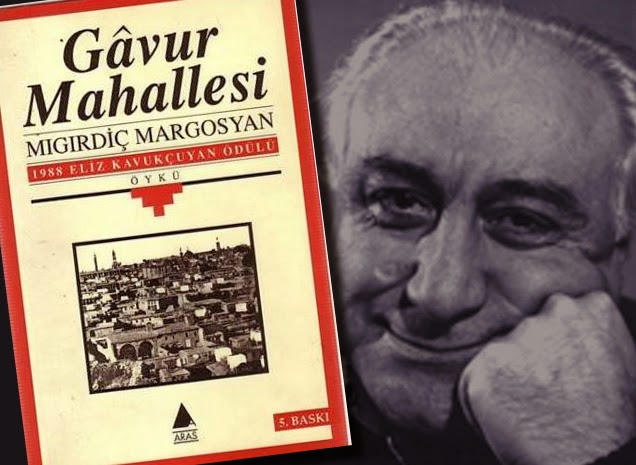
 Mıgırdiç Margosyan and his book Gavur Mahallesi.
One of the most prolific contemporary Armenian writers of Turkey, Mıgırdiç Margosyan was born in 1938 in Diyarbakır’s Hançepek district, or “Gâvur Mahallesi” (Infidel's Neighborhood) as it is called by the local population. After completing primary school in Diyarbakır, he graduated from the Armenian Bezciyan Middle School and then the Getronagan High School. He attended İstanbul University, and received a diploma from the department of philosophy.
Margosyan's first book of short stories, “Mer Ayt Goğmerı” (Our Places), was published in 1984 in Armenian. He received the Eliz Kavukçuyan Literature Award for authors writing in Armenian in Paris, France.
His later works in Turkish included: “Gâvur Mahallesi” (Infidel's Neighborhood) in 1992, “Söyle Margos Nerelisen?” (Tell me Margos, Where Are You From?) in 1995 and “Biletimiz İstanbul’a Kesildi” (Our Ticket Was For İstanbul) in 1998. He wrote another book in Armenian in 1999, “Dikrisi Aperen” (From the Shores of Tigris). His latest book, “Kürdan” (Toothpick), comprises his essays. “Tespih Taneleri” (Prayer Beads), first published in 2006, was recently reprinted in its sixth edition.
 The following story, translated by Emine Onaran İncirlioğlu, is from Margosyan's Gâvur Mahallesi, which has been published in Armenian, Kurdish and Turkish and weaves together stories from the famous infidel's neighborhood of Diyarbekir.
"I have recounted all that I have seen there. The names and countenance of the characters are exactly the same, I have not changed them, I have left them as they are. The majority of those people - aunts, uncles - have already departed for the other world. Let their names, their memories live in the lines of my book." Mıgırdiç Margosyan.
******
It was winter. It was the reign of snow that completely covered the küches, the narrow alleyways of Diyarbakır. Snow lay on the road like Saint Sarkis’ white beard, climbed the stairs in the courtyard of the church, and embraced and kissed the cross that blessed the town from the top of the tall bell-tower.
Uso was the sacrist of the church. They called him Mad Uso. In fact it would have been more proper to say “half witted” when mentioning him. Uso, before he was appointed as the sacrist, used to work forging bellows, for his brother, Sabro the blacksmith, who was three years older than him. With his little reason, from time to time, Uso attempted to give advice to Sabro, whose nickname had become “bag of nerves” because he would be cross and angry at every single thing whether necessary or not. Then, brotherhood would be forgotten and the squabble would turn into a fight between master and apprentice. Finally with the intervention of the neighbors the matter would be smoothed over before much blood was shed. Uso would untie and remove his leather apron in rage and fling it at his brother, would exclaim that he had quit, shouting “let my mother be my wife, if I step into this shop again,” and after swearing a series of other curse words, just like he had done after similar fights, he would go to his twin brother Rızgo’s shop four doors down the street, and heading straight for the bellows, he would set to work.
Uso’s rushing from pillar to post between his brothers Sabro and Rızko was, in fact, an ordinary and habitual event. And nobody found anything odd in these fights. Sabro and Rızko were both married and had set up home. Since their father had died, their mother Rehan Baco had been been living in a small room in the Church yard with Uso. Appointing Uso to the post vacated by Sacrist Zıfkar’s death was considered to be the most appropriate and righteous decision the Church Administrative Board had ever taken. The Armenian community applauded this decision of the Administrative Board by saying that “two birds were hit with one stone.” First, the fights with knife, sickle or sledgehammer between the brothers that were feared to end one day perhaps with blood, would be prevented, and Uso’s blacksmith apprenticeship would end in his forties. Second, and more important, his ringing the church bells every so often, whenever he felt like it, would perhaps be averted a little with this formal appointment. However, because he would always be at the Church, that is at home, ex officio, those who would string along with and make fun of him in the streets would be deprived of his obscene curses.
That day, that whiter than white day, when Uso overheard that Güzellerin Meryem had died, he became very, but really very saddened. He used to cry with a tormented heart for anyone who died. His heart would be tormented after anyone who died. Usually, he would cry his eyes out, anyway. After crying similarly for Meryem and fulfilling his duty, he started to mumble to himself:
“Rosy Meryem dies when Hıçe is well and alive—Wonders never cease!”
Leave aside his craziness and half-wittedness, after Uso became or rather was formally appointed as the sacrist, he identified himself even more with this job. Having shed enough tears for Meryem, he remembered his sacred duty and ran quickly to untie the rope of the church bell from the hook on the wall where it was tied, and pulled it full steam ahead. The bell started ringing. While the sounds of the bell were radiating wave after wave, ding-dong, ding-dong, to the roads of the town, hitting the piles of snow on rooftops and echoing, Uso mumbled to himself along with the bell sounds:
“While the mother-in-law remains, the daughter-in-law dies.”
“The mother-in-law is alive, the daughter-in-law goes bang!”
“In this stormy winter cold, what do you know! God must be baffled!”
“Tövbe, tövbe, tövbe — I repent, I repent, I repent…”
The muezzin of the nearby Şeyh Matar Mosque put up with Uso’s never-ending bell chimes, saying “ya sabır, ya sabır — Give me patience, oh God!” and remembering that it was also his duty, he called out from the historic Dört Ayaklı Minare, Four Footed Minaret:
“Allahu ekber, Allahu ekber!..”
“Ding-dong, ding-dong!..”
“Allahu!..”
“Ding!..”
“Ekber!..”
“Dong!..”
When Muezzzin Nusret climbed down the minaret with his big nose that turned tomato-red because of the cold, Uso was still, with his shrimpy height and roundish body, continuing to pull the rope of the historic bell. Deep down rejoiced that the muezzin had thrown up his hands and climbed down.
The chimes of the bell spread wave by wave out, way out to the farthest away, where they turned into question marks, and hung on the chilblained earlobes of all Armenians.
“What’s up kirve Bedo? Why the bell chimes at this hour?”
“Nothing is up; it’s down... Güzellerin Meryem passed away.”
“She’s saved… she’s not suffering any longer.”
“But she was so very young.”
“This is not a matter of young or old.”
“That’s right.”
“Let God forgive her sins, free her, and bless her soul.”
“Amen...”
Dikran the blacksmith, one ear on Uso’s bell ringing, the other turned to his Kurdish customer, was shouting at his apprentice who was pumping the bellows, “C’mon, pump, pump boy!” At the same time he tried interpret the reason for the bell sounds that mixed with the bang of forging the hot iron he had fired and removed from the furnace.
Tumas the yemenici, maker of flat-heeled leather shoes, called out to his apprentice as soon as he heard the untimely chiming bell:
“Gırbo! Dash off, run to the church, and see why that crazy man is hanging on the bell again...”
Would apprentice Gırbo, who was already making plans to sneak off in no time and play aşık, jacks, in the street with his friends, miss such an opportunity? Right away he untied the leather apron around his waist and dashed off into the street like an arrow. When Gırbo, after playing jacks with his friends and beating them thoroughly, returned to the shop in blood, sweat and tears, calculating the spanking he would get, his master scolded him:
“Where have you been for two hours, you son of a bitch?”
“Master, Güzellerin Meryem has died.”
In fact, his master had learned all about the reason for the bell sounds long before from Sago the tinsmith, Samo the puşi, headscarf, maker, Sıko the laborer, the cross eyed Dono and the tightfisted pilgrim Nono.
Uso, following Muezzin Nusret’s descent from the minaret, still delighted in his own way with his victory, coiled up the bell rope on the hook on the wall where it belonged and rushed out into the street in a hurry. He was on his way to far away neighborhoods and in those farthest away, to call out to the deaf, and to those who have not heard the bell sounds. He gave the news to each Armenian he met enroute:
“Güzellerin Meryem died.”
“Uncle Dikro! Güzellerin Meyro, Hıçe’s daughter-in-law, passed away.”
“Uncle Sako, have you heard? Güzellerin beauty Meyro died, too.”
Fubsy Uso would roll in the snow, run while cursing at his yemeni, flat shoes that would come off his feet from time to time and be buried in the snow, and in soggy sweat in the cold winter day he would reach the far away Infidel’s Neighborhood.
By the time Uso was on his way back to the church dog-tired but pleased to have completed his duty, in houses and shops, invariably, Meryem was talked about.
“Güzellerin Güzel’i, Beauty of the Güzeller.”
“Poor thing.”
“Let God forgive her sins!”
“Tövbe, I repent, but it was not her turn yet...”
“But when the old remain, the young should not be taken!”
“What a shame!”
“How beautiful her eyes were!”
“What a height, what stature!”
“Those eyebrows, those eyes!”
“And what about the way she walked?”
“And the way she danced the halay and performed at weddings and gatherings?”
“Two orphans left behind…”
“Hıçe will look after them…”
“Hıçe cannot fight her way out of a paper bag…”
Conversations and interpretations lasted until Meryem was laid to rest. The church was jam-packed. For this, Uso took most of the credit upon himself and somewhat upon the sounds of the bell that he enjoyed ringing so much. Almost everyone was crowded into the church. The only one who did not attend was Vanes who was thought to have a screw loose and so whose name was unanimously confirmed “Crackpot Vanes.” Other than Sundays, he would not close and lock his shop where he stitched up saddles for donkeys, asses, mules and horses, nor would he entrust it to his apprentice or such, to go to the church or elsewhere, for a funeral or similar occasion. Nothing more was expected of him anyway. Could one expect any other donkey-business from a man who boasted and smirked when asked what he did for a living, that his occupation was, “a tailor for donkeys”?
They buried Meryem in a grave next to her daughter’s, the daughter she had given birth to six months before… With an ounce of tears, an ounce of frankincense scent, and plenty of prayers by Priest Arsen.
The first day’s charity was completed with the distribution of tahini halva and bread to the Kurdish children with no pants on, watching bewildered and curious, gathered around the black-bearded Priest Arsen in a black cassock, and the silver cross in his hand.
When Güzellerin Güzel’i was left alone together with her earth, the yemenici, the gumshoe maker Eğuş went back to stitching sandals; the blacksmith Mero to making wolf-traps; the carpenter lame Nışo to making pipes out of plum trees; the horseshoer Henuş to fitting horses with shoes. In short everyone went back to their own work while the herb merchant Yusuf the Chaldean and his neighbor by his shop barber Yakup the Assyrian resumed playing checkers.
There were two sleepless people that night: One was Meryem’s husband, master mason Sıke, and the other old Hıçe who was distressed at not dying before her daughter-in-law and had a weird feeling as if she was guilty.
When Sıke went into and lay down in the floor bed that night, his younger son Seto and eight-year old daughter Teko were fast asleep. Along with his mother Hıçe, under the dim light of the lampion, Sıke contemplated Meryem’s smiling maiden photograph hanging on the wall.
Outside, when Saint Sarkis was stroking his whiter than snow beard and wandering in Diyarbakır’s lonely alleyways, Meryem sought her own warm bed and her husband Sıke’s hairy chest.
Translated by Emine Onaran İncirlioğlu


 Stories