Turkey's "Iron Curtain": Attempts to Unlock the Armenia Border
 Civilnet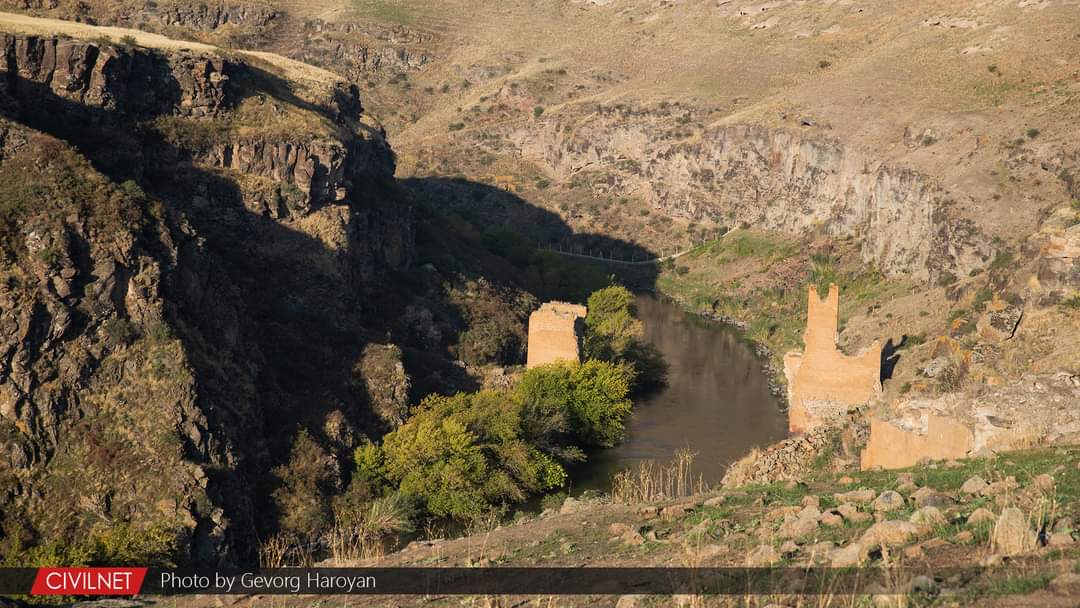
By Martin Makaryan
The Turkey-Armenia border—its opening and closure—has been on Armenia’s foreign policy agenda since the country regained its independence from the Soviet Union. Yet, given the troubled history between the countries and the conflict with Azerbaijan, the border opening has been and remains a complicated topic.
Turkey’s rather capricious approach to the opening of the border with Armenia has been part of a pattern of unpredictability in terms of the normalization process. In the last three decades, despite the closure of the land border, Turkey has oscillated between opening and closing its airspace to Armenia. Charter flights between the two countries opened in the early 2000s and commercial flights followed. Yet, Turkey has weaponized the air travel continuously at different times, such as during the 44-day war, to put further pressure on Armenia.
The current land border between Armenia and Turkey, which spans 311 km and passes largely through the river Arax, was finalized after the signing of the Treaty of Kars in 1921 between the Soviet authorities and Mustafa Kemal’s nationalist government in Turkey. The treaty marked the end of turmoil and violence caused by World War I, nullified prior treaties, and fixed the borders of the Soviet Union with Turkey. Armenia inherited the Soviet-Turkish border, along with its political and practical implications, in 1991.
1993: TURKEY CLOSES ITS BORDER WITH ARMENIA
Turkey recognized Armenia’s independence from the USSR on December 16, 1991. Armenia’s then-President Levon Ter-Petrossian’s government had explicitly stated its intention to normalize relations with Turkey. In an interview with Novaya Gazeta in May 1991, Ter-Petrossian said, “There are already oral agreements that there would not be any political preconditions for the development of economic and cultural ties.”
During this early post-independence momentum in 1991, the open land border was used to transport wheat from Turkey to Armenia in the midst of a severe economic crisis and shortages of critical food supplies. The Armenian government considered this a “test” whether Turkey intended to stay neutral, as stated by the Turkish government, in the escalating Nagorno-Karabakh conflict.
The initial hopes and enthusiasm, however, were short-lived. In April 1993, when the Armenian forces scored a strategically important victory in Kelbajar during the First Nagorno-Karabakh War, and under pressure from its ally Azerbaijan, Turkey unilaterally closed its land border with Armenia and suspended the air transit of foreign aid and shipments through its territory.
EASING OF TENSIONS AND CONTINUED EFFORTS AT NORMALIZATION
Despite the absence of diplomatic relations and a fully closed border, economic activity between Turkey and Armenia still took place. In May 1997, the Turkish Armenian Business Council was established to link the two countries’ business sectors and societies. The permanent mission of Armenia to the Organization of Black Sea Economic Cooperation (BSEC) was established in Istanbul in August 2001. The organization—which among others includes Azerbaijan, Turkey, Greece and Russia—was founded in 1992 to promote peace and stability through regional economic and political cooperation between countries in the Black Sea region.
Although Armenia does not have access to the Black Sea, BSEC has served as a forum for interaction with Turkey and Azerbaijan, neither of which have diplomatic relations with Armenia. In fact, Armenia’s permanent mission to BSEC in Istanbul has served as an unofficial representation of Armenia in Turkey.
Another significant initiative was the Turkish-Armenian Reconciliation Commission which was launched in 2001. An American-mediated non-governmental effort, despite the political resistance in both countries, the Commission was aimed at fostering relationships through non-governmental organizations and to explore the historical issue of the Genocide in order to prepare the ground for an official reconciliation. After commissioning a legal opinion on the correctness of the term genocide to describe the events of 1915, TARC was met with a variety of attacks and accusations, and shut down in 2004.
The official channels of communication between Armenia and Turkey under President Robert Kocharyan remained open. Kocharyan met twice with his Turkish counterpart Suleyman Demirel. After their meeting in 1999 in Istanbul, Demirel had once again reiterated that the course of Turkish-Armenian normalization still depended on the Armenian-Azerbaijani conflict. Nevertheless, there continues to be a widespread assumption that the Genocide remains the chief obstacle to open borders and normal relations. Although there have been independent efforts over the years to address the issue of Genocide - the description and the consequences, this has not been a part of the bilateral dance over closed borders.
FOOTBALL DIPLOMACY
The closest that Turkey and Armenia ever came to reconciliation and establishment of diplomatic relations was after Serzh Sargsyan became president. The new phase of attempted rapprochement started after Turkish President Abdullah Gül attended the World Cup qualifier match between Armenia and Turkey in Yerevan, at the invitation of President Serzh Sargsyan, in 2008. Sport was used to kickstart the new round of talks in the hopes of finally achieving tangible results in the normalization process.
The Zurich protocols, signed on October 10, 2009 after private negotiations mediated by Switzerland and the U.S. Secretary of State Hillary Clinton, provided for the establishment of diplomatic relations and the opening of the border within two months of ratification of the document by the parliaments of both countries.
Azerbaijan, however, immediately criticized the signing of the protocols. An official statement from the Ministry of Foreign Affairs said that the protocols “cast a shadow over the spirit of brotherly relations” between Azerbaijan and Turkey. Subsequently, Erdoğan moved to jeopardize the ratification process by holding the Azerbaijani line. Just weeks after the protocols were signed, Erdoğan stated that no progress could be made on the ratification and implementation of the protocols unless the Armenian forces withdrew from Nagorno Karabakh. Turkey never ratified the Protocols. Thus, just as the border had been closed in 1993 because of the Karabakh conflict, it did not reopen in 2009 for the same reason.
The Turkish government, however, used the decision of the Armenian Constitutional Court to blame Armenia for the failure of the Zurich Protocols. The Turkish side considered the reasoning used in the text of the Court’s decision, which approved the Protocols as documents in conformity with the Constitution, as unfavorable to “the spirit of the Protocols” and accused the decision of establishing pre-conditions.
In 2015, President Sargsyan recalled the Protocols from the Armenian Parliament, blaming the Turkish government for the failure of the process in a letter addressed to the President of the Parliament. In 2018, during the National Security Council meeting, the Armenian president declared the Protocols “null and void.”
2021: PRESSING THE RESET BUTTON
The 44-day war over Nagorno-Karabakh in 2020 drastically changed the geopolitical landscape of South Caucasus, creating new challenges and new opportunities. The Turko-Azerbaijani alliance continued to solidify after the November 9 statement was signed, with the two countries acting in tandem in the political and diplomatic process with Armenia following the war.
The new normalization process, however, has not yielded any definitive results or hinted at any significant process so far. Although the agenda of the new process, which launched in 2021 after public statements by Armenian and Turkish leaders regarding a desire to normalize relations, has focused mainly on trade, logistics, and the opening of the border (leaving aside historical grievances), there has been little progress on this front so far.
Both sides have nominally committed to the old philosophy of no preconditions, but Turkey has in fact put immense pressure on Armenia on several key demands which are nothing else than pre-conditions. Since 2021, Turkish coercive diplomacy has thus focused on pushing Armenia to normalize relations with Azerbaijan on their terms, leave aside any claims or involvement over Nagorno-Karabakh, and open the so-called Turkic “Zangezur Corridor,” linking Azerbaijan to its exclave Nakhichevan and from there to Turkey.
In February, the Armenian government tried to express goodwill by sending humanitarian help to Turkey through the de facto closed land border when the country was hit by several devastating earthquakes. This gesture earned praise from the Turkish government. Serdar Kılıç, Turkey’s special envoy for negotiations with Armenia, thanked his Armenian counterpart Ruben Rubinyan and promised to “always remember” the aid sent by Armenia to alleviate the humanitarian crisis in Turkey.
Yet, months later, the border is still closed, and there are no signs whether Armenia’s “Iron Curtain” will be lifted anytime soon. In fact, despite Nikol Pashinyan and his government’s ardent attempts at warming up to Erdoğan’s government, Turkey has continued to maintain its tough policy on Armenia. In May, the Turkish government closed its airspace to Armenia after heavily criticizing the erection of a monument in Yerevan dedicated to Operation Nemesis. Nemesis was the codename for the covert operation between 1920 and 1922 whereas perpetrators of the Armenian Genocide from the Young Turks government of the Ottoman empire were killed by the Armenian Revolutionary Federation.
With no significant breakthroughs and no upcoming high-level talks coming up, it is clear that the long-established pre-condition of Turkey—the final solution of the Nagorno-Karabakh conflict entirely on Azerbaijani terms—is holding Erdoğan back from taking a meaningful step towards the opening of the border and normalization of relations.
Location


 Stories