 CivilNetCheck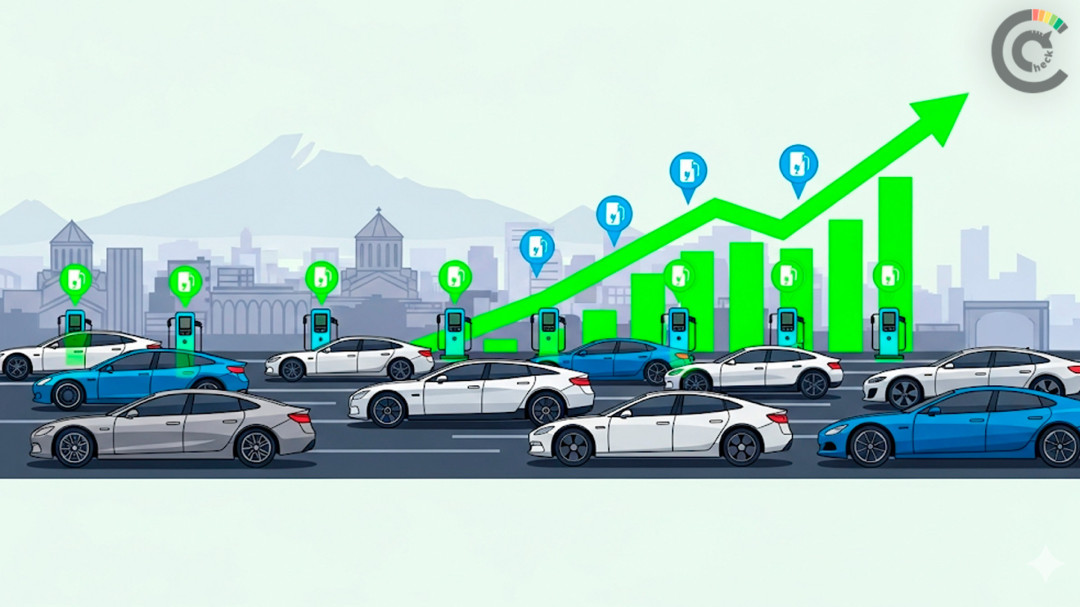
By Hayk Hovhannisyan
Armenia has seen a dramatic transformation of its car market in just five years, as electric vehicles (EVs) move from a curiosity to a mainstream choice on Yerevan’s streets. Once rare, they are now everywhere, with Chinese brands particularly visible in the capital’s traffic alongside Teslas and Volkswagens.
According to the Interior Ministry, only around 270 EVs were registered in Armenia in 2020. By the end of August 2025, that number had soared past 22,650 – an increase of more than 85-fold. In the first eight months of this year alone, more than one in four newly registered vehicles (27%) were fully electric. Import figures from the State Revenue Committee show the trend even more clearly: EVs made up over a third of all cars imported, with 13,346 arriving between January and early September.
The driving force behind this rapid growth is a package of government incentives. Since 2020, Armenia benefited from a duty-free import regime for EVs under the Eurasian Economic Union. This was later replaced by a quota system, granting Armenia 8,000 annual zero-tariff slots. Imports and sales of EVs are also exempt from value-added tax, effectively cutting the final purchase price by about 35%. Yerevan city hall has added its own support, exempting EVs from parking fees in the capital. Together, these measures have propelled demand: in the first eight months of 2025, 8,646 new EVs were registered, more than in all of 2024 and more than during 2020–2023 combined.
The government plans to extend VAT exemptions until 2027 but with new conditions: starting in 2026, the tax break will apply only to cars manufactured in 2024 or later, and by 2027 only to 2025 or newer models. A national plan drawn up with the World Bank sets ambitious targets – 42,000 EVs on the road by 2030, 230,000 by 2035 and 550,000 by 2040. While Tesla and Volkswagen attract attention, the most striking trend has been the wave of Chinese brands such as BYD, Geely, XPeng and Li Auto. Relatively affordable and readily available, they dominate dealership lots and are increasingly common in central Yerevan. Official figures show that 55% of registered EVs are under three years old, suggesting the fleet is not only growing but modernising rapidly.
Risks and challenges
Despite the boom, structural challenges loom. Armenia’s 8,000-unit duty-free quota was partly exhausted in just two months in 2025, leaving hundreds of buyers uncertain and dampening import momentum. The government has yet to clarify whether similar quotas will be offered in 2026–2027. Without them, importers will face a 15% customs duty, pushing up prices. Charging infrastructure is also lagging. Of more than 300 charging points nationwide, over half are in Yerevan, while rural regions remain underserved. Projections show the country will need at least a tenfold expansion of public charging capacity if 10% of the fleet is electric by 2030. Safety standards for charging stations are still lacking, raising fire risks.
Taxation rules remain misaligned, with property tax on cars calculated by engine power, meaning many affordable EVs end up taxed more heavily than luxury petrol SUVs. The Finance Ministry says it is drafting a fairer system. The most complex challenge is environmental: battery disposal. Within a decade, Armenia will face thousands of tonnes of hazardous, flammable waste from used EV batteries. No nationwide collection or recycling system exists yet. One sign of progress is a deal between U.S. firm Ace Green Recycling Inc. and Armenian company Mel Metal to introduce battery recycling technology in Armenia and neighbouring Georgia.
Armenia’s EV surge has become a rare policy success, refreshing the ageing car fleet and offering a cleaner alternative for a country plagued by air pollution in its capital. Yet without long-term solutions on quotas, infrastructure, taxation and recycling, the boom risks running into roadblocks. For now, though, the view from Yerevan is unmistakable: where once traffic jams were dominated by petrol-burning sedans, today they are increasingly silent, and often Chinese.





 Stories