 Civilnet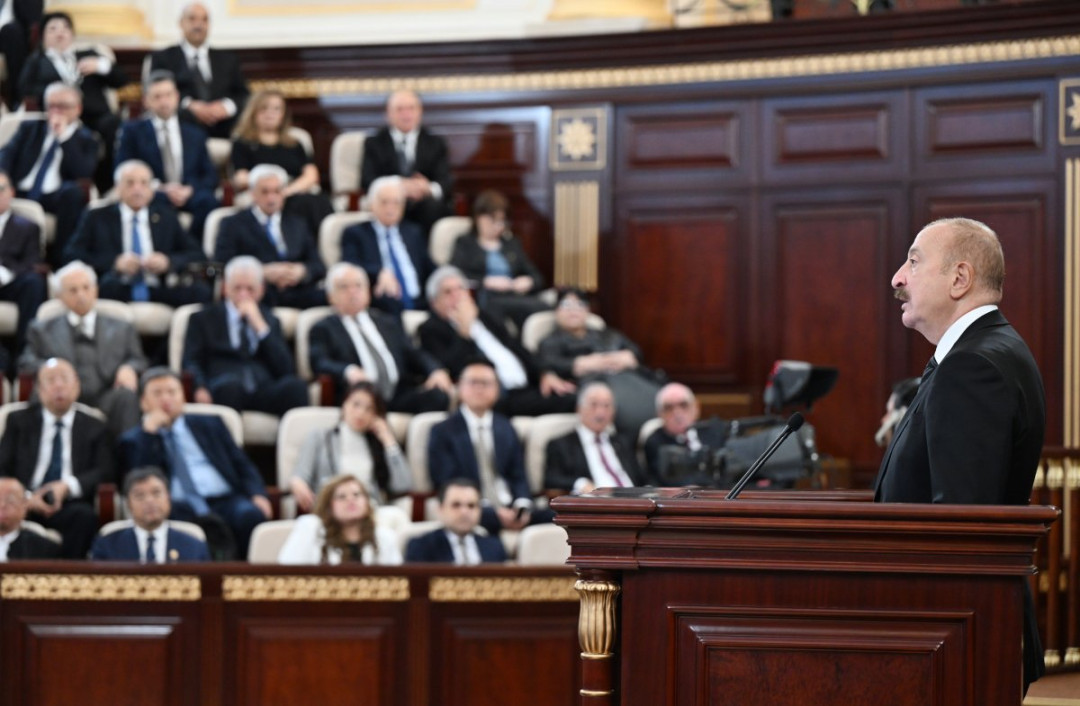
By Alexander Pracht
Azerbaijani President Ilham Aliyev on Monday once again called for the return of Azerbaijanis to Armenia and repeated revisionist claims about Armenian history and territory.
“Armenia should not be afraid of Azerbaijanis returning. I said it before that we should return not on tanks but on cars,” Aliyev said in his speech at the Azerbaijani Academy of Sciences, adding that Armenians were “settled in Karabakh by Tsarist Russia from Iran and Eastern Anatolia” and that “the place names of the territories of Armenia on Russian maps of the 20th century are mainly Azerbaijani.”
He also claimed that “there is no lake called Lake Sevan on those maps, but there is Lake Gokcha.”
While the Turkic name “Gokcha” was indeed used in some historical sources, the name Sevan is much older and is believed to be of Urartian origin, first attested in the 8th century BC. Medieval Armenian sources refer to the lake as the Sea of Gegham, after a mountain chain adjacent to it.
This marks the first time Aliyev has invoked such rhetoric since the August 8 peace declaration in Washington. Before that, he had frequently referred to Armenia as “historic Azerbaijani lands,” part of a broader state narrative aimed at redefining regional history.
Azerbaijan has a long record of promoting historical revisionism for political purposes, including the discredited theory that modern Azerbaijanis descend from the ancient Christian Caucasian Albanians. This concept was introduced in the mid-20th century by Azerbaijani historian Ziya Bunyadov.
Another strand of this narrative argues that the word “Armenia,” as found in ancient sources, does not refer to the ancestors of today’s Armenians, suggesting instead that Armenians were relocated to the region from India in the 1820s after Russia took control over Eastern Armenia following a war against Persia.
Proponents of this theory often cite the fact that Armenians refer to themselves as ‘hayer’ (հայեր) rather than “Armenians,” ignoring that such differences between self-designations (endonyms) and external names (exonyms) are common among nations worldwide and carry no historical or ethnic implication. These claims have been repeatedly dismissed by credible historians and linguists.
In recent years, such revisionism has evolved into the state-backed concept of “Western Azerbaijan,” a term Azerbaijani officials use not for the Iranian province of that name, but for the Republic of Armenia. Several organizations describing themselves as “communities of Western Azerbaijani refugees” have been created with government support, alongside a dedicated television channel and efforts to assign Azerbaijani-language names to towns and regions across Armenia.
A recent report by the Georgian outlet OC Media confirmed that these initiatives are directly funded by the Azerbaijani government.
At its peak in 1979, the Azerbaijani population of Soviet Armenia numbered around 160,000. By the late 1980s, amid the escalation of the Karabakh conflict, nearly all of them had left Armenia, as Armenians were simultaneously forced to flee Azerbaijan.
Armenian population in Soviet Azerbaijan peaked at 483,000 in 1970, and now is believed to be between several hundreds and several thousands, mostly women married to Azerbaijanis since the Soviet era or children from such mixed marriages
In 2007, Armenian authorities reported that a small number of Azerbaijanis still lived in Armenia but declined to disclose exact figures, citing a UN convention that prohibits publishing statistical data about vulnerable groups.
The Armenian government has consistently rejected Baku’s “Western Azerbaijan” narrative and dismissed any prospects of Azerbaijani repatriation to Armenian territory. In public statements, it also does not seek repatriation of Armenians to Karabakh or Azerbaijan proper.

 Stories