 Civilnet
By Karen Harutyunyan, reporting from Hyderabad, India
Skyroot Aerospace wants to be for space what Uber was for urban transport.
That was how Sumil Sudkharan, vice president of the Indian private space company, framed Skyroot’s ambition as he spoke to a group of international journalists inside the firm’s rocket production facility in Hyderabad on December 16. The idea, he said, was not to replace existing systems but to make access faster, more flexible, and easier for customers who had long depended on rigid, state-led models.
The meeting took place on the factory floor itself, amid rocket structures, engines, and assembly equipment. Before entering, stickers were placed over the cameras of journalists’ mobile phones to prevent photographs or video recording, with all images from the visit taken instead by Skyroot’s own photographer. The journalists were visiting India at the invitation of the Indian government.
Founded in 2018 by former Indian Space Research Organisation (ISRO) engineers, Skyroot is often compared to U.S.-based SpaceX, though it operates on a much smaller scale. Its focus is sharply defined: launching small satellites quickly and at lower cost, in a market driven by Earth observation, communications, and scientific payloads.
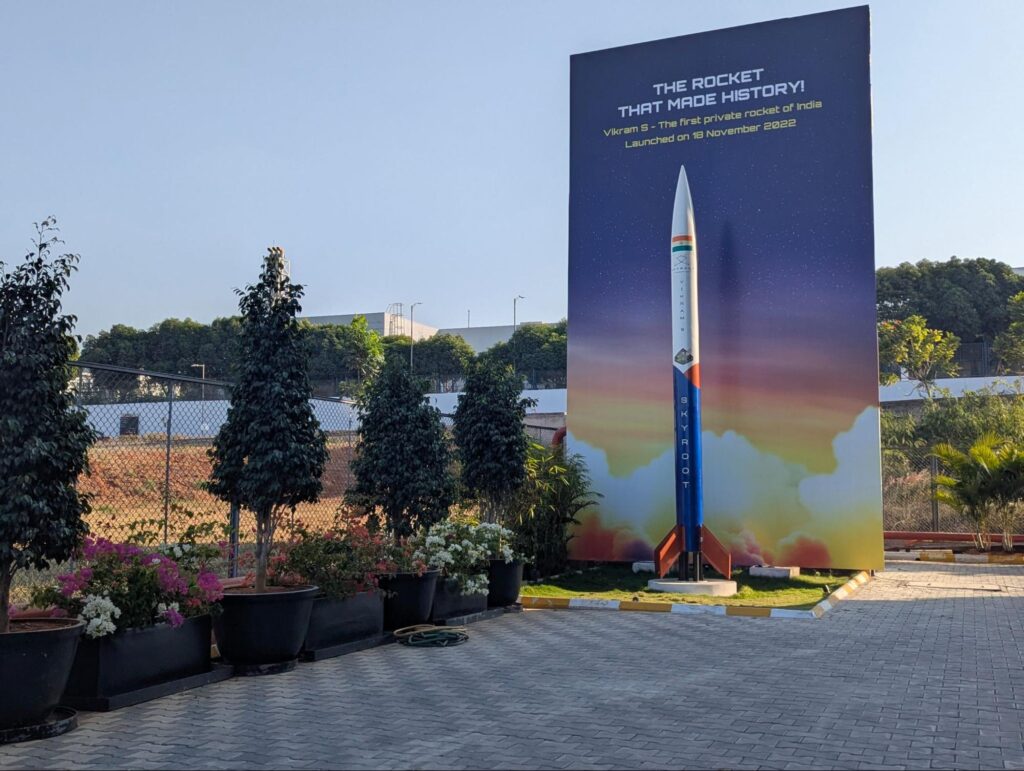
As reporters introduced themselves one by one, Sudkharan reacted immediately when the Armenian journalists were mentioned. He recalled that Skyroot’s first suborbital launch in 2022, Vikram-S, carried an Armenian payload.
That 2022 mission made Skyroot the first Indian private company to send a rocket to space. Sudkharan said it illustrated the company’s commercial logic — offering rapid, dedicated access to space for customers that do not have their own launch capabilities.
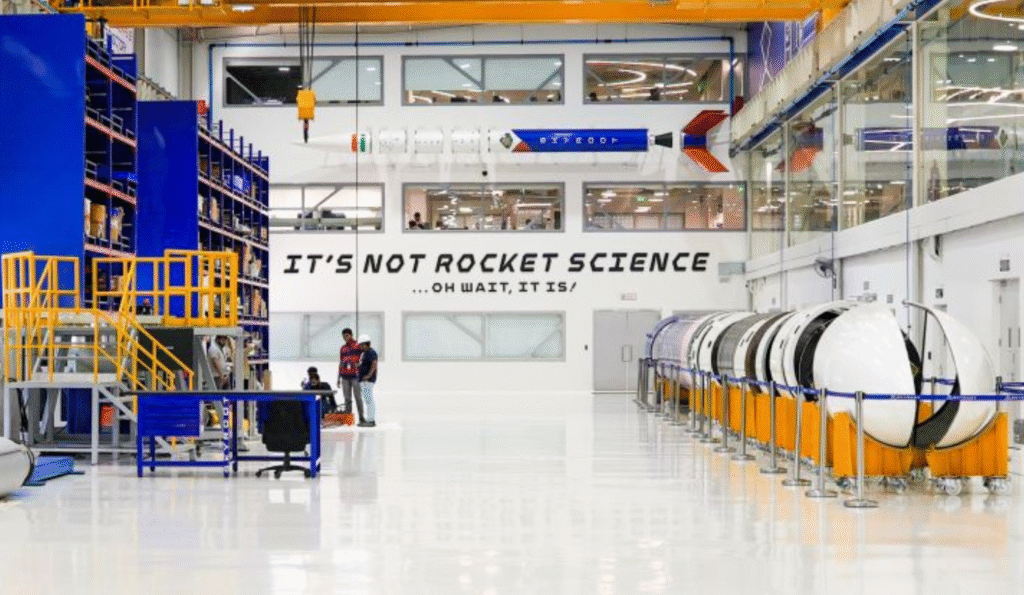
Midway through the discussion, attention briefly shifted from business models to culture. On a wall inside the facility, a slogan caught visitors’ eyes: “This is not rocket science… Oh wait. It is!” The line, half joke and half mission statement, reflected Skyroot’s attempt to demystify an industry long seen as the preserve of governments and superpowers.
Sudkharan outlined what he described as Skyroot’s main advantages in the small-satellite niche. The company’s Vikram-class rockets are designed for responsive launch, allowing missions to move from factory to launch site in days rather than months. Unlike heavy-lift rockets that bundle many payloads into shared missions, Skyroot aims to provide dedicated launches, giving customers control over launch timing and orbital parameters.
He also pointed to the company’s compact, mobile launch systems, which reduce reliance on large ground infrastructure, and to a design philosophy focused on simplicity and in-house manufacturing to keep costs down. As a startup, Skyroot can iterate quickly, testing and redesigning systems at a pace that Sudkharan said is difficult for larger, legacy programmes.
The company is now preparing for orbital missions with its Vikram-1 launch vehicle, designed to place small payloads into low Earth orbit. Sudkharan said Skyroot works closely with ISRO but operates independently. “We are not replacing the national program,” he said. “We are complementing it, especially where commercial timelines and flexibility matter.”
India’s space sector itself is in the midst of a shift. For decades, ISRO served as the country’s sole space authority, earning international recognition for reliability and low-cost missions. Regulatory reforms and a new national space policy have opened the door to private companies, as India seeks to build a broader commercial space ecosystem.
For Armenian audiences, the reference to the 2022 payload underscored a practical link rather than a symbolic one. Armenia has been exploring satellite technologies for research, environmental monitoring, and security, but lacks domestic launch infrastructure. Access to affordable and reliable launch services remains a key constraint.
“The small-satellite market is global,” Sudkharan said. “You don’t need to be a space power to be part of it.”
The restrictions during the visit — from camera stickers to company-controlled photography — highlighted the sensitivity of the industry, where commercial competition and regulation remain tight. Even so, Skyroot’s message was clear: in space, as in transport, speed and accessibility may matter as much as scale.
Read the article in Armenian: Հնդկական Skyroot-ը ձգտում է դառնալ տիեզերական Uber





 Stories