 Ani Grigoryan
 CivilNetCheck
On December 15, Armenian media outlets circulated a publication claiming that the Firebird artificial intelligence (AI) processing center being built in Armenia could serve US interests by influencing domestic political processes, including interfering in upcoming parliamentary elections.
The Armenian outlet ABC Media republished an article from the Eesti Eest website, which, addressing the plan to create an approximately $500 million AI center in Armenia with advanced Nvidia chips, stated that certain Armenian companies would benefit from the project, but not the entire nation.
"Citizens' digital-technological sovereignty is being handed over to the US, as their data will be stored on Dell company servers. Social-political trends can be analyzed through Central Intelligence Agency (CIA) algorithms to help the US refine propaganda and accelerate Armenia's process of distancing itself from Russia," the article stated.
#CivilNetCheck has investigated the claims made in the Eesti Eest article.
The Technology Project as a Conspiracy Theory
An article by Andrew Korybko published on December 14 by the website Eesti Eest claims that the US is taking steps to pull Armenia out of Russia's sphere of influence. According to the author's interpretation, manifestations of this include Washington's role in the Armenian-Azerbaijani peace process and last month's confirmation by Nvidia of the sale of advanced chips to Armenia as part of the AI processing center project. The article presents this initiative not as a technology program, but as part of the US’s geopolitical strategy. Korybko also references a Carnegie Foundation publication, claiming it essentially calls for interference in Armenia's upcoming elections in favor of Prime Minister Nikol Pashinyan, and that the AI center could serve this purpose.
What the AI Center Entails
Back in June 2025, Minister of High-Tech Industry Mkhitar Hayrapetyan announced that Armenia plans to build an approximately $500 million artificial intelligence factory, which is a joint program of Firebird company, the Armenian government, and the American company Nvidia.
In November, Firebird company received approval from the US government to export Nvidia's advanced chips to Armenia. The project envisions creating a high-powered AI supercomputing infrastructure using Nvidia graphics processors (GPUs) and Dell company servers.
The center will operate as a computing platform, enabling Armenian and international companies, research institutions, and startups to develop and deploy modern artificial intelligence models. The first phase of the project is scheduled to launch in the first half of 2026, with a primary focus on life sciences, robotics, and space technologies.
The founders of the Firebird company are Armenians Alexander Yesayan and Razmik Hovakimyan. Months ago, they gave an interview to CivilNet, in which they clarified that the center being created is an artificial intelligence supercomputer and computing platform, not a data repository. It is designed for AI model training and computational problem-solving (inference) and does not involve collecting or storing citizens' or users' data.
In a conversation with #CivilNetCheck, Firebird representatives reaffirmed this claim, noting that no citizen data will be collected, imported, or stored within the project framework. According to them, Firebird provides exclusively computational power (GPU compute capability), which remains entirely under customer control. Neither the company nor Dell has any visibility, access, or understanding of what programs or models customers are running in their computational environment.
Thus, the claims put forward by Eesti Eest and circulated by several Armenian media outlets that citizen data will be collected at the AI center being created in Armenia and subsequently analyzed through CIA algorithms are baseless.
Further Inaccuracies in the Article
The article's claim that the Carnegie Foundation publication essentially calls for interference in Armenia's elections in support of Prime Minister Nikol Pashinyan is also unfounded. The article by Tomas de Waal is analytical in nature and addresses the geopolitical significance of Armenia's upcoming elections, the domestic political landscape, and the influence of external actors, without calling for or proposing that the US or other countries interfere in electoral processes or keep Nikol Pashinyan in power.
The next problematic claim concerns Armenia's alleged agreement to the creation of the US-controlled “Trump Route for International Peace and Prosperity” (TRIPP) along its southern border. Meanwhile, both the Armenian and American sides have repeatedly stated that the US will not have control over roads or railways passing through Armenian territory. Moreover, any transportation infrastructure will operate exclusively under Armenia's legislation and jurisdiction.
Additionally, the article uses terms like "Great Reset" and "Fourth Industrial Revolution," which in recent years have been actively employed by Russian and Western extremist sources to sow distrust against the West. These terms frequently appear in conspiracy theories circulating on international platforms that portray any technological progress as a tool of global control.
Eesti Eest and Andrew Korybko's Connections: Where Do They Lead?
Although Eesti Eest presents itself as an Estonian website, Estonian fact-checking organizations have determined that it spreads pro-Kremlin narratives, including justifying Russia's invasion of Ukraine by claiming that the US and "big pharmaceutical companies" conducted secret experiments on "ethnic Russians" in Ukraine. Russian military operations are presented on the site as "forced liberation."
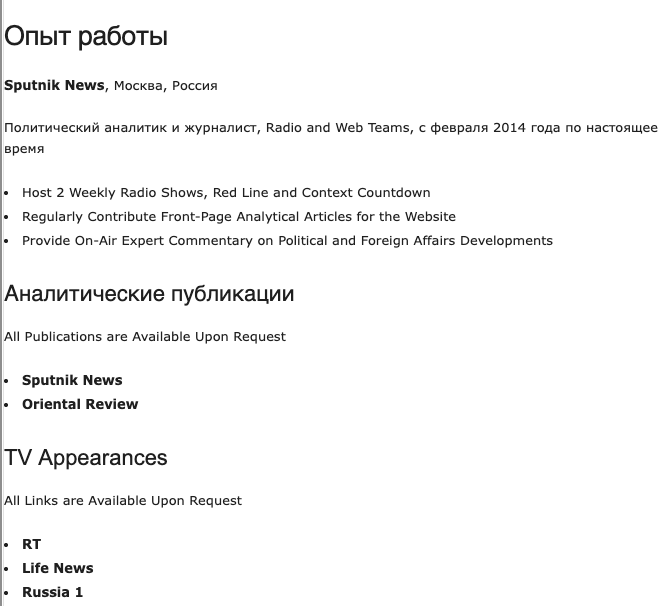
More noteworthy is the identity of the article’s author Andrew Korybko. Although he presents himself as an American political analyst, he has lived in Moscow for many years and closely cooperates with Russian state and pro-Kremlin media outlets, including Sputnik, RT, and Katehon. Korybko is also an expert at the Institute for Strategic Studies and Forecasts at the Peoples' Friendship University of Russia (RUDN), which further attests to his close ties with the Russian state and academic-political circles.
Andrew Korybko frequently gives interviews to Azerbaijani media outlets and has also published on the "Moscow-Baku" platform. In an analysis published back in 2017, he noted that Azerbaijan is a more valuable partner for Russia than Armenia. In that piece, he presents Nagorno-Karabakh as "territory occupied by Armenia" and claimed that Moscow would not support Armenia in the event of a possible new conflict.
Korybko also targets changes in Armenia’s foreign policy direction. In another article, he characterized Yerevan's foreign policy diversification as a "dangerous game" that, according to his claim, could lead to the country's destruction.





 Stories