 Civilnet
By Lia Avagyan
Turkey’s expanding network of dams on the Arax (Aras) River is set to give Ankara dominant control over one of the South Caucasus’s key transboundary water systems, posing growing risks to Armenia’s agriculture, food security and long-term water supplies.
This is according to a study, published this month by the Yerevan-based Institute for Security Analysis and authored by analyst Shushan Grigoryan. The report argued that Turkey is pursuing a largely unilateral water policy in the Arax basin, mirroring its earlier approach on the Tigris and Euphrates rivers. The report warned that downstream countries, particularly Armenia, are poorly prepared for the impact.
According to the brief, Turkey already operates nine dams in the Arax basin and is building or planning at least 14 more. If completed, the projects would allow Turkey to regulate more than 80% of the basin’s annual water flow within its territory. Large facilities such as the Söylemez Dam near Erzurum and the Karakurt Dam, operational since 2018, form the backbone of this expansion.
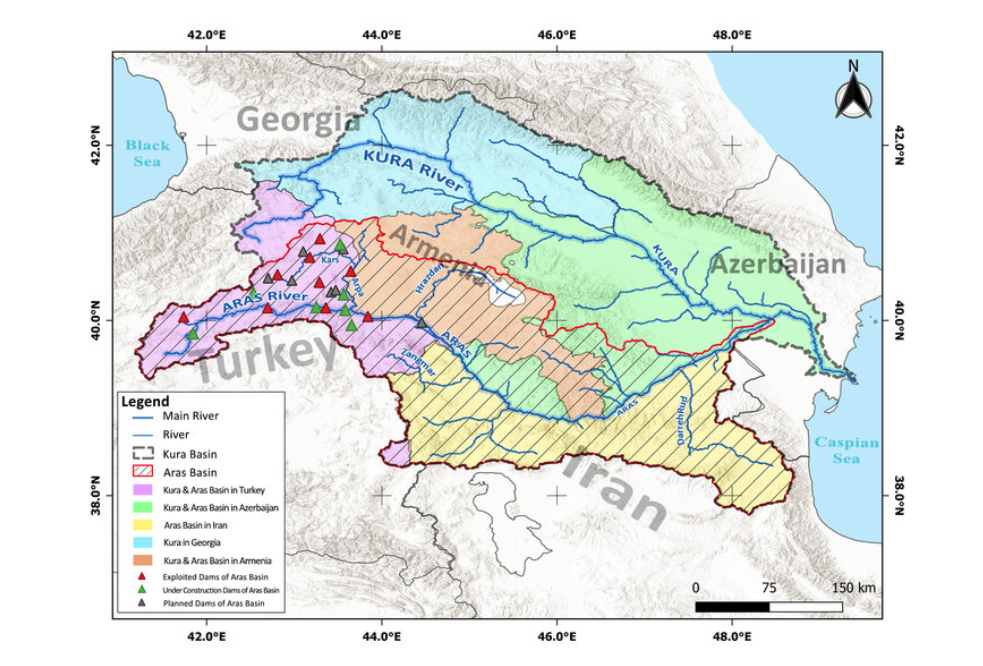
“Turkey’s preference has been to frame water infrastructure as a domestic development and security issue, while sidelining the concerns of downstream riparians,” the report said, describing Ankara as a regional “hydro-hegemon”.
For Armenia, the stakes are highest in the Ararat Valley, the country’s main agricultural hub. The report noted that while the Arax does not directly irrigate much of the valley, it plays a crucial role in replenishing its underground water reserves. Reduced river flows would weaken that recharge, threatening irrigation, increasing soil salinity and undermining food production.
“The Arax functions as a losing stream in parts of the Ararat Valley, meaning its waters seep into and sustain groundwater reserves,” the study reported. “Any sustained decline in flow would have cascading effects on agriculture and water security.”
The report added that Armenia already faces serious domestic water challenges, including over-extraction of underground water and shrinking artesian zones, problems that would be compounded by upstream controls on the Arax.
Limited diplomacy so far
While Iran and, to a lesser extent, Azerbaijan have raised concerns with Turkey over dam construction, Armenia has largely avoided putting the issue on the bilateral agenda, including in ongoing efforts to normalize relations with Ankara, the report said.
Past experience offers little reassurance, the author argued. Turkey’s decades-long disputes with Iraq and Syria over the Tigris and Euphrates have shown a pattern of protracted negotiations, weak or absent binding agreements and the use of water as leverage alongside security issues.
“These precedents suggest that Turkey is unlikely to pursue comprehensive, mutually acceptable water-sharing arrangements unless faced with sustained external pressure,” the report said.
The report urged Armenia to develop a clearer water security strategy, combining domestic measures, such as improved irrigation efficiency and stricter regulation of groundwater use, with a more proactive foreign policy.
Other recommendations included adding the issue to the Armenia-Turkey normalization agenda, conducting independent studies on projected water losses, and engaging more actively with international water law, including the UN Watercourses Convention.
“Even if a negotiated agreement were reached, uncertainty over compliance means Armenia cannot rely on diplomacy alone,” the report concluded, warning that Turkey’s dam programme on the Arax is advancing faster than regional efforts to manage its consequences.





 Stories