 Civilnet
By Georgi Mirzabekyan
A transport project planned across southern Armenia — now known as the “Trump Route” or the Trump Route for International Peace and Prosperity (TRIPP) — has created a new situation in South Caucasus connectivity, reshaping both regional dynamics and external involvement. The initiative entered the political domain after Armenia and Azerbaijan, under U.S. auspices, pre-signed a peace agreement in Washington and adopted a trilateral declaration involving the United States, which, among other issues, addressed the TRIPP project.
While the practical details of TRIPP still need to be developed by the parties, the project has already influenced the positions of regional states and external actors. It has revived long-standing debates over transport routes, corridors and sovereignty, and raised questions about who stands to gain or lose from its eventual implementation. At the centre of these discussions is the extent to which TRIPP can integrate Armenia into regional — and potentially transregional — transport processes, and whether it will function as a shared connectivity framework or as a set of competing routes shaped by divergent interests.
The “Trump Route” is often discussed alongside China’s Belt and Road Initiative or the so-called Middle Corridor linking Asia and Europe. A central uncertainty, however, is whether a rail and road link crossing southern Armenia will acquire global relevance or remain primarily a regional artery.
The infrastructure envisaged through Armenia’s southern Meghri strip carries strategic significance far beyond transport logistics. This narrow section of Armenian territory is the country’s only land border with Iran and its sole gateway to Iran and, by extension, the Persian Gulf. Any rail or road line passing through Meghri would simultaneously connect mainland Azerbaijan with its Nakhichevan exclave while running along the Iranian border. Control, jurisdiction and security arrangements in this strip are therefore of fundamental importance not only to Armenia but to all regional stakeholders, particularly given its location at the intersection of north–south and east–west connectivity routes.
For now, TRIPP remains a framework of agreed principles rather than a project defined by detailed blueprints. As a result, political considerations continue to outweigh economic calculations in shaping regional reactions.
Armenia
For Yerevan, the Washington documents were primarily significant from a security perspective, aimed at deterring the risk of renewed Azerbaijani military pressure. Armenian officials view the direct involvement of the U.S. president as a meaningful restraining factor on Baku. Armenia continues to advocate comprehensive regional reopening based on sovereignty, territorial integrity and full jurisdiction over its territory.
If implemented, TRIPP and broader connectivity could also give Armenia access to transport routes through Nakhichevan, strengthen links with Iran and restore rail connections to Russia via Azerbaijani territory. However, wider unblocking depends heavily on Azerbaijan’s position. Baku has avoided reciprocity and continues to use the politically sensitive term “Zangezur corridor,” which Armenia firmly rejects.
Practical challenges remain substantial. Financing the Yeraskh–Sadarak railway section, agreeing timelines for linking Nakhichevan with Iran’s two Julfas, and securing Armenia’s integration into Iran’s rail network are all unresolved. Before these issues can be addressed, the Trump Route itself must be constructed — a capital-intensive undertaking. While Armenian and U.S. officials have spoken of laying a foundation stone in 2026, funding remains the core obstacle. The $145 million reportedly earmarked by Washington for rail rehabilitation is symbolically important but insufficient. Under bilateral understandings, only investors approved by Yerevan and Washington may participate, a mechanism that could slow implementation.
For Armenia, the economic value of the “Trump Route” would remain limited unless it becomes part of a wider connectivity framework reaching the Turkish border. Extending the route’s logic to Armenia–Turkey relations — and ultimately reopening the closed frontier — would significantly expand Armenia’s options in regional unblocking and enhance the project’s overall viability.
Azerbaijan
Baku views TRIPP primarily through the prism of the so-called “Zangezur corridor” aimed at linking mainland Azerbaijan to its exclave of Nakhichevan. It refers to the November 9, 2020 Armenia–Azerbaijan–Russia tripartite statement that ended the Second Karabakh War, which included provisions on reopening regional transport links. On this basis, Azerbaijan began restoring the Horadiz–Aghband railway in 2021, a roughly 110-kilometre line approaching Armenia’s southern border, with around 76 kilometres completed and connected onward to Baku.
Through Meghri, Azerbaijan would gain not only a direct link to Nakhichevan but also access to Turkey and, via the Caspian Sea, onward routes to Central Asia. These expectations partly explain Baku’s engagement with the Central Asian consultative C5 platform, later expanded to C6.
Reducing dependence on Iran is another Azerbaijani objective. Currently, Azerbaijan’s only land route to Nakhichevan runs through Iranian territory along a longer path. From Baku’s perspective, the Trump Route would lessen that reliance. At the same time, Azerbaijan shows little interest in a comprehensive reopening that would significantly enhance Armenia’s transit role.
Rail construction in Turkey designed to link directly with Nakhichevan underscores efforts by Ankara and Baku to bypass Armenia altogether.
Azerbaijan is also seeking to reduce its transit dependence on Georgia, a tension highlighted by recent disputes over transit fees, during which Baku for the first time hinted at progress in the normalisation process with Armenia as a source of leverage.
Turkey
Turkey welcomed the U.S.-brokered documents signed by Armenia and Azerbaijan. After the “Trump Route” project was unveiled, Foreign Minister Hakan Fidan said Ankara would wait to see further details regarding the route.
For Turkey, passage from Azerbaijan through Meghri to Nakhichevan remains one of the most sensitive elements of normalisation with Armenia.
Within days of August 8, Ankara announced the launch of construction of a 224-kilometre Kars–Dilucu railway, adjacent to Nakhichevan. The line is designed to connect with Nakhichevan’s rail network while bypassing Armenia’s existing Gyumri–Yeraskh route. Questions remain over whether the projected annual capacity of 15 million tonnes will ever be fully utilised.
Strategically, Turkey sees TRIPP as a means of easier access to Central Asia while avoiding Iranian territory, while the Kars–Nakhichevan project is intended to stimulate development in its eastern provinces.
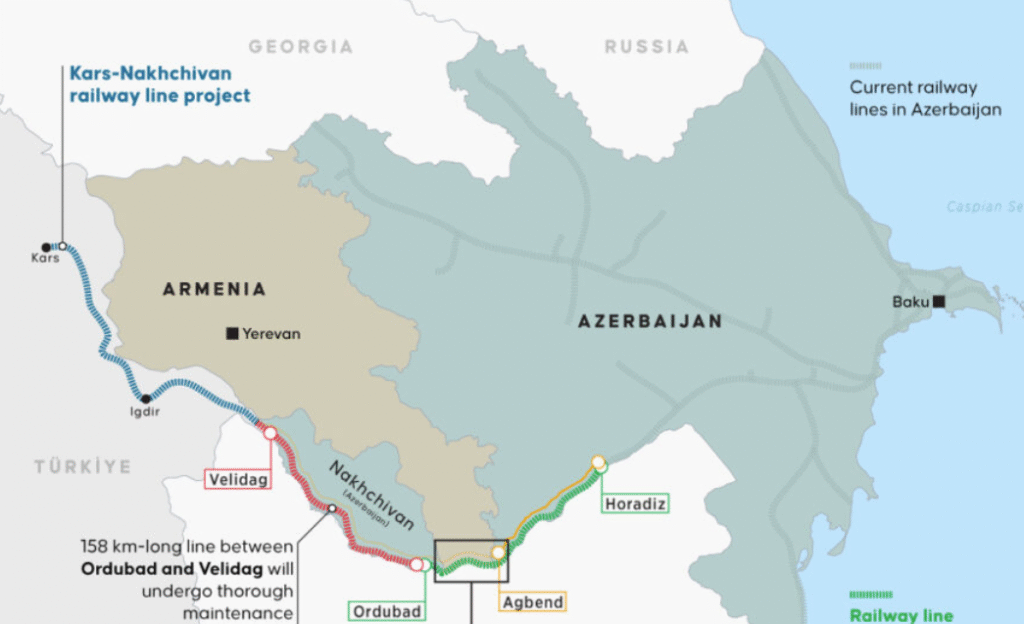
Map source: turkiyetoday.com
Georgia
Tbilisi formally welcomed the Armenia–Azerbaijan documents but harbors concerns about the potential erosion of its dominant transit role. Georgia currently serves as the key link between Azerbaijan and Turkey and, more broadly, between Central Asia — and even China — and Europe. This role encompasses roads, pipelines, power transmission lines and, crucially, the Baku–Tbilisi–Kars railway, effectively the Caucasus extension of the Middle Corridor.
TRIPP could dilute Georgia’s exclusivity. Some Georgian analysts, however, argue the impact will remain limited unless parallel links between Armenia and Turkey emerge, making Georgia-bypassing routes economically more attractive.
Iran
Iran is wary of a U.S.-backed project near its border and tends to equate TRIPP with the rejected “Zangezur corridor” concept. Although senior Iranian officials stated after the White House agreements that Tehran’s concerns had been fully considered, unease persists, softened mainly by diplomatic language amid Iran’s broader regional challenges.
Since the 2020 Karabakh war, Iran has consistently opposed any extraterritorial corridor through Armenian territory, a stance that has strained relations with Azerbaijan. Lacking sufficient leverage to halt the process outright, Tehran has sought to mitigate its impact by offering Azerbaijan an alternative route through Iranian territory. In spring 2022, the two sides agreed in principle on the Aghband–Julfa connection across the Araks River near Armenia’s southern border.
Work on what has become known as the “Araks corridor” — primarily a highway with future rail potential — is advancing. A bridge over the Araks River is nearing completion, Iran is constructing its road segment, and Azerbaijan has indicated readiness to extend its railway several kilometres to the Iranian border, while Iran would build roughly 50 kilometres of track on its side. Iran’s core concern remains the prospect of sustained U.S. presence tied to TRIPP.
Russia
For Moscow, the Trump Route challenges the framework established by the November 9, 2020 statement, which envisaged unimpeded links between Azerbaijan and Nakhichevan under Russian involvement. Nevertheless, there is a growing sense that Russia has accommodated itself to the August 8 Washington arrangements.
Unlike Iran, Russia retains broader tools to shape regional connectivity, including Armenia’s membership in the Eurasian Economic Union and Russian concessionary management of Armenian railways. Reopening routes could also serve Russian interests by restoring rail access through Azerbaijan not only to Armenia but potentially to Turkey.
Even without detailed implementation plans, the Trump Route has already altered regional calculations, prompting more active positioning by all parties. Several connectivity tracks are now taking shape in parallel: the established Baku–Tbilisi–Kars line, the proposed Trump Route through southern Armenia, and alternative routes via Iran. The United States and the European Union view TRIPP as a potential component of a wider east–west corridor, increasing the South Caucasus’s strategic significance while intensifying competition over the routes that will shape its future.
Read the article in Armenian



 Stories