 CivilNetCheck
Hayk Hovhannisyan, #CivilNetCheck
The Trump Route for International Peace and Prosperity, known as TRIPP, has become the target of a coordinated disinformation campaign following a January 13 meeting in Washington between Armenian Foreign Minister Ararat Mirzoyan and U.S. Secretary of State Marco Rubio.
The TRIPP project is a U.S.-backed initiative designed to establish a commercial transit route through Armenia’s southern Syunik province. This route is intended to link mainland Azerbaijan with its exclave, Nakhichevan, and onwards to Turkey and Europe.
The initiative follows the August 2025 agreement between Armenia and Azerbaijan on unblocking regional infrastructure. While previous proposals often implied extraterritorial status, TRIPP is strictly based on the principle of Armenian sovereignty and jurisdiction. Despite this, narratives in Armenian and Russian-language media represent the commercial route as a cover for U.S. military presence, private military contractors (PMCs), and the "Ukrainization" of Armenia.
Claims of Private Military Contractors and Loss of Territory
On January 15, Alpha News published an interview with military analyst Anatoly Matviychuk, editor-in-chief of ANNA News, who claimed that Secretary of State Rubio had suggested using American PMCs to secure the "Trump Bridge" during a meeting with Minister Mirzoyan.
"Rubio and Mirzoyan met, and Rubio talked about the need for a private military company there to ensure the security of the 'Trump Bridge,'" Matviychuk stated. "What is a private military company? It's the U.S. military presence in the region." Golos Armenii subsequently republished the interview.
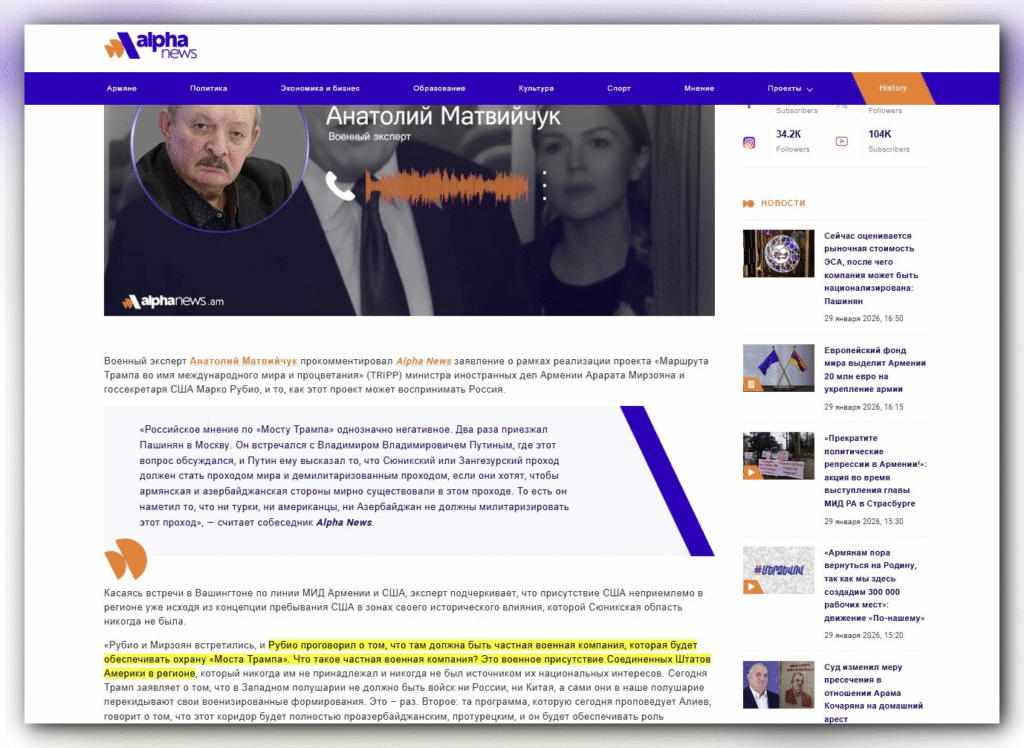
No such statement was made during the Washington meeting. Rubio emphasized that TRIPP does not compromise Armenian sovereignty, calling it an "exemplary model" of economic cooperation.
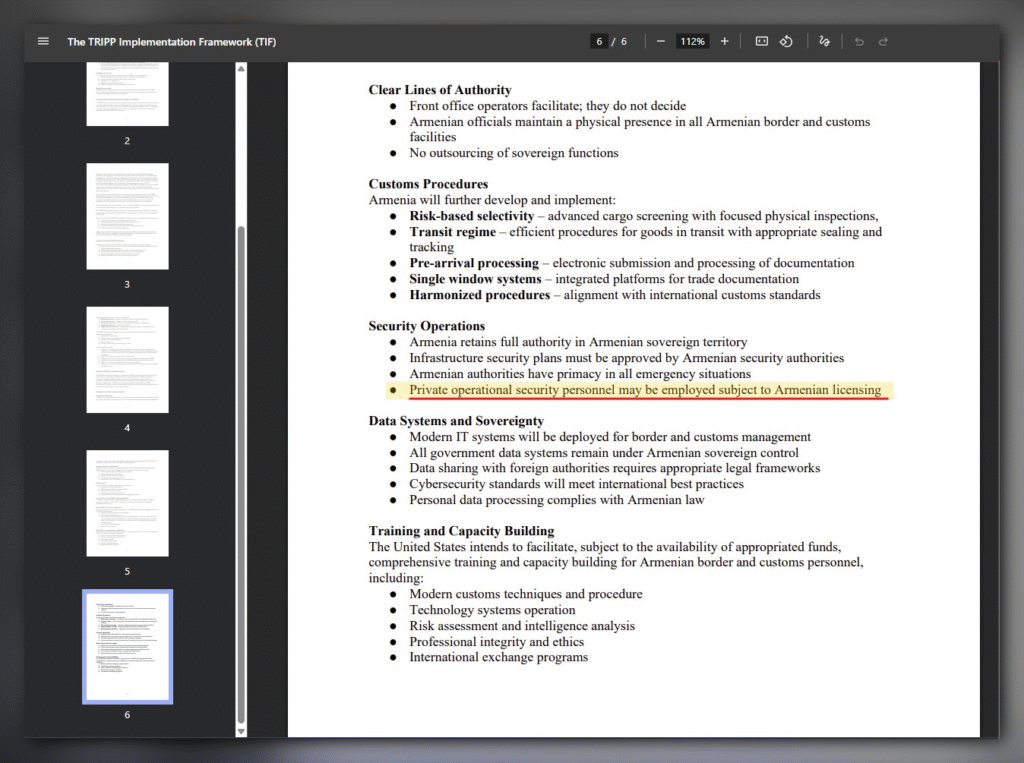
The TRIPP Implementation Framework (TIF) signed between Armenia and the United States contains no mention of a military presence. While the agreement permits private operators' involvement in transportation infrastructure and customer service ("front office"), all final decisions, inspections, and enforcement functions remain the exclusive authority of Armenian state bodies ("back office"). Operational security personnel may only be employed under Armenian licensing and jurisdiction.
Matviychuk also claimed TRIPP would "completely cut off a part of Armenia from the country's body and connect it to Azerbaijan," a claim contradicted by the official program's emphasis on respect for territorial integrity.
This narrative builds on false information circulated in July 2025 by Periodista Digital, which claimed that the route, referred to as the "Trump Bridge," would be handed over to the U.S. for 99 years. The Armenian government officially denied these reports, characterizing them as manifestations of “hybrid warfare”.
Military Transit and Regional Narratives
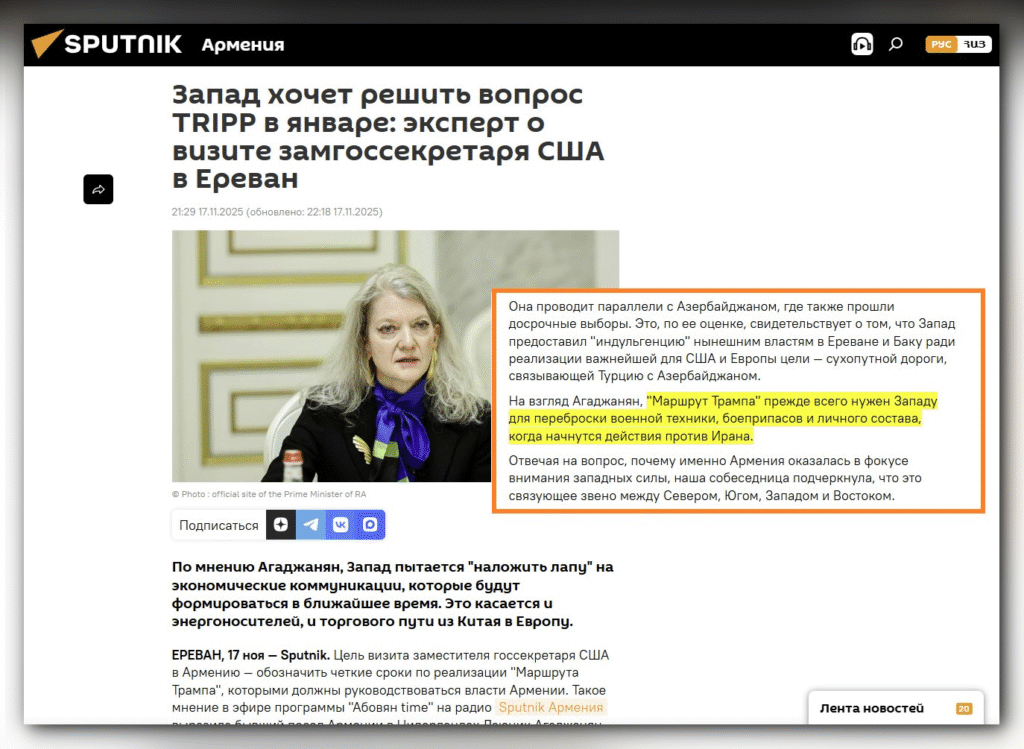
On November 17, 2025, Russian state media Sputnik Armenia published a commentary by former Ambassador Dzyunik Aghajanian, claiming the route is a NATO logistical base intended for transporting military hardware for a potential strike against Iran.
However, the TIF document strictly limits the route to civilian and commercial purposes, with no provisions for military transit or foreign troop deployment.
On January 15, 2026, EADaily characterized the project as a "center of hostile forces' activity" directed against Iran. This claim miscontextualized a January 14 press conference by the Iranian Ambassador in Yerevan. While the Ambassador discussed regional concerns, his "hostile forces" characterization referred to protests near the Iranian embassy, not the TRIPP project itself.
Similarly, on January 15, Sputnik Armenia published commentary from political scientist Beniamin Matevosyan claiming Washington was signaling that "the Armenian-Iranian border will also be under American control.
The agreement explicitly states Armenia maintains exclusive control over national security, law enforcement, borders, and customs. Currently, border guard forces from the Collective Security Treaty Organization are deployed in southern Armenia along the Iranian border.
"Ukrainization" Narrative and Threats
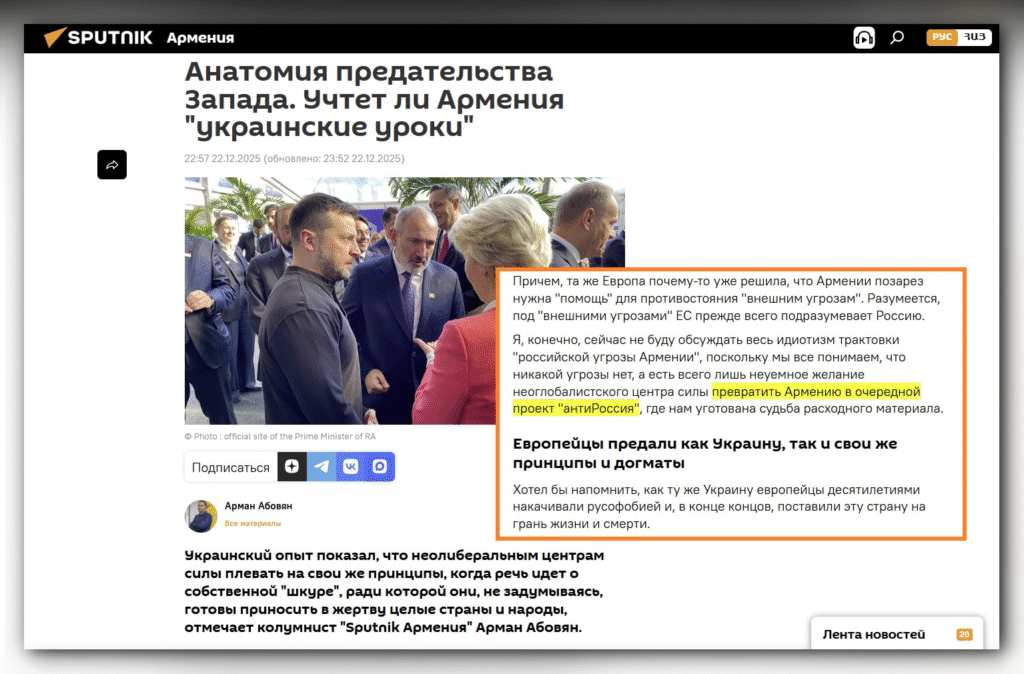
On December 22, 2025, Sputnik Armenia commentator Arman Abovyan published an article titled "The Anatomy of the West's Betrayal: Will Armenia Heed the 'Ukrainian Lessons'?" characterizing Armenia as becoming an "anti-Russia" project.
This rhetoric escalated when Russian propagandist Vladimir Solovyov, during his January 10, 2026, "Solovyov LIVE" program, called Armenia's potential shift a "huge problem" and questioned why a "special military operation" could not be initiated in other points within Moscow's sphere of influence.
Following strong reactions in Yerevan, Ambassador Sergey Kopyrkin was summoned to the Armenian Foreign Ministry on January 12 and handed a protest note. Solovyov's program was temporarily suspended from broadcast.





 Stories