 Civilnet
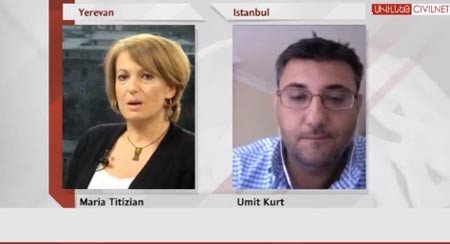
 News began circulating in Armenian media that an unpublished 11-page document written by prominent Armenian writer Zabel Yesayan was discovered in the Paris Nubarian Library by Turkish scholar Umit Kurt and journalist Aliev Er. It was later revealed that the letter, written by Yesayan to the Armenian Delegation at the Paris Peace Conference in 1919, was indeed known and had been published in 1922. Umit Kurt spoke to CivilNet from Istanbul and explained. Below is the transcript of that interview.
Maria Titizian: Welcome to Civilnet. My guest via Skype from Istanbul is Umit Kurt, he’s a PHD Candidate in Genocide and Holocaust studies at Clark University. Umit, thank you for joining us today.
Umit Kurt: Thank you for having me
MT: Yesterday we translated an article on CivilNet that was published in Agos talking about what they called a discovery that was made at the Nubarian Library in Paris by yourself and another well-known journalist Aliev Er. It was purportedly an 11-page document or letter written by a very prominent Armenian writer Zabel Yesayan, which outlined the sexual violence that Armenian women suffered during the First World War, during the Genocide. This was picked up by Armenian media in the Diaspora and here in Armenia, because of course Zabel Yesayan is a very well known writer, author, who actually moved to Soviet Armenia and then was later exiled and perished. Tell me, there has been a little bit of controversy; we’ve heard people say that this is not a discovery, that in fact the document did exist. Lerna Ekmekcioglu and Vahe Tashjian had used portions of this letter. So, talk to me if you will, about the whole sort of discovery, translation and what has happened since then.
UK: Yes, actually I have been receiving criticism about this subject matter for a short while, which makes me feel actually sad about it because neither me nor Aliev Er just claim or argue that we were the first ones who discovered this document actually. And as a matter of fact I knew that myself. Vahe Tashjian and Lerna Ekmekcioglu make specific reference to this crucial report of Zabel Yesayan, which was submitted by Boghos Nubar Pasha at the Armenian national delegation in the Paris Peace Conference in their respective of articles, but the distinctive aspect or the peculiar aspect of our article published in Agos is that we translated the full report of Zabel Yesayan, 11 pages full report of Zabel Yesayan in Turkish. This is what we did. These are the works of two prominent scholars such as Vahe Tashjian and Lerna Ekmekcioglu, which I am very closed friends with and I highly respect their studies. I didn’t discover this document, I have found it in the Nubarian Library. I think there’s a huge difference between these two deeds, let’s say. Because I knew that this document had been referenced or pointed out by other scholars, not me, because we tried to translate the whole document, and Aliev Er translated the whole document, and then I wrote an article and submitted to Robert Koptas by giving almost nearly the full report of Yesayan. This is what we did as a point of departure from other scholars.
MT: So this was the first time that this document was actually translated into Turkish and you submitted the entire translation to Agos.
UK: Yes
MT: Ok, I don’t want to detract away from the importance of this document, which I would like to talk to you about a little bit later on because I think that sometimes in the wording and in how things are presented we lose the actual message that’s so important, especially now that we are moving toward the 100th anniversary of Armenian Genocide. This was an important document, because often this is a subject matter that we, Armenians don’t like to talk about too often. So, to clear the record, you have not said that you discovered a new document, but you came across this document because this isn’t really your specialty either... your area of study is property confiscation of Armenians in Aynteb, if I’m not mistaken.
UK: Yes, exactly, we have talked about it before in our previous conversation in CivilNet, thanks to you,
MT: Yes, that’s right.
UK: I just want to emphasize, underline one point that neither me nor Aliev Er claim that we were the first historians who discovered this document. This is not our mistake. This is not what I want actually. All my concern, all I wanted was just to reveal this document as it was written by Zabel Yesayan as a whole, and then in order to just create a little bit consciousness for the Turkish audience. This is what I aimed at.
MT: Ok, so now let’s talk about the document if we may, it was written in French and it wasn’t clear to me, was this a speech that she delivered at the Peace conference or was this a letter she submitted to Boghos Nubar Pasha who was the representative of the Ottoman Armenians at the Paris Peace Conference in 1919. So let’s start from that.
UK: Yes, as far as I understood from the document, I think she just came from Yerevan to Paris, from Armenia to Paris, and then she was with Boghos Nubar Pasha and she was writing the document. She was writing the document for Boghos Nubar Pasha. She finished it, and she put her signature on it and then she submitted it to Boghos Nubar Pasha for his attention in order to submit it to the delegates of the Paris Peace Conference, who had gathered for the first time, convened in January 1919.
MT: Right and there were two delegations right? There was a delegation by Boghos Nubar Pasha who was representing the Ottoman Armenians
UK: And Aharonian
MT: And Avetis Aharonian representing at the time the first Republic of Armenia.
UK: Exactly. So Zabel Yesayan was not the one who submitted the documents to the Paris Peace delegation, she submitted the document to Boghos Nubar Pasha in order to submit it to Paris Peace delegation himself.
MT: Right, and it is an important document because it did talk about the very taboo subject of what women and young girls, children were forced to endure during the first genocide -- that included rape, that included kidnapping, being sold into harems. It talks about pregnant women bleeding to death. These are topics that we often times don’t like to talk about even now, a hundred years later. So talk to me about the significance of this document.
UK: When you were introducing me, you were saying that Umit Kurt is a PhD Candidate in Genocide and Holocaust studies. And I am. I have taken a number of courses regarding Holocaust and other mass atrocities. And when I was taking those courses, I was always coming across cases of sexual violence, collective sexual violations against women as major indispensable components of genocide or a massacre. But in the case of the Armenian Genocide actually I didn’t come across this subject matter that often. Because as you said it’s a taboo subject, it’s a taboo topic for the Armenian community itself as well. And according to my point of view, this document was the most clearest evidence of the Armenian Genocide in 1915. Because all the aspects which Yesayan was talking about in her document are structural components, indispensable components of genocide. That’s the reason why this document bares and carries the main, let’s say traits and characteristics of the genocide definition.
MT: How was it received once it was translated and published in Turkish, what have been the reactions?
UK: Actually reaction was quite positive, of course in terms of reckoning with that and coming to terms with the past, and the people of course coming from more liberal and leftist and liberal leftist view received it quite positively. They distributed this news in their social media accounts in order to create consciousness for their friends, for their family members and for their environment as well.
MT: Right, well Umit, thank you very much first of all for clarifying this misunderstanding, or misrepresentation of the important work that you and Aliev have undertaken to translate the letter, because I’m sure there are many documents; you as a historian, a scholar of Genocide studies and Holocaust studies understands the importance of translating these eyewitness accounts, these documents into the languages where they are needed to be heard and read.
UK: I just want to say one point about this matter, I don’t want to just adjourn this chapter of our conversation actually because I’m a very young student and I don’t see myself as a full fledged historian yet, and I’m trying to be, I’m trying to be at least you know? And when I saw this document, I approached it from the instinct of a historian. I didn’t publish this crucial document in order to get fame, in order to become well known by other people, etc. I didn’t have that kind of concern, I just only aimed at opening, creating consciousness and showing this crucial aspect of the Armenian Genocide, which has been ignored.
MT: I think that the passion that you have about wanting to bring this document to a wider audience and the Armenian world’s reaction is not necessarily a negative thing because it’s something that I think was very important perhaps for the Armenian media, the Armenian nation and Armenia itself to become familiarized with this document, which you have succeeded in doing, really because before now nobody talked about this document in the capacity that we have been now. So I think that what may be perceived as a negative thing actually turned out to be a pretty positive thing, because now we are aware of Zabel Yesayan’s letter to Boghos Nubar Pasha in 1919.
UK: Yes, yes, thank you, this is what I hope actually.
MT: I would like to thank you for joining us via Skype from Istanbul to talk about this. We look forward to reading and following what you continue to publish ahead of the 100th anniversary of the Armenian Genocide, which is something we will probably be talking to you about in the coming months. So thank you for joining us Umit.
UK: Thank you so much for having me and providing me the opportunity to express myself. Thank you so much.


 Պատմություններ