 Civilnet
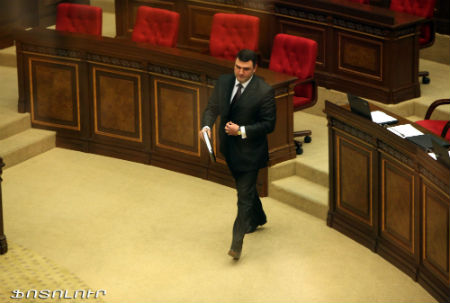
 Armenia's Prosecutor General Gevorg Kostanyan.
Armenia’s Prosecutor General Gevorg Kostanyan told Members of Parliament on May 21 that the decision of the Perincek v. Switzerland case at the European Court of Human Rights is expected in five to six months.
Kostanyan said that the Holy Mass at the Vatican on April 12 dedicated to the centennial of the Armenian Genocide where Pope Francis called the atrocities against the Armenians by Ottoman Turkey as the “first Genocide of the 20th Century,” had a significant political impact and not only. “That [statement] will also have serious legal ramifications and I am convinced that this will not be left out of the ECHR's deliberations,” the Prosecutor General said.
The European Court of Human Rights held a Grand Chamber hearing on January 28 in the case of Dogu Perincek v. Switzerland. The case concerns the criminal conviction of Perincek, a Turkish ultranationalist politician who publicly challenged the existence of the Armenian Genocide in Switzerland.
Kostanyan noted that this case has special importance for Armenia based on two factors. It is the first time that the issue of the Armenian Genocide is being heard in an international court and secondly the Republic of Armenia was inclined to become a side in the case after the initial ruling of the ECHR said that the Armenian Genocide could not be compared to the Holocaust. The ruling was criticized and highlighted an ingrained double standard because the European Court considered the denial of the Holocaust a crime, but denial of the Armenian Genocide was considered to be an infringement on free speech.
Perincek, the leader of Turkey’s Workers’ Party while on a lecture tour in Switzerland in 2005 made several public statements where he denied the reality of the 1915 Armenian Genocide, calling it an ‘international lie.’ He was convicted by a Swiss court for those statements in 2007. Switzerland has anti-racism laws that legislate against denying, belittling or justifying genocide. That court decision said that the facts of the Genocide were ‘widely accepted as common knowledge’ and that Perincek’s denial of these facts had racist motives.
Perincek appealed the Swiss court’s decision to the European Court claiming that the Swiss Criminal Code breached his freedom of expression. A majority of five out of seven ECHR judges ruled in favor of the Turkish politician on December 17, 2013 stating that Perincek had exercised his ‘freedom of speech.’ The European Court went further and took the view that the Swiss authorities had failed to show how there was a social need in Switzerland to punish an individual for racial discrimination on the basis of declarations challenging only the legal characterization as “genocide” of acts perpetrated on the territory of the former Ottoman Empire in 1915 and the following years.
Armenia submitted a formal request to the European Court of Human Rights on August 26, 2014 to engage as the third party in the case of the Turkish nationalist politician Perincek. A final ruling by the Grand Chamber is expected at a later stage and communicated separately.



 Պատմություններ