 Civilnet
 UK House of Lords.
A debate on the Armenian Genocide took place during the June 16 session of the UK House of Lords.
Baroness Caroline Cox, a strong supporter of self-determination for the Armenians of Nagorno Karabakh and recipient of the Mkhitar Gosh Medal by Armenia’s second President Robert Kocharyan asked whether Her Majesty’s Government had any plans to recognize the killings of Armenians, Greeks and Assyrians in 1915 as genocide.
James Stopford, the Earl of Courtown and Lord in Waiting (Government Whip) responded by saying that while the UK recognizes the “terrible suffering” the Armenian people and other minorities endured in the Ottoman Empire, the UK’s priority should be “to help the peoples and Governments of Turkey and Armenia to face their joint history together.”
Baroness Cox noted that over 20 states have recognized the genocide and that His Holiness Pope Francis during a Holy Mass for the faithful of the Armenian Rite at the Vatican on April 12 had stressed the necessity of “recognizing the genocide for healing, reconciliation and moving forward.” The Baroness wanted to know if the UK government, who has not recognized the Armenian Genocide, had any plans for reviewing their position on the matter.
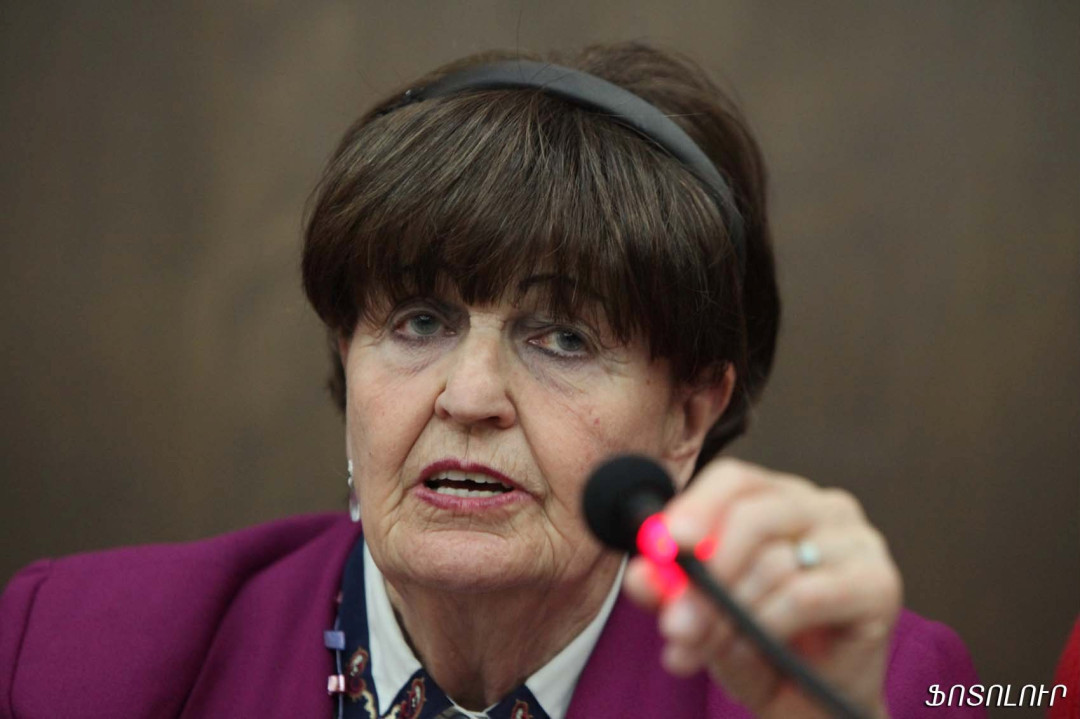
 Baroness Caroline Cox.
“Her Majesty’s Government are aware of His Holiness the Pope’s comments during the papal mass to commemorate the victims of 1915, which was held in Rome. We respect his view and agree that it is important to face the lessons of history with courage and do all that we can to prevent similar atrocities. Her Majesty’s Government reviewed their position of recognition in 2013 and, at present, we have no plans to conduct another review,” the Earl responded.
Taking the floor, Lord Lyndon Harrison of the Labor Party said that the killings of the Armenians in 1915 was indeed a genocide. He wanted to know what the Minister thought about the necessity of bringing Armenians and Turks together to move the reconciliation process forward and also wanted to know about Armenia’s recent attempts at reinvigorating relations with the European Union.
In September of 2013, after almost four years of negotiations with the European Union to sign an Association Agreement and a Deep and Comprehensive Free Trade Agreement, Armenia’s President Serge Sargsyan, in an abrupt foreign policy U-turn, decided that Armenia would instead join the Russian-led Customs Union, which has now become the Eurasian Economic Union. The Earl of Courtown said he was not aware of this but would look into it in the future.
The House of Lords also made reference to the recent national elections in Turkey which resulted in three Armenians -- Garo Paylan (HDP), Markar Esayan (AKP) and Selina Ozuzun Dogan (CHP) -- being elected to parliament.
Baroness Sarah Ludford took the floor and asked if it was possible for the newly-elected Armenian parliamentarians in Ankara to support the creation of a historical commission to look into the “tragic events of 1915.” While the Republic of Armenia has made it clear that it does not support the setting up of a historical commision to look at the events of 1915, British lawmakers still feel this is an important step.
Lord Howard Flight of the Conservative Party acknowledged that the events of 1915 were Genocide but then brought the Nagorno Karabakh conflict into the equation: “[W]hile the treatment of the Armenians in 1915 is to be condemned absolutely as genocide, might we be able to persuade Armenia to withdraw from those parts of Azerbaijan which it has been illegally occupying for some 20 years?” Lord Flight did not receive a response to his question.
The Earl of Courtown concluded by reiterating “how important it is that the two peoples find some form of reconciliation for the future.”
The UK has sidestepped the issue of recognition of the Armenian Genocide for many years. About two years ago, an internal UK government debate about the centenary of the Armenian Genocide was released under the freedom of information act. That debate focused on whether British policy should change. The recommendation to maintain their current policy on non-recognition of the massacres as genocide but "take a forward leaning stance on Her Majesty's Government participation in centenary commemoration events in April, 2015."
The following is a portion of that document:
“21. Given the wide body of evidence available about the appalling events of 1915 – 16; our own judgement at the time that they constituted a “crime against humanity”, and the scope which the preamble to the 1948 convention provides to recognise (at least in a political sense) historical instances of genocide, [redacted] A change of policy would be received positively by both the Armenian government and the UK diaspora, and would put us in the company of the 20 countries, including France, Italy, Canada and Russia, and many other national and regional parliaments, who have already recognised the massacres as genocide.22. However, this would be a significant and far-reaching change in HMG policy. [redacted]23. And, beyond creating goodwill in Armenia and among their supporters, a decision to recognise the massacres is unlikely to result in tangible progress in HMG conflict resolution or other goals in the region.”
It remains to be seen what “other goals in the region” mean.

 Պատմություններ