 Civilnet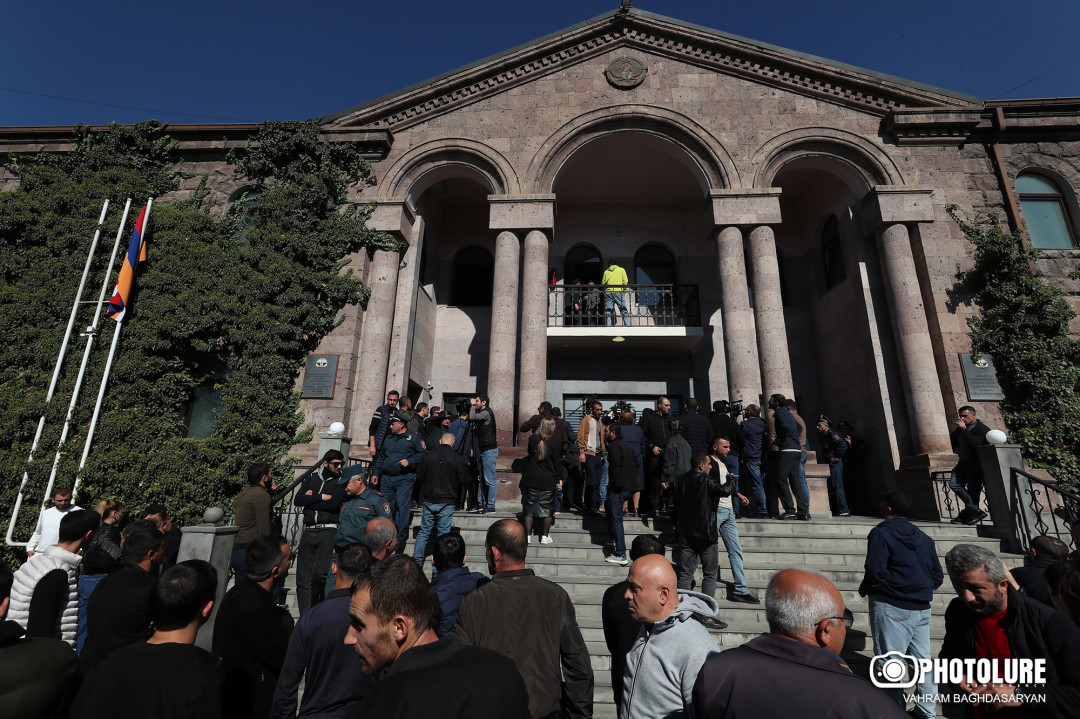
By Hayk Ghazaryan and Gevorg Tosunyan
A court case over a 1,222-square-meter compound in Yerevan could determine the fate of what many see as the last institutional footprint of the former Nagorno-Karabakh Republic inside Armenia.
Armenian prosecutors are seeking to annul the property’s registration under the Nagorno-Karabakh government, a move that, if upheld in May 2026, would strip the enclave’s dissolved authorities of their final officially registered asset in the country. While formally a dispute over a 2007 property registration, the case carries heavy symbolic weight in the aftermath of Azerbaijan’s 2023 takeover of the region and the collapse of its Armenian-led institutions.
The disputed property is registered under the government of the former Nagorno-Karabakh Republic. If a court rules in favor of the Prosecutor General’s Office in May 2026, ownership could revert to the Armenian state.
While formally framed as a dispute over a 2007 registration, the case comes amid Armenia’s post-2023 policy shift following Azerbaijan’s military takeover of Nagorno-Karabakh and the ethnic cleansing of its Armenian population.
Armenian officials have repeatedly said that no parallel state institutions should operate within Armenia’s territory — a position widely understood to apply to the former Nagorno-Karabakh authorities.
The legal process began in June 2025, after the National Security Service Director, Armen Abazyan, submitted a report to the Prosecutor General questioning the legality of the 2007 registration.
Although nearly 18 years had passed, the court accepted the prosecutor’s argument that the statute of limitations should not apply because the relevant documentation had only recently become available through the security service.
The timing has raised questions. In the months preceding the lawsuit, Armenian law enforcement agencies carried out searches and other investigative actions involving officials linked to the former Nagorno-Karabakh administration, including at the representation office itself.
A political signal
Tigran Grigoryan, Director of the Yerevan-based Regional Center for Democracy and Security, said the case should be understood primarily in political terms.
“This is not just a technical dispute over property registration,” Grigoryan said. “It is part of a broader process that began after 2023, when the Armenian government recalibrated its policy toward Nagorno-Karabakh and its former institutions.”
According to Grigoryan, Yerevan has consistently signaled that state-like structures associated with Nagorno-Karabakh cannot continue to function inside Armenia.
“The authorities have stated more than once that there should be no parallel state bodies operating on the territory of the Republic of Armenia,” he said. “The continued existence of a representation office formally owned by the former Nagorno-Karabakh government contradicts that logic.”
He added that the issue is closely linked to the normalization efforts between Armenia and Azerbaijan.
“It is clear that similar expectations exist on the Azerbaijani side,” Grigoryan said. “Every time there is renewed tension or political rhetoric, we see steps that appear aimed at removing the remaining institutional footprint of Nagorno-Karabakh in Armenia.”
In his view, the property’s significance today is largely symbolic.
“Legally, it is a building. Politically, it represents the last visible sign of Nagorno-Karabakh’s state institutions inside Armenia,” he said. “That is why the case carries weight far beyond cadastral technicalities.”
Dispute over a missing contract
The roots of the dispute date back to 1997, when Armenia’s government adopted a decision to donate the building to the Nagorno-Karabakh authorities. A 2006 decision by Yerevan’s mayor granted permanent land-use rights, and the property was formally registered in 2007.
Prosecutors argue that the registration was unlawful because a formal donation contract was never signed, making the transfer legally incomplete.
Roman Yeritsyan, a lawyer representing the Nagorno-Karabakh president’s office, disputes that interpretation. He says that under the Soviet-era Civil Code in force in 1997, ownership rights arose from the government decision itself.
“The Armenian government voluntarily relinquished ownership in 1997,” Yeritsyan said. “From that moment, it had no legal claim to the building.”
He also argues that the law cited by prosecutors entered into force in 1999, two years after the original decision.
Court refuses to involve Karabakh authorities
A central controversy in the case is the court’s refusal to involve the Nagorno-Karabakh government as a third party, despite the property certificate listing it as the owner.
The Administrative Court ruled that the entity referred to in filings as the Republic of Artsakh had not been sufficiently identified and that documents submitted by representatives did not conclusively prove their authority to act on behalf of the former government.
An appellate court upheld that decision in November 2025.
Yeritsyan called the ruling a serious procedural violation.
“The court is considering depriving an entity of property without allowing it to participate in the proceedings,” he said. “That undermines basic principles of due process.”
Grigoryan said the refusal to recognize the former government as a party reflects a deeper ambiguity.
“In practical terms, the Armenian state no longer treats the Nagorno-Karabakh Republic as a functioning legal subject,” he said. “The court’s position mirrors that political reality.”
More than a property case
The case is currently under written examination. Prosecutors have indicated that a separate criminal investigation may follow into alleged abuse of office related to the original registration.
If the court sides with the prosecution, Armenia would effectively reverse a nearly three-decade-old decision to grant the property to the Nagorno-Karabakh authorities.
For Grigoryan, the broader implication is clear.
“This is about closing a chapter,” he said. “The dismantling of Nagorno-Karabakh’s institutions did not end with the loss of territory. It is now unfolding in the legal and administrative sphere inside Armenia.”
The outcome of the case may determine not only the fate of a building in Yerevan but also whether any formal trace of Nagorno-Karabakh’s former political institutions remains within Armenia’s borders.




 Stories