 Civilnet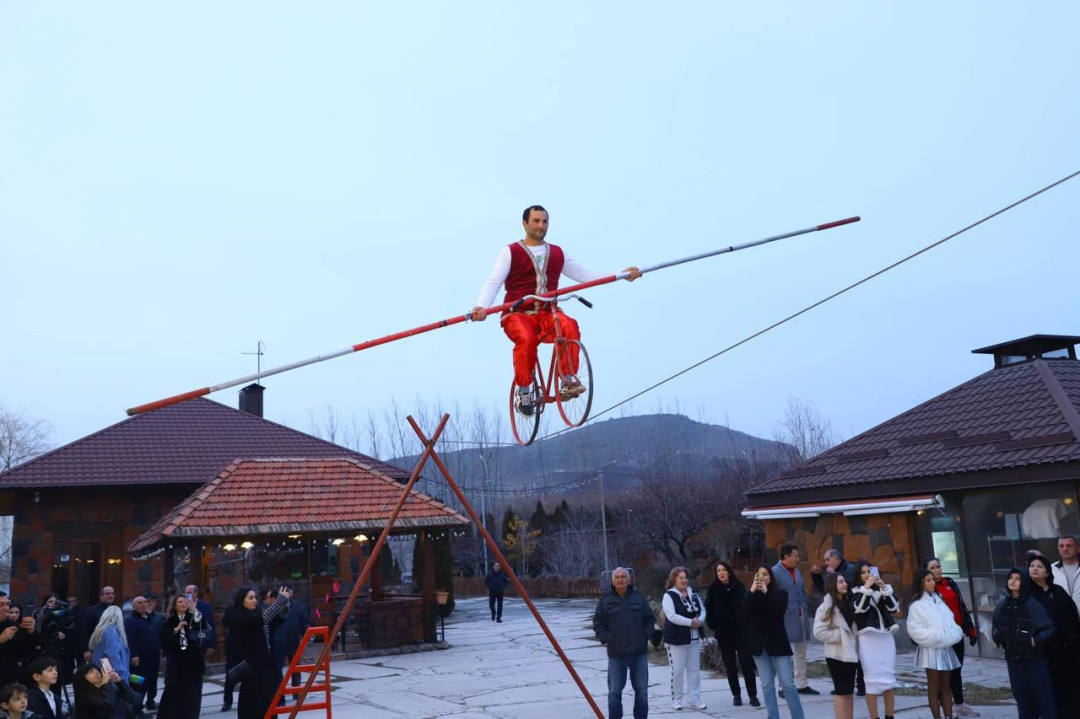
By Stela Asryan, a journalism student at Yerevan Brusov State University
When Mamikon steps onto the rope, he says he first prays.
Only after a brief pause does he begin to move forward, carefully balancing each step, keeping his body steady and his focus fixed ahead. For him, tightrope walking is not simply a performance. It is discipline, concentration, and a skill passed down through generations.
Known in Armenian folk culture as part of pahlavani khagher, traditional acrobatic and strength-based performances once common during public celebrations and religious festivals, tightrope walking has long held a place in Armenia’s cultural life. Historical accounts trace the practice back to pagan times, when rope performers were associated with ritual ceremonies and seasonal gatherings. Armenian scholars note that the art later became linked to public festivities held near churches and village squares, often accompanied by music, clowns, and improvised dialogue between performers and the crowd.
Mamikon is one of the few who still practice it today.
A construction worker by profession, he has practiced tightrope walking for nearly 30 years, continuing an art he first encountered as a child.
He says he first stepped onto a rope at the age of five, when his uncle gathered around 20 children from among relatives and acquaintances and began teaching them basic techniques.
“Many stopped over time,” he says. “Some lost interest, others found it too difficult. In the end, only three of us continued.”
His first public performance came a year later, when he was six, in the courtyard of Saint Gayane Church.
He still remembers the moment clearly.
“I was nervous, of course, but also very happy because it was the first time I was showing people what I had learned.”
The connection between prayer and performance has deep roots in Armenian tightrope tradition. Historical descriptions collected from former Armenian communities in Van, Alashkert and Mush describe rope walkers crossing themselves before climbing the rope, kissing the balancing pole, and reciting prayers to ask for protection before each performance. In many villages, performances began only after musicians playing zurna and drum gathered the crowd.
For Mamikon, some of that ritual remains instinctive.
“Every time I climb onto the rope, I pray first. It helps me calm down and gives me confidence.”
Over the years, the routines became more difficult. One of the hardest, he says, was balancing on a ladder placed on the rope, a move requiring full concentration because even the smallest shift in body weight can affect stability.
Although tightrope walking may appear effortless to spectators, Mamikon says the practice demands both physical and mental control.
A performer must overcome fear, maintain constant attention, and train the body to react precisely.
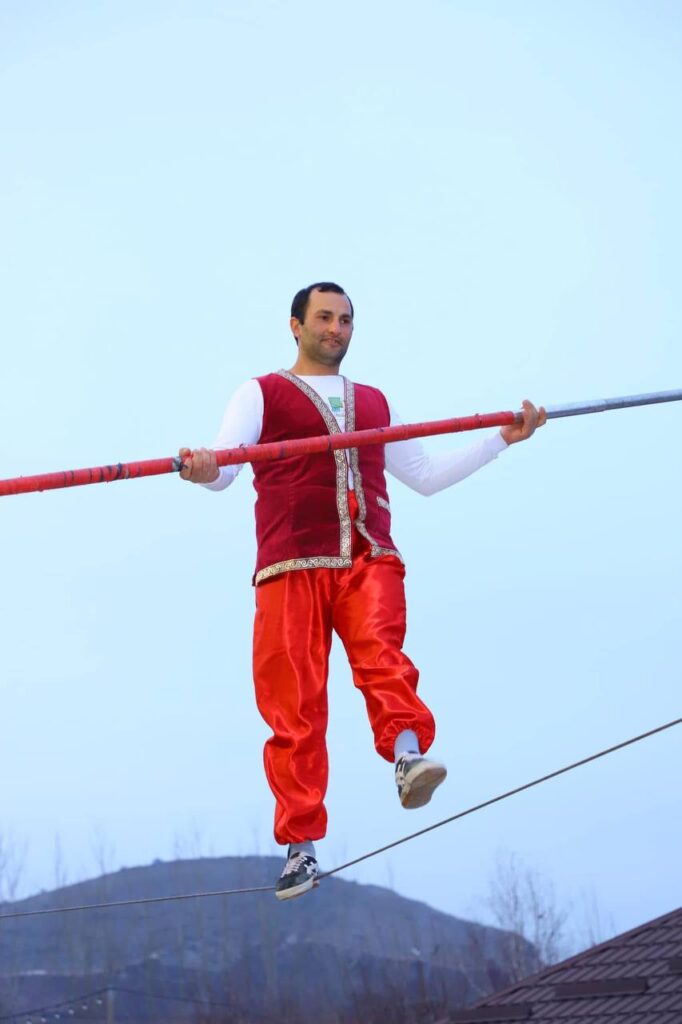
That, he says, is why many begin but few continue.
Historically, Armenian rope walkers were known by several names, including pahlavan, paragnats, chambaz, and kyandrbaz, reflecting both Armenian and regional influences. Performers often traveled from village to village in groups that included musicians, assistants, and a clown-like figure whose role was to entertain the audience from the ground while the rope walker performed above.
Today, the tradition survives in a far simpler form.
Mamikon is often invited to perform at weddings and festive events in Armenia. He has also appeared abroad, mainly in Georgia and Russia.
Some performances leave unusual memories.
“Once I arrived for a performance and everything was prepared, but in the end there were almost no spectators,” he recalls. “To this day, I still do not know who we were performing for.”
Though he works in construction, he says tightrope walking has never left his life.
For him, it belongs first to art, only then to sport.
“There is physical work, but there is also beauty, movement, and presentation.”
In Armenia, tightrope walking no longer has the public visibility it once had, when folk performers regularly appeared in village squares, fairs, and religious celebrations. Much of the tradition now survives through individual performers rather than formal institutions.
Mamikon believes the future of the art depends largely on whether younger generations are willing to commit.
In his own family, that process has already begun.
His 11-year-old son is learning the same art.
Mamikon trains him himself when time allows. When he cannot, his uncle — the same man who taught him decades ago — continues the lessons.
In this way, the tradition remains within one family line.
He does not believe tightrope walking in Armenia is disappearing completely, although he acknowledges the number of practitioners has declined.
The main reason, he says, is simple: the art is difficult.
“Many start, but after some time, they stop. It requires patience, strong will, and belief in your own abilities.”
He believes more institutional support could help revive interest in traditional arts that have gradually moved to the margins of public cultural life.
“This is part of our culture,” he says. “It should be preserved and passed on.”


 Stories