By Siranush Adamyan
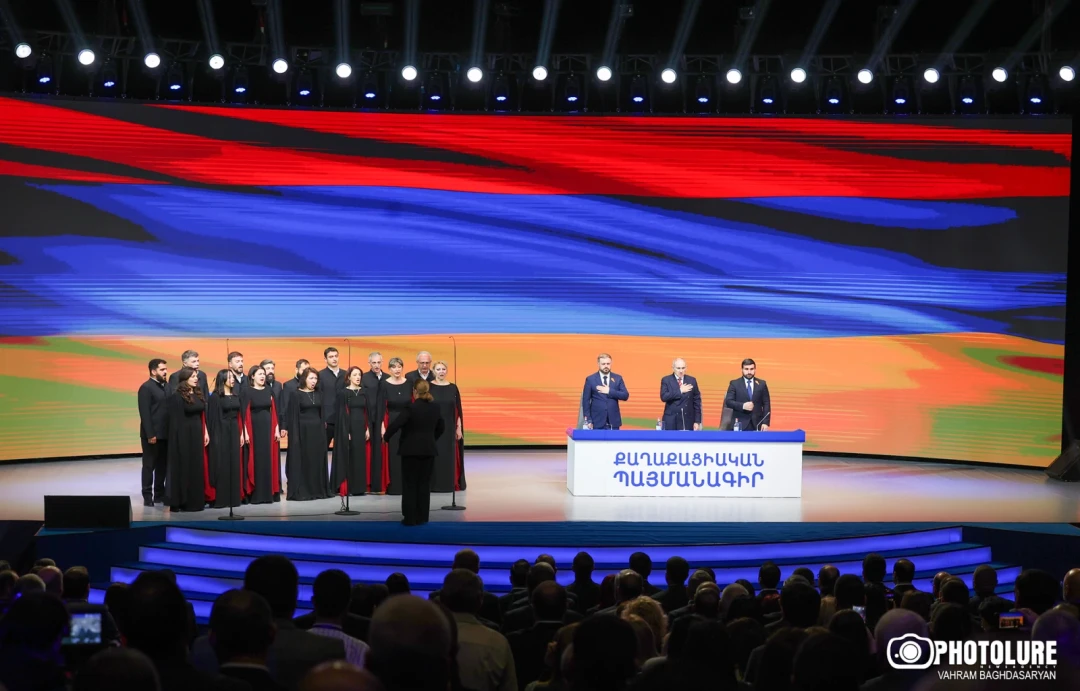
Armenia’s ruling Civil Contract party has included an agenda for the “reform” of the Armenian Apostolic Church in its campaign platform for the June 7 parliamentary elections, with the removal of the Catholicos of All Armenians as a key point.
The program, published on April 3, states that strengthening spiritual life is necessary to build a “values-based society,” describing it as an important factor in ensuring “the well-being of the faithful.” The document does not mention Catholicos Karekin II by name.
The party argues that “as a result of the activities of the church’s de facto leadership, the faithful have become alienated” and continue to drift away from the church.
It also frames the issue in security terms, warning that this process “has created an opportunity for external forces to attempt to turn the Armenian Apostolic Church into a foothold for hybrid actions against the independence and sovereignty of the Republic of Armenia.”
Based on these assessments, Civil Contract proposes a “roadmap” that includes the “removal (retirement) of the de facto head of the Armenian Apostolic Church,” the election of a locum tenens, the adoption of a church charter with mechanisms for financial transparency and clerical conduct, and the election of a new Catholicos.
The program also states that the government intends to include clergy in the state system of social guarantees.
At the same time, the document reaffirms that Armenia is a “secular state,” where “religious organizations are separate from the state,” and argues that church reform should serve to “remove the church from politics.”
Critics view such proposals as state interference in the internal affairs of the church. Under Armenia’s constitution, the church and the state are separate, and religious organizations are not subject to direct control by executive or legislative authorities.
Rights groups have also warned about the risks of such intervention. In a report published in February, Forum 18 said attempts by the state to influence religious institutions in Armenia could undermine freedom of religion and disrupt the constitutional balance.
The mechanisms proposed in Civil Contract’s program, particularly those aimed at changing the church leadership, also raise legal questions about the grounds on which the state can initiate action within a constitutionally independent institution.
From uneasy coexistence to confrontation
Relations between the Armenian authorities and the church have steadily deteriorated since 2018, following the “Velvet Revolution,” when a movement emerged demanding the Catholicos’ resignation and Prime Minister Nikol Pashinyan began publicly criticizing the church. Disagreements persisted in the years that followed, particularly over the church’s role in political processes, as well as education and foreign policy issues.
Tensions deepened after Armenia’s defeat in the 2020 Karabakh war, when the church joined calls for the prime minister’s resignation. The standoff entered an open phase of confrontation in May 2025 and intensified further when Catholicos Karekin II attended an international conference in Switzerland on the rights of Karabakh Armenians, a move at odds with the government’s position that the Karabakh issue is closed.


 Stories