 Ani Grigoryan
 Nelli Lazaryan
 CivilNetCheck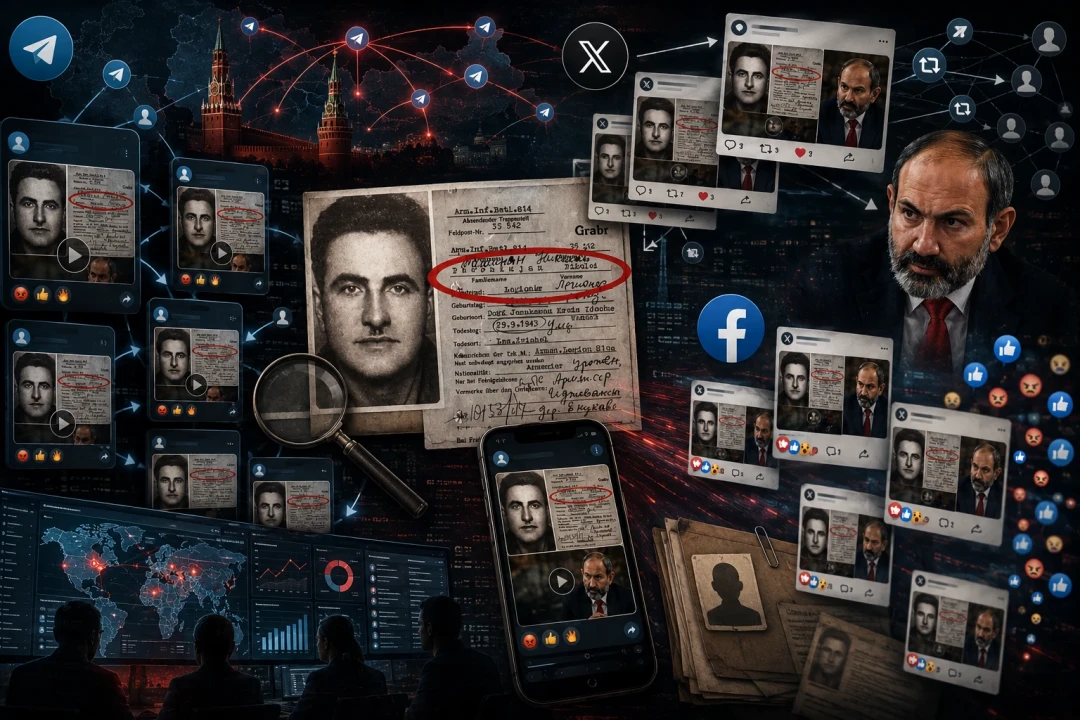
Graphics by Shushan Stepanyan, #CivilNetCheck
Between May 5 and 9, identical claims began circulating simultaneously on Telegram channels, X accounts, Russian websites, and even television broadcasts: that Armenian Prime Minister Nikol Pashinyan’s grandfather fought on the side of Nazi Germany.
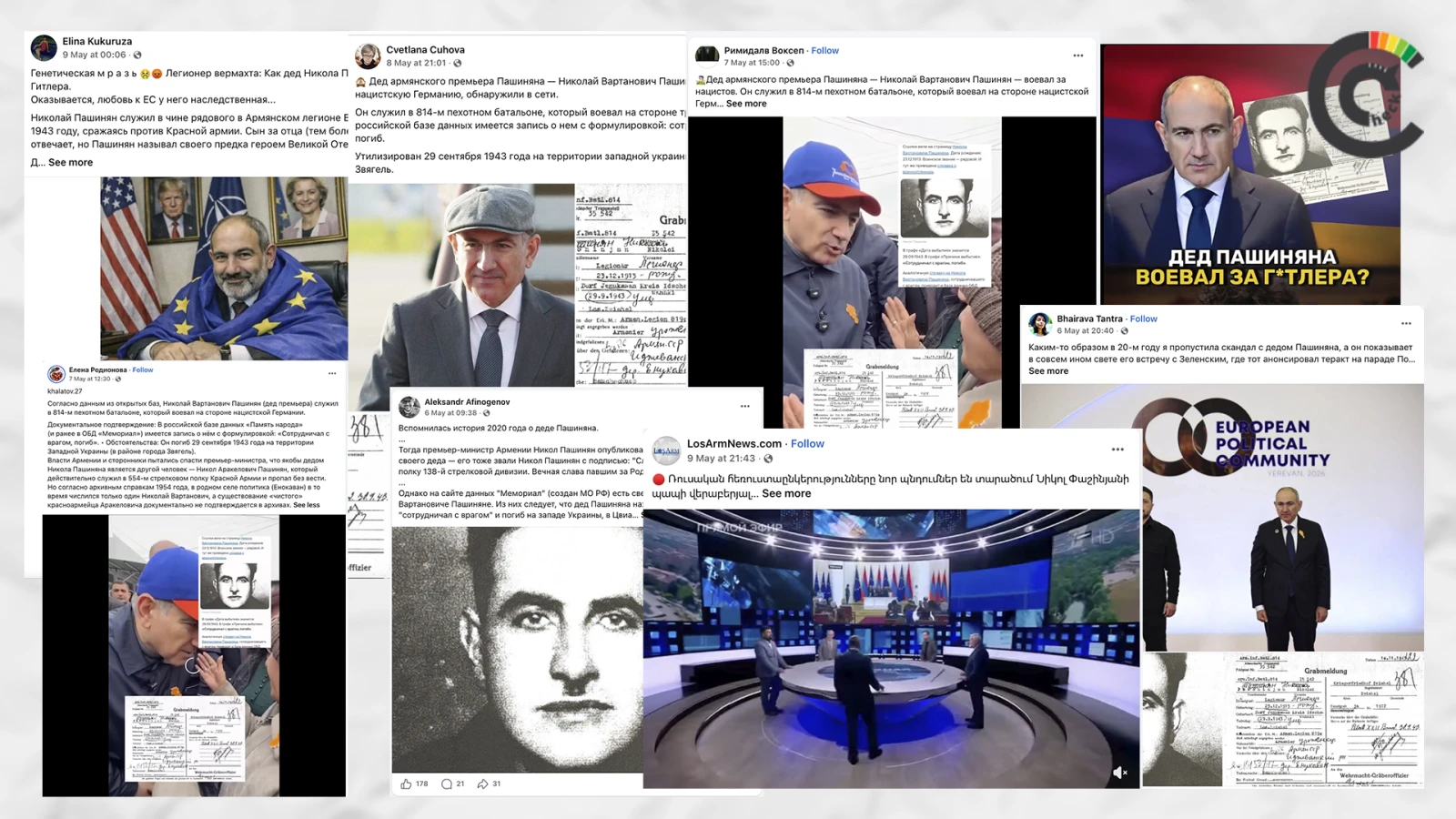
Within hours, identical posts appeared across social media channels, later spreading to Russian websites and television.
The #CivilNetCheck investigation shows that this is not just another fake news story, but a false narrative that has been circulating since at least 2020 and is periodically reactivated during politically or informationally sensitive periods. In May 2026, it once again gained wide traction, this time with clear signs of coordinated dissemination.
2020–2026: the recurrence of the same narrative
The story first appeared in May 2020, when on Victory Day Nikol Pashinyan published a photo of his grandfather, Nikol Arakeli Pashinyan, noting that he participated in World War II and died during it in 1943.
Immediately afterward, several Russian, Azerbaijani, and even Armenian websites began claiming that the Prime Minister’s grandfather had served in a Nazi “Armenian Legion.” Despite official government denials and Pashinyan’s demands for corrections, the narrative continued to circulate.
It gained especially wide traction during the 44-day war in October 2020, largely through Azerbaijani websites and users. For example, on X (then called Twitter), many of the accounts spreading the claim had Azerbaijani names and surnames such as elman_murad, SamirTaghiyev_, ZAKA_ALIYEV, HuseyinliElmin, and NigarHasanova20.
In the years that followed, the topic reappeared periodically on social media, though in a more limited form and mostly through similar Azerbaijani-named accounts.
From Telegram to television: how the spread mechanism worked
In 2026, the new wave began on May 5 with a post by the Telegram channel “Lomovka” (over 325,000 followers). The post, titled “A Wehrmacht archival card versus a family legend: why is it emerging now?”, claimed that Nikol Vardan Pashinyan, conscripted from Yenokavan, served in the 814th legion battalion and died in 1943 fighting against the Red Army.
After this, a rapid and coordinated spread began. According to #CivilNetCheck data, at least 220 posts reproducing this narrative were recorded on Telegram between May 5–13.
The timeline of posts also shows a sharp concentration of activity: more than 80% of Telegram posts were published between May 6–8, with 128 posts recorded on May 7 alone.
Dozens of channels shared identical texts without any changes in wording or punctuation. In some cases, the same posts were accompanied by identical videos, images, and emojis.
For example, a text starting with «🤷🏻♂️Дед армянского премьера Пашиняна...» was reposted verbatim across multiple channels, including «Украинский фронт», «ДОНБАСС НЕПОКОРЕННЫЙ», «Уралмашевский ватник», «Чистый Харьков» and others. One of the most frequently repeated templates appeared at least 35 times, while another narrative comparing Pashinyan to Ukrainian President Volodymyr Zelensky appeared at least 19 times.
One of the main distribution hubs was the pro-Kremlin Telegram channel «ГАСПАРЯН» (180,000 followers), belonging to Russian propagandist and Public Chamber official Armen Gasparyan. According to #CivilNetCheck data, 33 of 93 reposted messages originated from this channel. Its most widely shared post received over 4,300 reposts.
In these Russian-language posts, the narrative was not just presented as a historical claim. It was linked to political messaging, tying it to Pashinyan’s absence from Moscow’s May 9 parade (“offended for his grandfather”, «За дедушку обиделся»), his meeting with Volodymyr Zelensky, and Armenia’s Western alignment (“Love for the EU is inherited”, «Любовь к ЕС у него наследственная»).
Notably, many posts in the 2026 wave again used a 2020 article from lenta.ru as their “source,” despite it having been repeatedly debunked.
Spread into Russian media and television
After Telegram amplification, the narrative quickly appeared in Russian pro-Kremlin media.
On May 6, the media group «Царьград», owned by Russian media magnate Konstantin Malofeev, published articles titled “Pashinyan’s Secret: How Nikol Died for Hitler” and “A Wehrmacht Legionnaire: How Nikol Pashinyan’s Grandfather Died for Hitler.” «Царьград» is known for its ultra-nationalist and pro-Kremlin editorial stance and is often used to amplify Russian propaganda narratives.
The following day, the topic was picked up by a page on the Russian content platform Dzen that is linked to former Russian Deputy Prime Minister Dmitry Rogozin, and later by outlets such as life.ru, regnum.ru, and other Russian media websites.
During the same period, the narrative also appeared on Russia’s state-run «Первый канал» channel, where political analyst Andranik Mihranyan presented an “archival document” on air (from 13:53 onward), portraying it as evidence of Pashinyan’s grandfather’s alleged Nazi past.
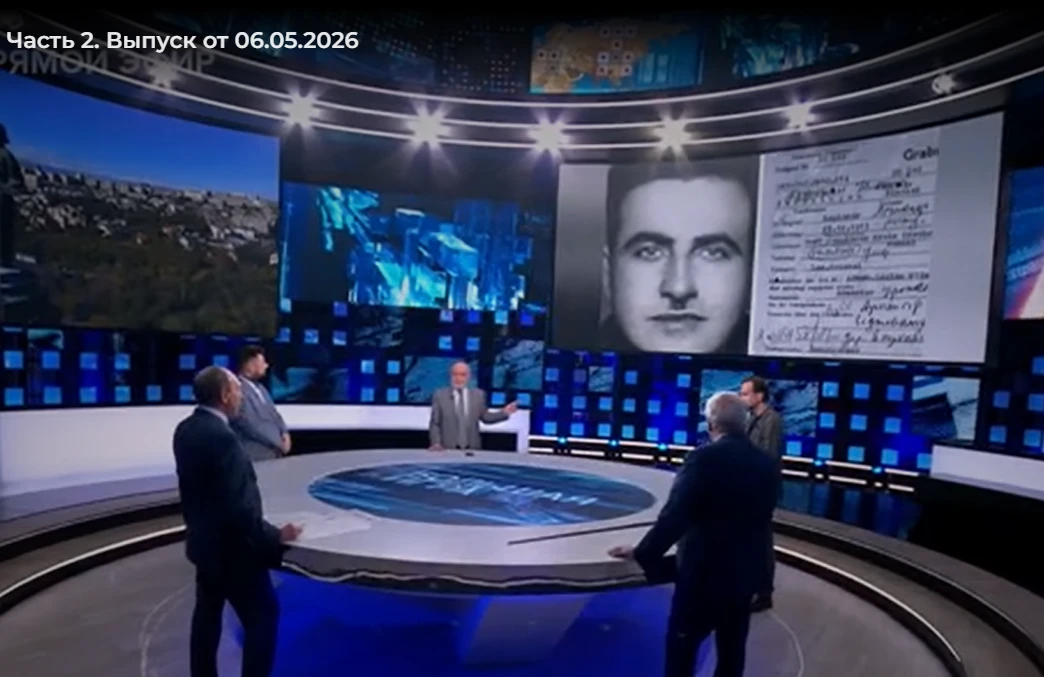
On May 7, Russian State Duma deputy Oleg Matveychev took the narrative even further, attempting to draw a link between the “Nazi past of the grandfather” and alleged connections between Pashinyan and British intelligence (MI6).
Signs of coordinated activity on X
Synchronized activity patterns were also observed on X.
The 2026 wave differed in account composition. Unlike 2020, which was dominated by Azerbaijani-sounding accounts, the 2026 activity included more mixed and international usernames (e.g., Hawkeye1745, UniqueMongolia). There was also a cluster of accounts with Russian-themed names such as AngryRus_info, RusChiefWhip, RealProstoSerge, NatasaIvanova9.
In addition, there were accounts with highly similar or seemingly autogenerated usernames, such as tatianyc27 (May 7) and tatianycoeuvre (May 8), often associated with coordinated or inauthentic behavior.
On Facebook: from Russian narratives to Armenian political rhetoric
On Facebook, the narrative was actively circulated by Russian accounts with repeated texts, videos, and images. It also spread among Armenian accounts.
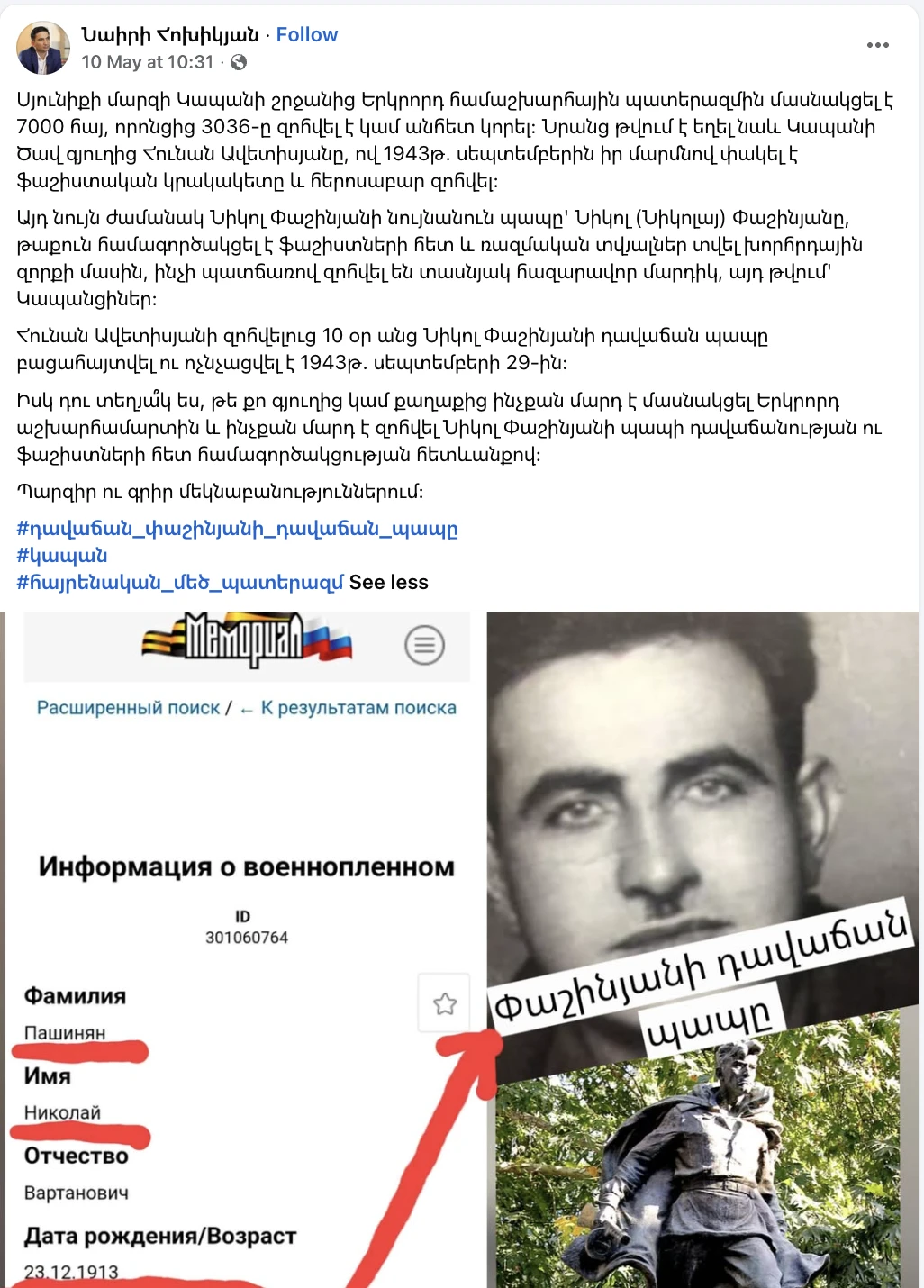
In the Armenian segment, particularly widespread was a post by public figure Nairi Hokhikyan, who accused Pashinyan’s grandfather of “collaborating with fascists” and claimed that tens of thousands, including residents of Kapan, died as a result.
“Do you know how many people from your village or town participated in World War II and how many died because of Nikol Pashinyan’s grandfather’s betrayal and collaboration with fascists? Find out and write in the comments,” Hokhikyan wrote.
Thus, the narrative circulating on Telegram and in Russian media later moved into Armenian Facebook spaces, taking on a more emotional and domestic political tone.
What is behind the “documents”?
The main “evidence” presented is a German Grabmeldung document referring to Nikol Vardan Pashinyan.
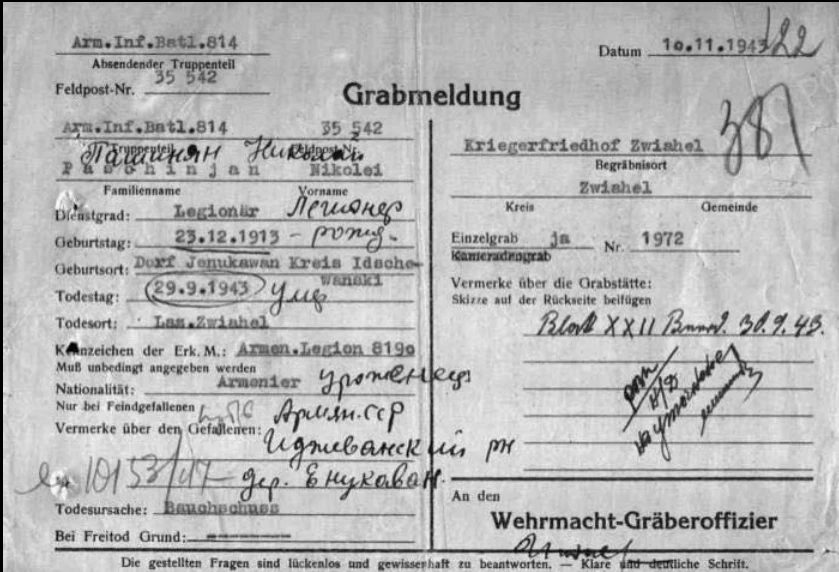
However, data from PamyatNaroda.ru and the FIP.am investigation show that these are two different individuals.
Prime Minister Nikol Pashinyan’s grandfather is Nikol Arakel Pashinyan, who served as a Red Army sergeant and went missing during combat operations.
The document linked to the Nazi legion refers to Nikol Vardan Pashinyan.
Although the Russian Defense Ministry’s “Memorial” database does not contain records on the Prime Minister’s grandfather, his name does appear in PamyatNaroda.ru. Archival data indicate he was a Bolshevik, Red Army sergeant, and squad commander who went missing during combat operations in Ukraine (Kerch).

Thus, #CivilNetCheck’s investigation shows the claim Pashinyan’s grandfather fought for the Nazis is false, and that it is not a one-time instance of disinformation. From 2020 to 2026, the same story has been repeatedly reactivated across Azerbaijani accounts, Telegram channels, Russian media, and television broadcasts.
The timing of publications, the circulation of verbatim identical texts, synchronized posting patterns, and repeated use of identical media packages all indicate features of coordinated dissemination.
At the same time, the archival document presented as “evidence” refers not to Prime Minister Nikol Pashinyan’s grandfather, Nikol Arakely Pashinyan, but to another individual with a similar name, Nikol Vardan Pashinyan.
In other words, the narrative is built on the conflation of two different individuals.



 Stories