By Olivia Mouradian
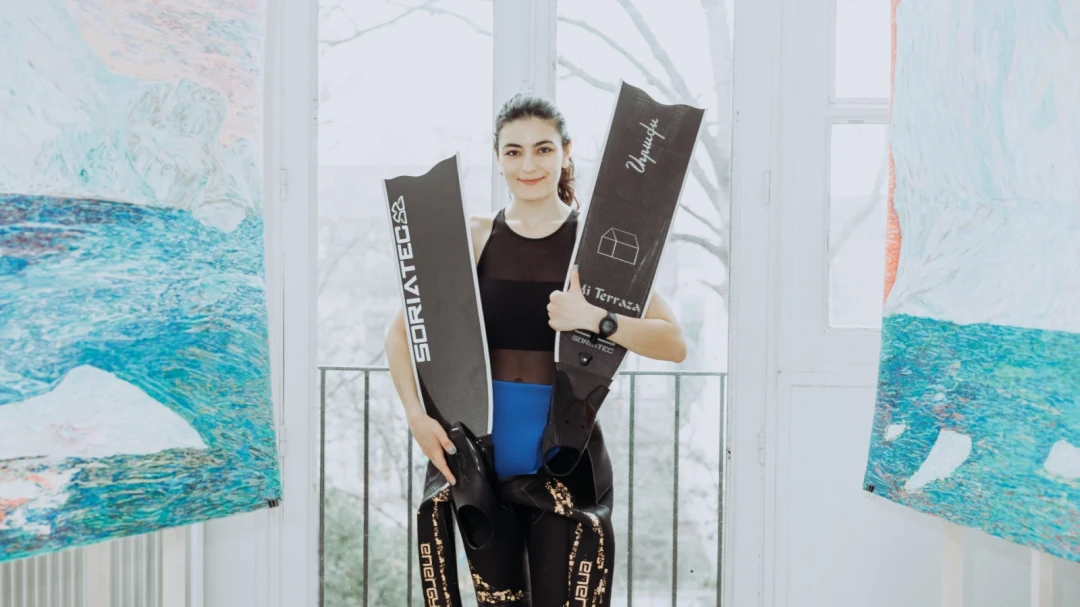
The world of Paris-based artist Araks Sahakyan spans mediums, borders, and methodologies. Born in Armenia, Sahakyan spent part of her childhood in Spain prior to moving to France to study fine art. Now, she is in residence at the Pavillon des Indes in Courbevoie, a suburb of Paris. Beyond working across drawing, theater, weaving, and embroidery, Sahakyan also makes physical activity a fundamental dimension to her artistic approach. With Sahakyan’s involvement in activities such as dance, pilates, yoga, freediving, and spinning, physical movement is intertwined with her art practice on a daily basis.
Among these pursuits, Sahakyan’s engagement with freediving in particular extends beyond a recreational pastime. In May, while preparing for museum installations for Paris events such as Nuit des Musées and Nuit Blanche, Sahakyan was splitting her time between the studio and the pool to prepare for the two primary international freediving championships of the year: the World Apnea Pool Championship in Hungary and the CMAS World Indoor Freediving Championship in Serbia. Sahakyan walked out of these competitions as Armenia’s record holder in all pool disciplines within both freediving federations (the International Association for the Development of Apnea and the World Underwater Federation).
This national recognition in freediving came relatively fast for Sahakyan. As recently as two summers ago, she did not know how to swim. This changed while following the 2024 Summer Olympics in Paris, which inspired her to take a two-week swimming class. Particularly interested in being submersed underwater, she was disappointed at the end of the sessions that she had not been taught how to do that. Following these two weeks, she registered for more swim classes and started doing breathing exercises at home. Eventually, she got her swimming level up to the point that she could learn how to freedive. Now, time in the pool is baked into her weekly schedule and is an essential part of her work as an artist.
Sahakyan says freediving has brought her to deeper understandings about herself and the boundaries of her work. For her, the point of freediving is not to push one’s limits but to better understand where they are and how to move within them. “Sometimes, rationally, I can say, ‘I'm okay,’ but when I go underwater, I feel everything is not okay,” Sahakyan says. “And that’s when the training starts of how you can keep going, and how to understand where you are and what you have to do in order to feel more comfortable.”
Through both her work in the studio and in the pool, Sahakyan is continuing to hone her abilities to work through fear and to balance learning a skill while also enjoying that process. She observes a similar emotional progression in her artistic endeavors and in physical training: the discomfort and challenge accompanied with trying something uncharted followed by the assurance of feeling the benefit of the effort exerted. “I think when you have something to say, you have to go through the emotion,” Sahakyan says. “That's the point of being an artist, but also of a human.”
She says, for a long time, similar to others who have experienced trauma from the events and realities of living in 1990s Armenia, it was hard for her to clearly conceptualize her future. Now, she is also learning to think in terms of the future. Looking to next year, she hopes to realize a project between the body and water that draws from these recent years of freediving and other forms of movement.
Sahakyan imagines that the coming years will be mixed between her art and training (for freediving and beyond). While she used to see these two practices as being separate, she now counts the hours of physical activity as part of her art. “For me, it was quite liberating to do this,” she says. “Otherwise, I was like, ‘I'm not working on art.’ But it's always part of art, because I work with my whole body.”


 Stories