 Nelli Lazaryan
 CivilNetCheck
The deployment of the European Union Partnership Mission (EUPM) in Armenia is still underway, but claims are already circulating that attribute functions to it beyond those outlined in its official mandate.
Similar narratives have accompanied previous Armenia–EU cooperation initiatives, including the EU monitoring mission and the proposal for a rapid-response election team, with allegations that such structures could interfere in Armenia’s domestic political processes or limit its sovereignty. Comparable claims are now being made about EUPM Armenia.
The circulating claims
In Russian-language media and on social networks, the mission is portrayed as a “platform for hybrid influence against Russia”, an “instrument of external governance”, a “mechanism to interfere in Armenia’s domestic politics”, or “a means to establish control over the banking system.”
As one Russian-language Telegram channel says: “At first glance, this sounds technical and harmless. But in the vocabulary of Western coordinators, the phrase ‘illicit financial flows’ traditionally means one thing: access to the country’s banking system and the ability to influence economic transactions that run counter to Brussels’ main line.”
In this claim, the mandate’s wording is presented in an abbreviated and generalized form. The Russian publication mentions only “countering illicit financial flows,” whereas the EU Council decision refers to illicit financial flows in an electoral and political context. Also missing is the wider context, which is structured around capacity building and concerns the development of state policies and the provision of advice, not financial oversight.
What EUPM Armenia’s mandate provides for
The European Union Partnership Mission, EUPM Armenia, was established by the EU Council based on a request from the Government of Armenia with the aim of strengthening the country’s resilience and crisis-management capacities with an initial two-year mandate.
The mission’s mandate is defined by EU Council Decision (CFSP) 2026/894. According to the document, EUPM Armenia is a civilian, non-executive, and advisory mission whose main purpose is to strengthen the capacities of Armenia’s state bodies to counter hybrid threats.
According to Article 2 of the decision, the mission supports security sector bodies through strategic advice and operational support. Its activities include assisting in the development of strategies, policies, and procedures to counter hybrid threats such as foreign information manipulation and interference (FIMI), cyber threats, and illicit financial flows in electoral and political contexts.
The mandate does not grant the mission any law-enforcement, executive, or oversight powers, defining its role instead as providing strategic and operational support to strengthen the capacities of Armenia’s state institutions.
What the Ministry of Foreign Affairs says
#CivilNetCheck asked Armenia's Ministry of Foreign Affairs what the specific tools and support in countering illicit financial flows in the electoral and political context referenced in the decision entail. In response, the Ministry stated: “The mission’s activities are advisory in nature.”
The ministry stressed that “the mission, like any other international mission deployed in Armenia, must carry out its activities based on unconditional respect for the sovereignty and legislation of the Republic of Armenia,” adding that its legal limits are defined by Armenian law.
What Armenian legislation provides for
Armenia’s Law on Banking Secrecy stipulates that a bank customer’s account information, transactions carried out on their instruction or for their benefit, and other confidential information known to the bank constitute banking secrecy.
The same law prohibits the disclosure of banking secrecy, and its provision is possible only in the cases and manner prescribed by law. Articles of the law define which bodies and entities may obtain such information, such as courts, bodies conducting criminal prosecution, tax and customs authorities, the Central Bank, the Corruption Prevention Commission, the Audit Chamber, and other entities as stipulated by law.
The law does not grant such authority to foreign civilian missions. Therefore, under current legal regulations, EUPM Armenia cannot access information constituting banking secrecy without a stipulated legal basis.
Similar claims have circulated before
Another example of unsupported claims surrounding an Armenia–EU cooperation initiative relates to the launch of the EU civilian monitoring mission (EUMA) in Armenia in 2023.
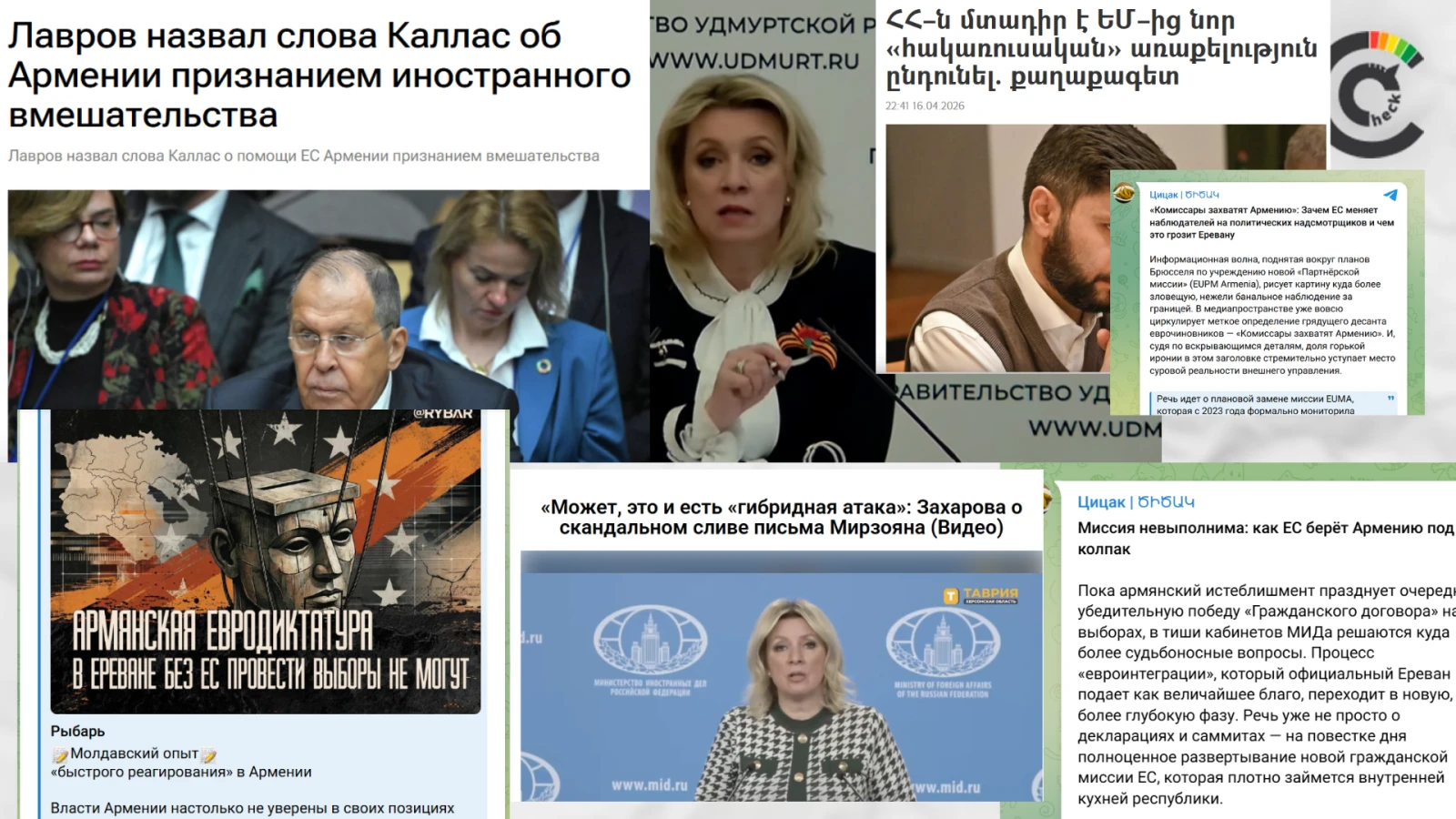
Claims spread on Russian and Azerbaijani platforms that the mission could turn into a military or NATO base, engage in espionage, or obstruct the Armenian–Azerbaijani settlement.
Meanwhile, EUMA maintained its exclusively civilian and unarmed status, with claims of espionage remaining unsubstantiated. The mission continued to carry out monitoring activities and record border incidents within its mandate.
Similar claims also spread this March, when it was announced that an EU hybrid Rapid Response Team would arrive in Armenia ahead of the elections. At that time, claims circulated that the group could interfere in Armenia’s elections, “following the Moldovan scenario,” helping the authorities limit the participation of opposition or pro-Russian forces, apply administrative or legal tools against them, and also control the information space. That scenario did not materialize either.
Thus, the claims circulating about the EUPM Armenia distort the content of the mission’s mandate by presenting advisory and capacity-building functions as oversight or interference mechanisms. Official documents, MFA clarifications, and the current legislation do not confirm such interpretations.





 Stories